
Dissolving a Business in Canada: Avoid Costly Closure Mistakes
Dissolving a business in Canada? Starcycle helps you avoid costly mistakes and close your corporation cleanly, fast, and legally.


Closing a business in Canada involves far more than stopping operations. Legal filings, tax clearances, and outstanding obligations must be addressed in the correct order, and missing a step can result in penalties, unresolved liabilities, or a dissolution that is not legally recognized. Understanding how to dissolve an LLC or its Canadian equivalent, whether a corporation, partnership, or sole proprietorship, is essential to exiting cleanly and without lasting consequences.
The process varies depending on business structure and jurisdiction, but the core requirements follow a predictable path: settling debts, canceling registrations, filing final returns, and obtaining clearance from the relevant government bodies. Owners who approach this methodically avoid the costly mistakes that come from guessing which steps apply to them. For professional guidance through every stage, Starcycle offers dedicated support for business closure.
Table of Contents
- Dissolving in Canada: Why Most Founders Wait Too Long
- What Dissolving a Business in Canada Actually Involves
- The Most Common Mistakes Founders Make During Dissolution and 6 Companies That Can Help
- Why Closing a Business Has Become More Complicated Than Starting One
- What Founders Should Do Before Filing for Dissolution
- How Starcycle Helps Founders Close One Chapter and Prepare for the Next
- Sign up to Make Your Business Closure Process Easier
Summary
- Corporations in Canada remain legal entities until formally dissolved, regardless of whether they are actively operating. The Canada Revenue Agency still requires T2 Corporation Income Tax Returns every tax year, even when a company has earned no revenue, and Corporations Canada expects annual returns while the company remains on the registry. Silence is not interpreted as closure by any government body.
- The gap between stopping operations and completing dissolution creates compounding administrative risk. Founders who delay the process often face accumulated missed filings, fees, and compliance notices sent to addresses nobody monitors. Canada already has 121,000 fewer entrepreneurs with employees than in 2000, and a significant portion of that figure reflects founders who exited without completing the administrative closure of their companies, which were still legally required.
- Tax obligations are among the most commonly underestimated aspects of winding down. Beyond filing a final T2 return, corporations must close payroll accounts, reconcile GST and HST remittances, and address outstanding balances before dissolution can be completed cleanly. Approximately 96,000 businesses dissolved in Canada in 2022 alone, meaning the CRA processes an enormous volume of final filings each year, with no accommodation for founders who arrive unprepared.
- Modern businesses accumulate far more active commitments than founders typically remember. Software subscriptions, vendor contracts, cloud infrastructure, insurance policies, and business licenses rarely cancel on their own, and none of them appear on a government dissolution checklist. Tracking and closing each one is consistently the most time-consuming part of the wind-down process, and it is where overlooked costs tend to accumulate.
- The complexity of closing a business now exceeds the complexity of opening one in most cases. More than half of small business resource organizations reported an increase in closures over the past year, yet the administrative infrastructure for winding down has not kept pace with how businesses are actually built. Nearly 6 in 10 of those organizations also identified access to capital as a significant barrier, meaning founders are often managing this complexity under direct financial pressure.
- Record retention obligations continue after a company is formally dissolved. The CRA generally requires corporations to keep financial records, tax filings, and corporate documents for at least six years from the end of the last tax year those records relate to, meaning an audit or legal question can surface long after the business has been struck from the registry.
- Starcycle addresses this gap by providing founders with a structured action plan, contract and subscription tracking, and document organization, all built specifically for the business closure process.
Dissolving in Canada: Why Most Founders Wait Too Long
Most founders assume that once they stop operating, the business is effectively closed. This assumption is one of the most expensive mistakes in the entire shutdown process.
"Failing to formally dissolve a corporation in Canada can result in ongoing annual fees, penalties, and personal liability — even years after operations have ceased." — Canadian Business Corporations Act
⚠️ Warning: Simply stopping operations does not legally close your business. Without formal dissolution, your corporation remains legally active — and you remain on the hook for fees, filings, and potential liability.
💡 Tip: The moment you decide to stop running your business, start the dissolution process immediately. Every month of delay can mean unnecessary costs and compounding legal exposure.

What keeps a Canadian corporation legally alive after you stop operating?
A corporation in Canada continues to exist as a legal entity until formally dissolved through proper channels. Stopping operations does not cancel registration, eliminate tax filing obligations, or remove directors from their legal responsibilities. The Canada Revenue Agency still requires a T2 Corporation Income Tax Return each tax year, even when the corporation has earned nothing. Corporations Canada still expects annual returns while the company remains on the registry.
How does inaction turn a simple wind-down into a tangled backlog?
The pattern repeats consistently: founders stop running the business, then stop thinking about it entirely, while administrative obligations accumulate. Missed annual returns pile up. Filing deadlines pass. Fees and notices arrive at addresses nobody monitors. What begins as a straightforward wind-down becomes a tangled backlog. According to Statistics Canada data reported by The Globe and Mail, Canada has 121,000 fewer entrepreneurs with employees than in 2000, with a significant portion attributable to founders who exit without completing the administrative closure that their companies legally require.
The emotional dimension makes this worse. Dissolving a corporation feels final in a way that stopping operations does not. Founders often leave companies technically active to preserve the option to return. But the longer dissolution is postponed, the harder it becomes: records are harder to locate, shareholders and directors have scattered, and obligations have grown more complicated. Our Starcycle business closure platform was built for this gap, giving founders a structured path through the wind-down process.
What does it actually cost to keep postponing a dissolution filing?
Before submitting a dissolution filing, you must pay off liabilities, settle tax accounts, distribute property, and address registrations. According to The Globe and Mail's coverage of a Build Canada survey, tech founders are leaving Canada at an accelerating rate, leaving more corporations in various states of incompletion. The administrative residue of those companies does not disappear with the founders.
The cost of waiting is the weight of an unfinished thing sitting in the background, requiring occasional attention, generating anxiety, and preventing a clean start on whatever comes next. Finishing strong means closing the loop completely so nothing from the last chapter follows you into the next one.
What Dissolving a Business in Canada Actually Involves
Dissolution is a sequence, and the sequence matters more than most founders expect when they first start looking into how to wind down a Canadian corporation. Every step builds on the last — skipping or reordering stages can trigger legal liability, tax penalties, or leave the business in a state of incomplete dissolution that haunts founders long after they've moved on.
"The order of dissolution steps is not optional — it is a legally structured process that protects directors, shareholders, and creditors alike." — Canadian Corporate Law Practitioners
💡 Tip: Before filing any dissolution paperwork, map out the full sequence from start to finish. Understanding the complete picture upfront saves time, money, and legal headaches down the road.
⚠️ Warning: Many founders assume dissolution is a single filing — it is not. It involves multiple stages across federal or provincial authorities, the CRA, and potentially creditors and shareholders.

Where does the dissolution process actually begin?
The process begins before any paperwork is filed. A corporation incorporated federally under the Canada Business Corporations Act follows a different path from one incorporated provincially, and each provincial registry carries its own forms, timelines, and requirements. Getting this wrong can invalidate steps already taken and force founders to restart portions of the process. Once the correct framework is identified, the corporation must formally approve dissolution through documented shareholder resolutions, a step that can take longer when multiple founders or investors are involved.
Why do tax obligations slow down so many dissolutions?
Tax obligations consume significant founder time. A common mistake is assuming that when revenue stops, tax responsibility ends. The Canada Revenue Agency does not see it that way. Corporations must still file final T2 returns, close payroll accounts, reconcile HST or GST payments, and settle any outstanding amounts before official closure.
According to Key Small Business Statistics 2025 from Innovation, Science and Economic Development Canada, about 96,000 businesses closed in Canada in 2022 alone. This scale of closure does not accelerate the process for unprepared founders.
What operational commitments do founders need to clear before filing?
The operational layer is where the real surprise tends to live. Most founders underestimate how many active commitments a corporation accumulates: vendor contracts, software subscriptions, business licenses, insurance policies, corporate bank accounts, and outstanding payables. Corporations Canada requires that liabilities be paid off and remaining property distributed before a dissolution filing is submitted. Tracking them down one by one is often the most time-consuming part of the entire wind-down. Platforms like Starcycle address this specific problem by providing founders with a guided action plan that surfaces active contracts and subscriptions, organizes required documents, and keeps the shutdown moving forward.
What responsibilities remain after a dissolution filing is accepted?
Even after the dissolution filing is accepted, responsibilities do not fully end. The CRA generally requires corporations to keep financial records, tax filings, and corporate documents for at least six years from the end of the last tax year to which those records relate. Founders who dispose of documents prematurely risk complications if a tax audit or legal question arises later.
The Canadian Federation of Independent Business reports that more businesses have been closing than opening in Canada. Dissolution is a legitimate, structured process that thousands of founders move through every year. Those who finish cleanly are not those with simpler businesses, but those who treated closure as a real project with real steps rather than an administrative footnote.
Related Reading
- How To Close An LLC
- How To File Business Bankruptcies
- Closing A Company
- How To Close A Business With The Irs
- How Much To Dissolve Llc
The Most Common Mistakes Founders Make During Dissolution and 6 Companies That Can Help
Most founders who make costly dissolution mistakes fail not because they ignore the rules, but because they underestimate how many moving parts exist beneath what appears to be a straightforward process.
"The most dangerous assumption in business dissolution is that simple-looking processes have simple execution — they almost never do." — Dissolution Advisory Insight
⚠️ Warning: Even experienced founders are caught off guard by hidden compliance requirements, tax obligations, and creditor notification deadlines that can turn a clean exit into a costly legal liability.
💡 Tip: Before initiating any dissolution steps, map out every moving part — from state filings and tax clearances to employee obligations and asset liquidation — to avoid the most common founder mistakes.

🎯 Key Point: Dissolution is not a single event — it is a multi-layered sequence of legal, financial, and operational steps, each with its own deadlines, requirements, and consequences.
Forgetting Final Tax Obligations
Tax responsibilities do not stop when operations cease. Final corporate tax returns, GST/HST accounts, payroll accounts, and outstanding remittances all require attention even after revenue reaches zero. The CRA does not distinguish between a company that closed last month and one that closed three years ago without filing; both owe the same returns.
According to Catalyze | Gunderson Dettmer, 90% of startups fail. Most founders are unprepared for CRA requirements that persist after operations wind down.
Leaving Subscriptions and Vendor Contracts Active
Modern businesses use automatic payments for software subscriptions, cloud infrastructure, payment processors, marketing platforms, and insurance policies. These recurring charges can continue for months after a company ceases operations, depleting its remaining cash.
Why do active vendor contracts become a problem during wind-down?
Founders need a complete list of every active vendor relationship before closing them. Most lack one, allowing unnecessary costs to accumulate.
How can you systematically surface all active subscriptions before closing?
Manually reviewing bank statements works for simple businesses but misses important items as subscriptions grow across multiple cards, accounts, and team members. Our business closure management tools help you identify and cancel subscriptions across multiple cards, accounts, and team members during wind-down.
Overlooking Provincial Registrations
A corporation is not one filing. Depending on where the business operates, it may have permits, trade name registrations, provincial tax accounts, and business licenses that exist separately from the incorporation itself. Dissolving the corporation does not close any of these; each requires its own process.
This detail surprises people most. Founders receive compliance notices months after they thought the business was fully closed because a provincial registration that nobody remembered was still technically active.
Distributing Assets Before Obligations Are Resolved
It's tempting to distribute leftover cash early, but you must address outstanding debts, tax obligations, and contractual commitments before moving assets out of the company. Withdrawing funds before completing this work creates serious legal problems if obligations emerge later that the company cannot pay.
A clean dissolution works in a specific order: resolve first, distribute second. Reversing that sequence is one of the most serious mistakes a founder can make, and it rarely becomes visible until it's too late to fix.
Poor Documentation and Record Keeping
Corporate resolutions, account closure confirmations, final filings, and stakeholder communications create a paper trail that proves the dissolution was handled correctly. Without it, a founder cannot reliably respond to questions from the CRA, a former creditor, or a regulator that surfaces years later. A dissolution without records is never truly complete.
Who Can Help
Six types of professional support can help during the closure process. Our Starcycle platform streamlines communication during this challenging transition, ensuring all stakeholders stay informed and aligned.
1. Starcycle
Starcycle is a guided shutdown platform for founders closing U.S.-based companies. It provides tailored action plans, contract and subscription management, and document organization, bringing structure to a process most founders navigate for the first time. For founders seeking an organized alternative to manual closure management, Starcycle offers a purpose-built solution.
2. Ownr
Ownr handles incorporation and corporate records, making it helpful for reviewing dissolution requirements before you shut down your company.
3. LawDepot Canada
LawDepot Canada offers legal document templates for resolutions, notices, and other business documents founders need when closing a business, providing a helpful resource for preparing paperwork without starting from scratch.
4. Corporate Lawyers
Corporate lawyers are important when companies have multiple shareholders, outstanding debts, investor agreements, or intellectual property. They identify risks founders might miss and structure closures to protect all parties involved.
5. Provincial Corporate Service Providers
Corporate service providers in each province understand the specific filing requirements for that province across Canada, helping reduce the risk of paperwork mistakes that can slow down the dissolution process.
6. Accounting Firms
Accountants are often the first person a founder should call. They handle final tax filings, outstanding payments, payroll account closures, and GST/HST reconciliation, all of which require financial expertise. An accountant experienced in company closures ensures that the CRA has everything it needs before formal closure.
What most founders discover too late is that the paperwork was never the hard part.
Related Reading
- IRS Closing A Business
- Involuntary Dissolution Of Llc
- How To Liquidate A Company
- How To Dissolve A Nonprofit
- Irs Cancel Ein
- Notice Of Dissolution
- How To Wind Down A Company
Why Closing a Business Has Become More Complicated Than Starting One
Closing a business has become significantly harder than starting one because starting creates a single legal entity, while closing requires unwinding every decision, relationship, and obligation that the entity accumulated over its lifetime. This gap grows wider every year — and the reasons are structural, not personal.
"Starting a business creates one legal entity. Closing one means dismantling every decision, relationship, and obligation that entity ever made." — Core Principle of Business Dissolution
🚨 Warning: Many business owners underestimate the complexity of closure — assuming it mirrors the simplicity of formation. It never does.
💡 Key Insight: The structural complexity of closing a business compounds over time — the longer a business operates, the more relationships, contracts, and liabilities must be carefully dissolved.

Why has the administrative burden of closing a business grown so much?
The rise of subscription-based software illustrates this shift. A decade ago, small companies purchased tools outright. Today, even lean startups operate on dozens of recurring contracts, each with cancellation terms, notice periods, and data retention policies. According to the Federal Reserve Banks' 2025 Survey of Small Business Resource Organizations, more than half of small business resource organizations reported an increase in business closures over the past year, yet the administrative infrastructure for winding down has not kept pace. Canceling a CRM or cloud storage account requires documentation, data export windows, and contractual obligations: it is not a five-minute task.
Why digital assets complicate the exit
The failure point is usually not the filing but the inventory. Businesses accumulate domain names, customer databases, trademarks, proprietary code, and social media accounts that fall entirely outside the formal dissolution process. These assets don't appear on government checklists. Some carry real value and should be transferred or sold, while others carry legal obligations—particularly around customer data and privacy compliance—that require careful handling before the company formally closes.
Why does a mental checklist break down at scale?
Most founders handle this with a mental checklist, working through items as they remember them. This works for short lists but breaks down when spanning contracts, registrations, digital assets, international vendor relationships, and multi-jurisdictional tax accounts. Platforms like Starcycle address this by providing a structured action plan that surfaces obligations in logical sequence, preventing oversights.
The human side of winding down
Modern companies rely on employees, freelancers, contractors, and agencies simultaneously, each relationship governed by different legal terms and closing procedures. Final payments, documentation, and contractual obligations require active resolution when operations stop. The Federal Reserve Banks' survey found that nearly 6 in 10 small-business resource organizations identified access to capital as a significant barrier for businesses trying to wind down operations, meaning many founders navigate this complexity under financial pressure.
The founders who close cleanly are not those with simpler businesses, but those who treated the wind-down as a structured process from the start rather than a series of problems to solve as they arose.
But knowing the process exists and knowing where to begin are two different things.
What Founders Should Do Before Filing for Dissolution
The preparation phase is where dissolution is either protected or exposed. Before filing with Corporations Canada or a provincial registry, founders must figure out what the business owes, to whom, and in what order. That sequence matters more than most people expect.
"The preparation phase is where dissolution is either protected or exposed — founders who skip this step risk personal liability, regulatory penalties, and creditor disputes that outlast the business itself."
💡 Tip: Before submitting any dissolution paperwork, compile a complete liability ledger — missing even one creditor can expose founders to personal legal risk after the company is dissolved.
⚠️ Warning: The order in which you settle obligations is not optional — it is governed by law. Paying the wrong party first can result in clawback actions and director liability that follow founders long after the business closes.

Why does a full liability audit matter before you file?
Start with a full liability audit. Beyond obvious debts like loans or leases, account for software subscriptions, recurring service agreements, domain renewals, payment processor accounts, and professional memberships that continue running after a founder has moved on. According to the Inkle Blog on Business Dissolution, filing fees range from $10 to $200 or more, depending on the jurisdiction, but the real cost of an incomplete wind-down is the compounding obligations that nobody audited before the process began.
How should founders handle tax obligations before dissolution?
Tax readiness cannot be treated as a final step. The CRA does not pause obligations when a founder decides to close. Corporate T2 returns, GST/HST reconciliation, and payroll account closures carry their own deadlines. The Inkle Blog on Business Dissolution notes that the IRS requires final tax returns within 3.5 months of dissolution, reflecting how seriously tax authorities treat wind-down timelines. Addressing these obligations before filing provides critical protection.
Where do most founders fall short in tracking their commitments?
Most founders handle preparation through spreadsheets, email threads, and memory. This works for short lists, but Canadian corporations typically have more active commitments than founders realize until they count them. The problem arises when no single place contains all obligations, deadlines, and stakeholder communications. Platforms like Starcycle, built for business closure, address this directly, providing structured action plans, contract and subscription tracking, and document organization in one place.
When should founders communicate with stakeholders about closure?
Talking to stakeholders should happen during the planning phase, not after. Employees, contractors, vendors, and investors should hear about closure from the founder before anyone else. Early notice reduces arguments, protects relationships, and gives them time to handle their own responsibilities. A vendor with 30 days' notice handles contract closure differently from one with no warning.
Why is record retention so often underestimated during wind-down?
Record retention often receives insufficient attention. Corporate resolutions, financial statements, payroll records, customer contracts, and tax filings may need to remain available for years after dissolution. The CRA can audit a dissolved corporation, and inquiries from former investors or creditors do not cease upon removal from the registry. Organizing records before dissolution prevents personal liability for the founder.
The founders who close their companies without regret are not the ones who moved fastest. They are the ones who prepared most thoroughly before they moved at all.
How Starcycle Helps Founders Close One Chapter and Prepare for the Next
By the time most founders reach dissolution, the hardest decision has already been made. The challenge lies in closing properly and avoiding loose ends that create lasting legal or financial exposure.

"Dissolution involves far more than filing paperwork — it requires managing outstanding obligations, contracts, records, and stakeholder communications that accumulated across the entire life of the business." — Starcycle
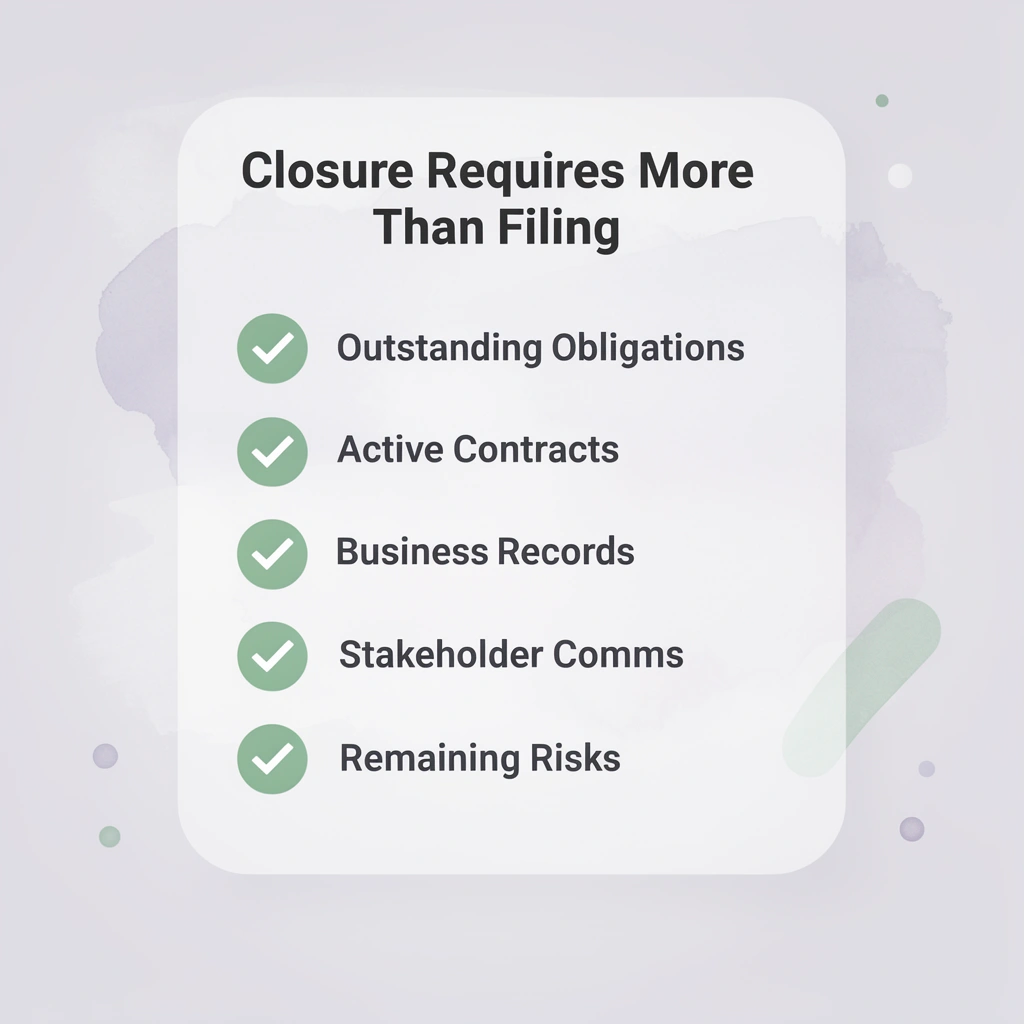
Dissolution involves far more than filing paperwork. Founders must handle outstanding obligations, contracts, subscriptions, records, deadlines, stakeholder communications, and countless administrative details that have built up over the business's life. Together, these tasks can feel overwhelming — especially for founders who are simultaneously planning their next move.
💡 Tip: Don't underestimate the administrative load of closing a business. The post-decision phase is often more complex than founders expect — start building your closure checklist early.
🎯 Key Point: Many entrepreneurs discover they need more than a filing service — they need a structured process that makes clear what needs to happen, when it needs to happen, and what risks remain at every stage. A disorganized closure can expose founders to ongoing liability, missed deadlines, and unresolved obligations that follow them into their next venture.
⚠️ Warning: Relying on a basic filing service alone is one of the most common mistakes founders make during dissolution. Without a structured process, critical steps are easily overlooked.
While Starcycle does not currently support business dissolutions in Canada, it represents a founder-first approach to closure that many entrepreneurs wish existed everywhere. The platform recognizes that founders closing a business are not simply completing a transaction; they are ending one chapter and preparing to begin the next.
🔑 Takeaway: The best closure processes help founders finish and move forward with clarity, confidence, and zero unresolved obligations for their next venture.
How does Starcycle approach the wind-down process differently?
Rather than treating dissolution as a legal filing problem, Starcycle approaches it as a founder transition problem. The platform was designed for U.S.-based founders navigating the challenges of closing a company and preparing for what comes next.
Starcycle provides guided wind-down support with action plans tailored to each founder's situation, reducing confusion and clarifying what needs to be completed before the company fully closes.
The platform tracks important deadlines and responsibilities that are easy to miss during wind-down. Missing a filing, forgetting an account, or overlooking a responsibility can cause problems long after the company stops operating. A structured system helps founders move through the process with confidence.
What practical tasks does Starcycle help founders manage?
Starcycle also focuses on contract and subscription management. Many businesses accumulate dozens of recurring commitments throughout their lifetime. Identifying and addressing these obligations is often the most time-consuming part of the closure process. The contract and subscription management feature helps founders organize these responsibilities so fewer items fall through the cracks.
Record organization is another important component. Business closures generate significant documentation that founders often need long after the company ceases operating. Organizing key information before closure reduces future administrative burden and simplifies responses to later inquiries.
Why does the human side of closure matter as much as the administrative side?
Most importantly, Starcycle recognizes that closing a business is not just about paperwork—it is personal. Founders invest years of time, money, energy, and emotion into building a company. When that chapter ends, the experience can be stressful, uncertain, and lonely. Our human-centered approach understands this reality and helps founders navigate the process with greater clarity and support.
With clear pricing starting at $399, Starcycle aims to make structured wind-down support available to founders seeking guidance without hidden fees or unnecessary complexity.
Most founders think dissolution is about paperwork. In reality, it's about creating a clean transition into whatever comes next. The decision to close a business is difficult enough; the process should not create extra confusion, uncertainty, or stress. While Canadian founders need providers supporting Canadian dissolutions, Starcycle shows what a founder-focused closure experience looks like when the goal is to help entrepreneurs move forward.
Sign up to Make Your Business Closure Process Easier
Good preparation makes the difference between a clean closure and one that follows a founder into their next chapter. If you're winding down a U.S.-based business, business closure with Starcycle provides a tailored action plan, contract and subscription tracking, and document organization built specifically for this moment. The goal is to close one chapter completely so the next one starts without inherited weight.
💡 Tip: Don't leave loose ends — unresolved contracts, subscriptions, and documents can follow you into your next venture and create costly complications down the road.
"Good preparation makes the difference between a clean closure and one that follows a founder into their next chapter." — Starcycle
✅ Best Practice: Use a structured closure platform like Starcycle to ensure every obligation is tracked, organized, and resolved before you move on.
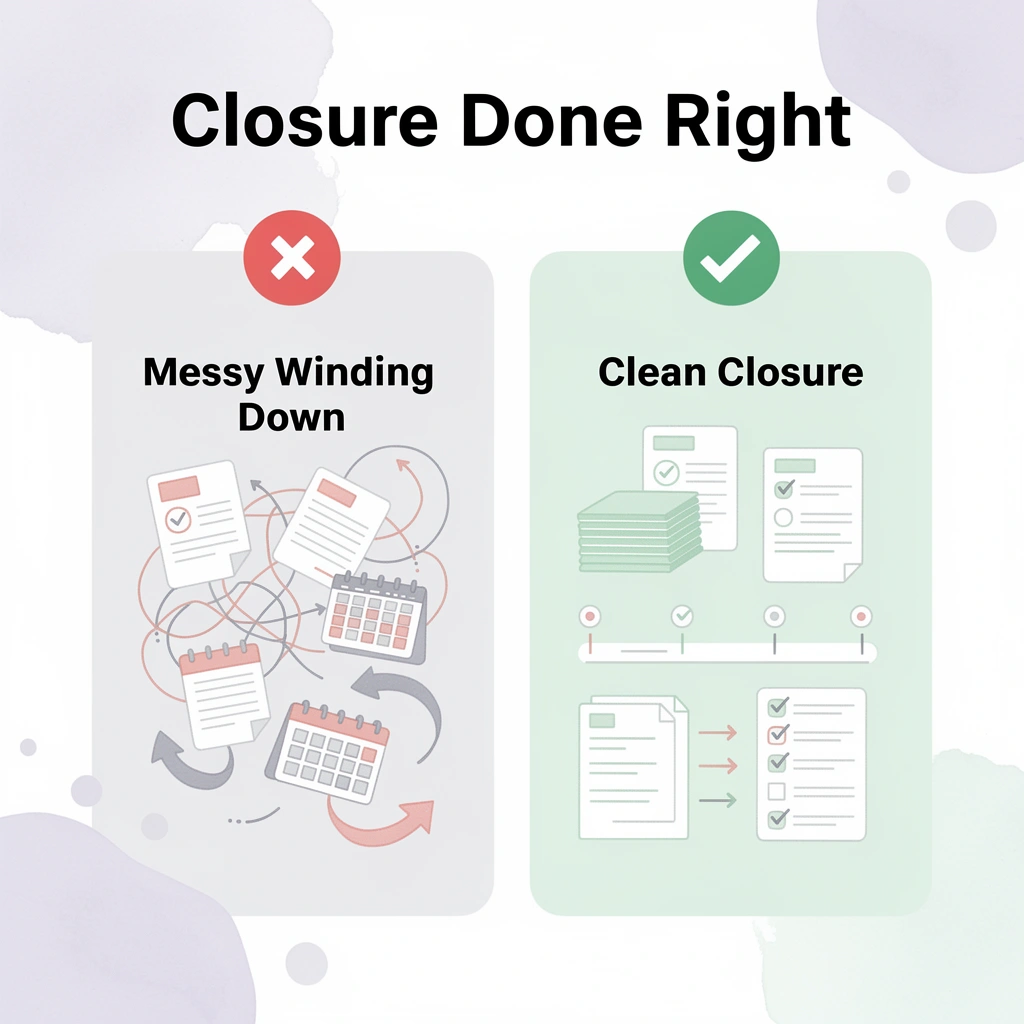
Shutting down is a legitimate, completable process that deserves to be done right. Starcycle was built by founders who have been through it, so the platform reflects what the process demands: not a generic checklist, but a real-world closure system. Sign up at starcycle.ai and finish strong.
🎯 Key Point: Closing a business isn't a failure—it's a process, and completing it cleanly is one of the most important things a founder can do for their future.
⚠️ Warning: Skipping a structured closure process risks leaving behind unresolved liabilities, missed obligations, and documents that could create legal or financial complications later.