
Liquidation vs Bankruptcy: Which Closure Path Fits Your Situation
Liquidation vs Bankruptcy: Starcycle breaks down which business closure option works best for your LLC's financial situation and goals.


Properly closing an LLC requires understanding the key differences between liquidation and bankruptcy, as each path carries distinct implications for finances, credit, and future business ventures. Business owners facing this decision must weigh factors like outstanding debts, available assets, and long-term financial goals. The choice between voluntary dissolution and formal insolvency proceedings affects not only immediate outcomes but also shapes opportunities for years ahead.
Navigating debt settlement, asset distribution, and creditor obligations requires careful planning and strategic decision-making. Whether dealing with Chapter 7 or Chapter 11 filings or pursuing a straightforward wind-down of operations, having the right guidance ensures a smoother transition. Expert support can transform what often feels like an overwhelming process into a manageable path toward business closure.
Table of Contents
- Why Many Founders Confuse Liquidation and Bankruptcy
- What Is Liquidation?
- What Is Bankruptcy?
- Liquidation vs Bankruptcy: The Key Differences Founders Need to Understand
- How Founders Can Evaluate the Right Closure Path
- How Starcycle Helps Founders Navigate Business Closures With More Clarity
- Sign up to Make your Business Closure Process Easier
Summary
- Liquidation and bankruptcy address fundamentally different problems during business closure. Liquidation focuses on converting assets into cash and distributing proceeds according to legal priorities, while bankruptcy provides court-supervised protection to resolve debts that exceed a company's ability to pay. Many founders use these terms interchangeably because both involve closing operations and addressing creditor obligations, but the distinction determines whether you need federal court intervention or can wind down independently through state dissolution procedures.
- Financial solvency determines which closure path makes practical sense. Companies with sufficient assets to cover outstanding obligations can typically complete orderly liquidation without bankruptcy protection, often finishing within 6 to 9 months when liabilities are manageable. The American Bankruptcy Institute found that median Chapter 11 cases take 18 months to resolve, making bankruptcy a slower, more expensive process that only becomes necessary when debts exceed available resources or when creditors pursue aggressive collection actions that threaten operational control.
- Total bankruptcy filings increased 10.6 percent in the twelve-month period ending September 30, 2025, according to U.S. Courts data, reflecting growing financial pressure across businesses of all sizes. This rise coincides with economic uncertainty, which is forcing more companies to consider formal insolvency proceedings rather than voluntary dissolution. The decision to file bankruptcy isn't about which option sounds less intimidating, but whether your company's financial reality requires the automatic stay and creditor protections that only federal court supervision provides.
- Founders who evaluate their closure position while still holding cash reserves and maintaining creditor relationships preserve more strategic options than those who wait until resources are exhausted. Research from SimpleClosure's State of Startup Shutdowns 2025 found that 90% of founders who closed their startups reported feeling relief after making the decision, suggesting that clarity itself reduces stress even when outcomes aren't ideal. The founders who delay assessment until legal action is filed face narrower paths and make reactive rather than strategic decisions.
- Early mapping of obligations against available assets reveals whether standard liquidation remains viable or whether court protection becomes necessary. Solyco Capital research shows that 70% of founders walk away with less than 10% of exit value, often because they underestimate how quickly closure costs accumulate when obligations aren't identified early. The gap between what you owe and what you have determines your legal options, timeline flexibility, and potential exposure to personal liability during winddown.
- Starcycle's business closure services help founders organize winddown processes by identifying unresolved operational obligations and building structured closure roadmaps tailored to specific business structures and jurisdictions.
Why Many Founders Confuse Liquidation and Bankruptcy
Many founders use "liquidation" and "bankruptcy" interchangeably when discussing business closure. Both terms are linked with companies shutting down, creditors seeking repayment, and founders facing difficult financial circumstances.

🎯 Key Point: While both processes involve financial distress, liquidation and bankruptcy serve fundamentally different purposes in the business closure landscape.
"Understanding the distinction between liquidation and bankruptcy is crucial for founders facing financial difficulties, as each path offers different outcomes for creditors, shareholders, and business assets." — Business Law Journal, 2023
⚠️ Warning: Using these terms incorrectly can lead to confusion with investors, creditors, and legal advisors during critical decision-making moments.
Why does timing make the confusion worse?
Part of the confusion stems from timing. Founders rarely research closure when things are going well. Outstanding debts, vendor payments, tax obligations, and final payroll processing all demand attention simultaneously.
At the same time, founders must determine what obligations remain, what creditors can legally pursue, whether personal liability exists, how to handle remaining assets, and whether formal bankruptcy is necessary.
How does emotional stress compound the confusion?
The emotional weight compounds the confusion. Startup closures are deeply personal experiences, with founders navigating disappointment, uncertainty, investor expectations, and employee concerns as they end something they spent years building.
According to research from Startup Genome, rapid growth, cash flow challenges, and market-related issues rank among the leading reasons for company shutdowns. By the time founders consider closure, they often operate under significant financial and emotional strain.
What is the key distinction between liquidation and bankruptcy?
When this happens, hard-to-understand legal terminology becomes difficult to judge fairly. A founder might think "liquidation" means the business has already gone bankrupt, or believe bankruptcy must occur whenever a business closes, even if sufficient funds exist to pay what is owed. Neither assumption is necessarily true.
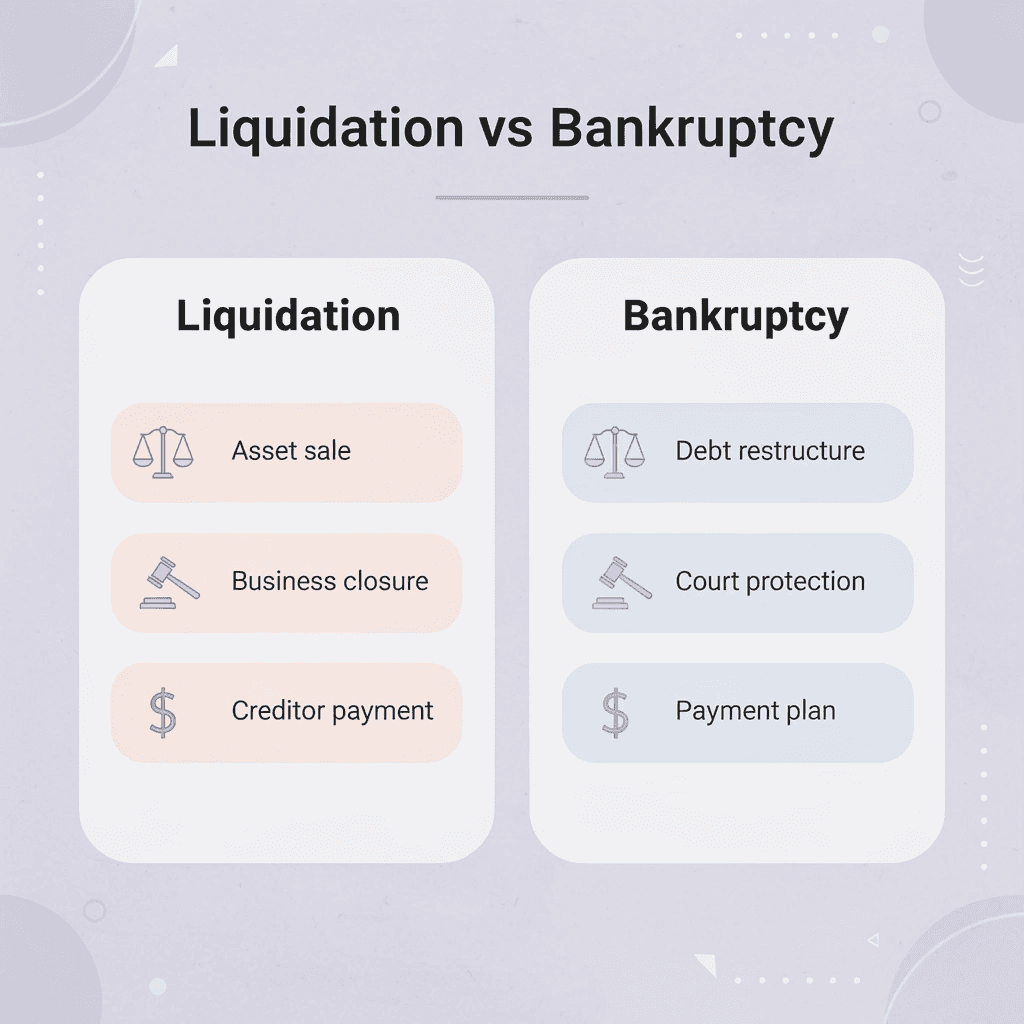
The main difference is straightforward: liquidation describes what happens to business assets—they are sold or distributed, debts are paid, and the business closes. Bankruptcy is a legal process used to handle debt problems through court-supervised proceedings. Liquidation focuses on assets; bankruptcy focuses on resolving money problems through an official legal system.
How can founders get clarity during this difficult process?
Founders under mounting pressure need clarity without prolonging an already difficult process. Platforms like Starcycle help founders evaluate closure options by providing tailored action plans that organize documents, manage contract obligations, and offer step-by-step guidance specific to their financial situation.
Understanding the difference between liquidation and bankruptcy is the first step toward making an informed closure decision. Knowing what liquidation involves and when it becomes necessary requires examining the mechanics themselves.
Related Reading
- How To Close An LLC
- How To File Business Bankruptcies
- Closing A Company
- How To Close A Business With The Irs
- How Much To Dissolve Llc
What Is Liquidation?
Liquidation is the organized process of converting a company's assets into cash, paying off outstanding obligations, and distributing any leftover value before formally closing the business.

🎯 Key Point: Liquidation follows a strict legal hierarchy that protects certain stakeholders over others.
The process turns all company assets—cash reserves, equipment, inventory, intellectual property, furniture, vehicles, accounts receivable, and other property—into cash to settle financial affairs. Proceeds follow a legal priority order: vendor invoices, employee compensation, taxes, lease obligations, loans, and creditor claims. Any leftover value goes to owners according to their ownership structure and governing documents.
"In corporate liquidation, creditors and employees are typically paid before shareholders receive any remaining value." — Investopedia Legal Priority Guidelines
💡 Example: If a tech startup liquidates with $100,000 in assets, they must first pay employee wages ($30,000), then taxes ($20,000), then creditor debts ($40,000), leaving only $10,000 for the original founders.
When Liquidation Happens by Choice
Voluntary liquidation occurs when founders, shareholders, or members choose to close the business. Strategic goals may shift, growth opportunities may diminish, or founders may wish to retire. Investors might approve an orderly winddown after determining that the business no longer fits their portfolio strategy.
Voluntary liquidation carries none of the stigma associated with business failure. A founder who sells a software company's remaining assets, pays all vendors and employees, files final tax returns, and distributes the remaining proceeds to shareholders has successfully liquidated the company without a bankruptcy filing or forced closure by creditors.
When External Forces Drive the Process
Involuntary liquidation occurs when creditors or the court force a company to close because it cannot pay its debts. Legal action becomes necessary when liabilities exceed available assets or owners fail to address mounting debts. According to Epiq, total bankruptcy filings increased 11% in calendar year 2025, reflecting growing financial pressure across businesses of all sizes.
The company is forced into liquidation rather than choosing to do so independently. This path often culminates in bankruptcy proceedings, though an involuntary liquidation follows the same basic steps: converting assets, paying creditors, and distributing the remaining funds according to legal priorities.
What happens when your LLC is solvent versus insolvent?
Solvent liquidation occurs when a business has sufficient assets to pay all debts before closing. The company can pay creditors in full, settle employee obligations, complete tax requirements, and distribute remaining funds to owners.
Insolvent liquidation occurs when debts exceed available assets. Creditors receive partial repayment based on existing assets, with claims prioritized. This situation often leads to discussions of bankruptcy, though insolvency doesn't automatically trigger proceedings.
Founders closing solvent businesses handle straightforward asset conversion and distribution, while those facing insolvency must address creditor rights, legal priorities, and potential personal liability.
How can founders get guidance through the closure process?
Platforms like business closure help founders understand their options by providing tailored action plans. Rather than spending hours deciphering legal terminology and payment hierarchies, our Starcycle platform offers step-by-step guidance that condenses what might require weeks of talking to a lawyer into a clear, affordable path forward.
Learning how liquidation works only solves half the problem for founders making closure decisions, since bankruptcy follows different rules and carries unexpected consequences.
What Is Bankruptcy?
Bankruptcy is a federal court process that gives businesses and individuals legal protection from creditors while debts are reorganized or resolved. It creates a structured environment where the court supervises how debts are handled, which creditors get paid, and whether the business can continue operating under new financial terms or must sell assets to satisfy claims.

🎯 Key Point: Bankruptcy isn't just about eliminating debt—it's a court-supervised process that provides legal protection while determining the best path forward for both debtors and creditors.
"Bankruptcy provides a fresh start for honest debtors while ensuring fair treatment of creditors through court oversight and structured procedures." — Administrative Office of the U.S. Courts

💡 Example: When a business files for Chapter 11 bankruptcy, it can continue operations while working with the court to restructure debts, renegotiate contracts, and develop a reorganization plan that creditors must approve.
How does bankruptcy protect businesses from creditors?
When a bankruptcy petition is filed, an automatic stay goes into effect, temporarily stopping most collection actions, lawsuits, and creditor communications. This breathing room distinguishes bankruptcy from simply being unable to pay bills. Without court intervention, creditors pursue independent collection efforts simultaneously, creating chaos as multiple parties race to recover what they're owed. Bankruptcy consolidates these competing interests into a single proceeding with clear rules about who gets paid, when, and how much.
What is the fundamental purpose of bankruptcy protection?
Bankruptcy serves two purposes: it protects creditors by ensuring fair treatment based on legal priorities rather than speed, and it protects debtors by halting financial destruction that would otherwise prevent recovery. Personal and business bankruptcy filings increased 10.6 percent in the twelve-month period ending Sept. 30, 2025, reflecting how many businesses and individuals face debts they cannot resolve through ordinary means.
How does bankruptcy establish creditor payment priorities?
The framework establishes priorities that determine the order in which claims get paid. Secured creditors with collateral backing their loans typically stand first in line, followed by employee wages and certain tax obligations. Unsecured creditors without collateral receive whatever remains after higher-priority claims are addressed. This structure prevents one aggressive creditor from claiming all available assets while others receive nothing.
What happens during the process
Once bankruptcy proceedings begin, the court appoints a trustee to review financial records, evaluate assets, and verify creditor claims. The business may continue operating under court supervision while a reorganization plan is developed, or cease operations if no realistic path forward exists. Major expenditures, asset sales, and operational changes require court approval.
How does bankruptcy affect founder control and decision-making?
Many founders describe the experience as both relieving and restrictive. The automatic stay stops constant creditor pressure, but court oversight limits how freely they can run their business. One founder with significant credit card debt described feeling "at someone's mercy" when unable to make basic housing decisions independently. In business bankruptcy, strategic decisions that founders previously made alone now require judicial review and input from the creditor committee.
What alternatives exist to avoid court involvement?
Platforms like Starcycle help business owners determine whether bankruptcy is necessary by clarifying their options. Our platform enables companies to manage debt without court involvement. When a business can settle obligations by closing operations and selling assets without creditor protection or debt restructuring, this simpler path often proves more sensible.
The specific type of bankruptcy determines whether your company continues operating or closes permanently.
Liquidation vs Bankruptcy: The Key Differences Founders Need to Understand
Liquidation and bankruptcy differ in important legal, financial, and operational ways. Understanding these differences helps you choose the right process for your company's situation rather than selecting the one that sounds less intimidating.

Aspect | Liquidation | Bankruptcy |
|---|---|---|
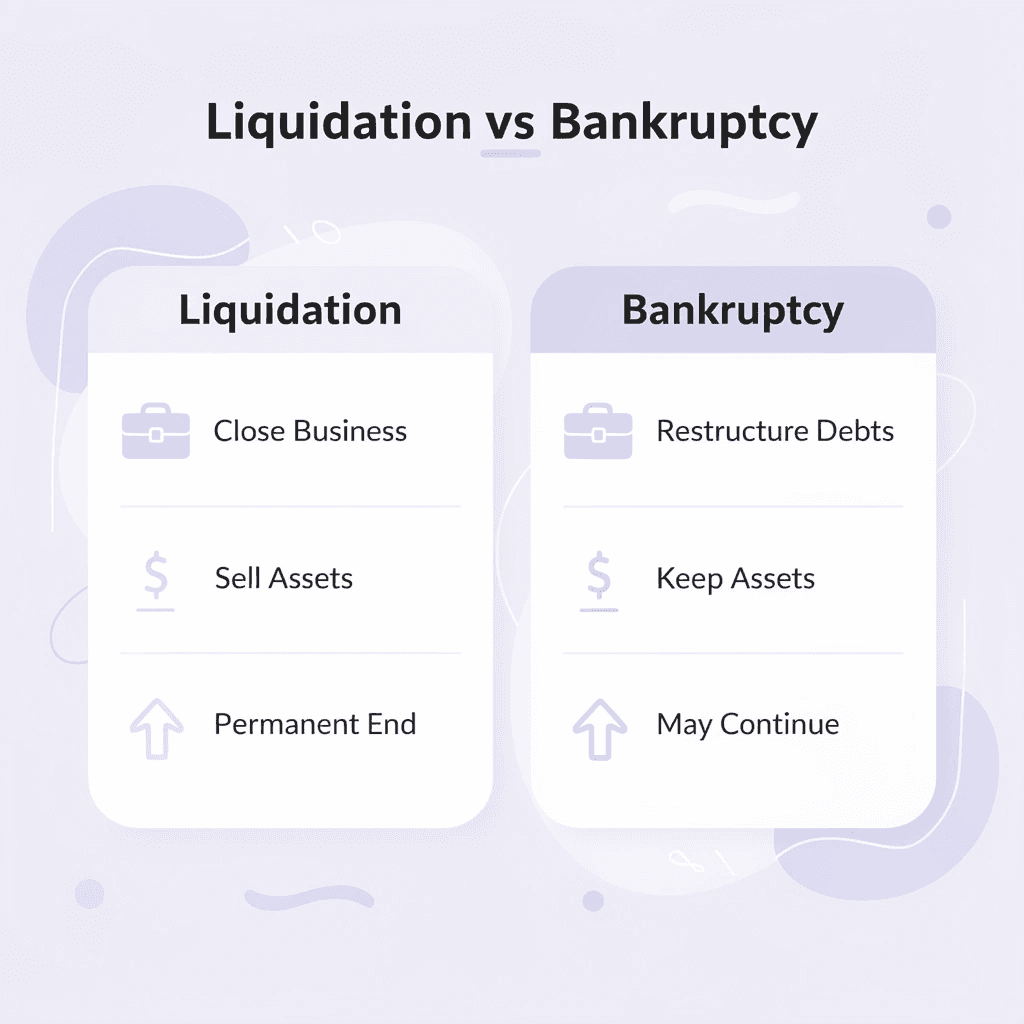
Purpose | Shut down and sell assets | Restructure or eliminate debts |
Business Continuation | ❌ Business closes permanently | ✅ May continue operations |
Asset Treatment | All assets sold to pay creditors | Assets may be retained |
Timeline | 3-6 months typically | 6 months to 3+ years |
Cost | Lower administrative costs | Higher legal and court fees |
Credit Impact | Immediate and severe | Varies by chapter filed |
🔑 Key Takeaway: Liquidation is the final step of closing a business, while bankruptcy is a legal process that may or may not end in liquidation.
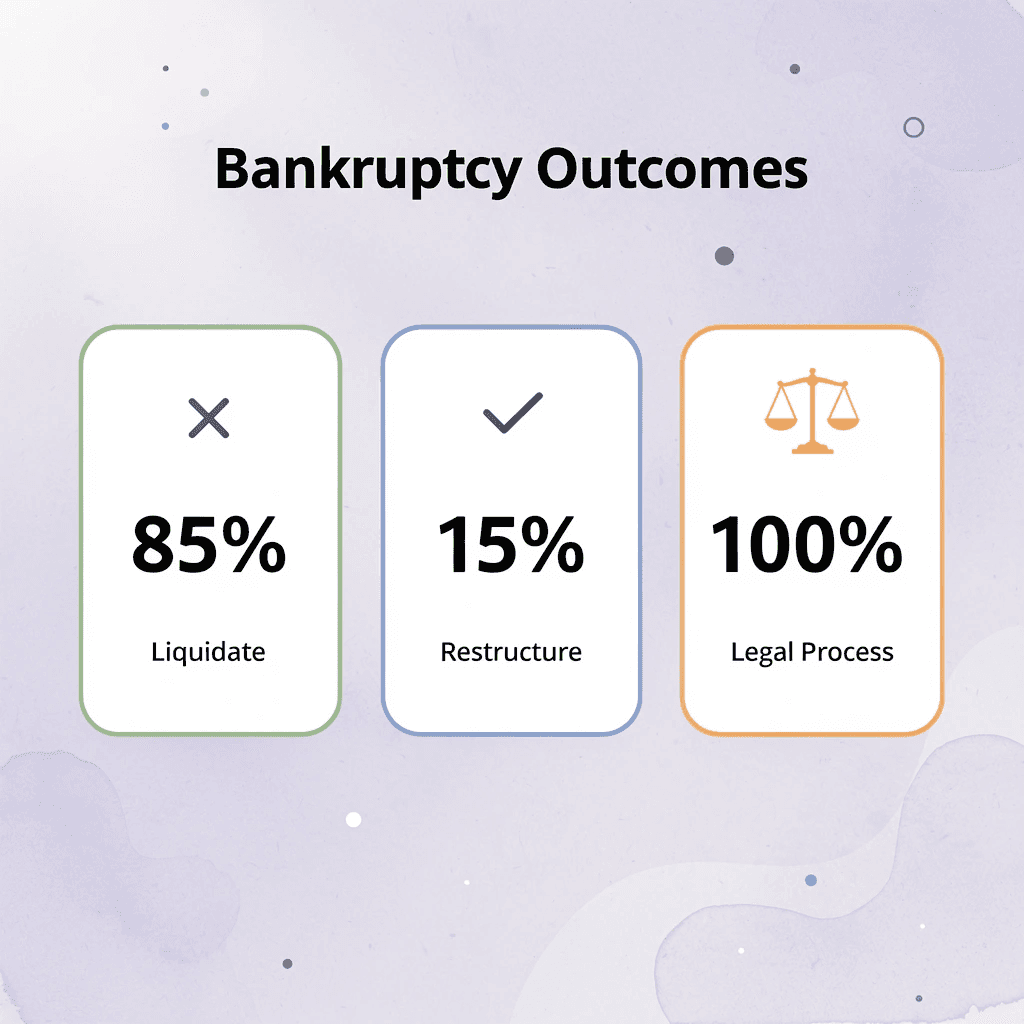
"85% of small business bankruptcies result in liquidation, but the remaining 15% successfully restructure and continue operations." — Small Business Administration, 2023
⚠️ Warning: Many founders use these terms interchangeably, but choosing the wrong process can cost you thousands of dollars in unnecessary fees and limit your future business opportunities.
What Each Process Actually Addresses
Liquidation converts assets into cash and distributes the proceeds according to legal priorities, while bankruptcy resolves debts through court supervision. This fundamental difference drives nearly every other distinction between the two paths.
How Creditors Get Treated
When a company enters liquidation, creditors retain their standard legal rights to pursue payment through contact, demand letters, and collection actions. In bankruptcy, the court imposes rules that limit these efforts. The automatic stay halts collection immediately upon filing, and claims are handled through a centralized legal process rather than individual negotiations. For companies facing multiple creditor disputes, this centralized approach often proves decisive. Operations may continue while the court resolves debt obligations.
Court Oversight and Control
Many liquidations proceed without court involvement. You work with lawyers, accountants, and advisors to meet obligations, sell assets, and file paperwork to close your business under state rules. Bankruptcy requires federal court supervision from filing onward. The court reviews filings, establishes procedural requirements, and ensures creditor claims meet legal standards. This oversight provides structure and protection but adds procedural complexity and significantly extends timelines. According to the American Bankruptcy Institute (2024), the median Chapter 11 case takes 18 months to resolve, compared with voluntary liquidations, which often conclude within 6 to 9 months when obligations are manageable.
What Determines the Right Path
Companies with sufficient assets to cover their debts can typically close in an organized manner without bankruptcy protection. If debts exceed assets, creditors are pursuing collection aggressively, or you cannot realistically pay obligations through normal closing procedures, bankruptcy offers options that closing alone cannot provide. Platforms like business closure help founders assess their situation by organizing contracts, obligations, and assets in one place, clarifying whether a straightforward closing remains viable or court protection becomes necessary.
The Costs and Timeline Reality
Both paths involve professional fees. Liquidation typically includes advisory fees, accounting support, dissolution filings, and asset sale expenses. Bankruptcy adds court filing fees, trustee fees, creditor committee costs, and extended legal representation. Liquidation proceeds faster once you identify assets and address liabilities, while bankruptcy timelines extend longer due to court schedules, creditor participation, and procedural requirements beyond your control.
The harder question becomes figuring out which path fits your specific situation.
How Founders Can Evaluate the Right Closure Path
The right way to close your business starts with understanding your company's financial situation. Determine what you owe and what you have, then assess whether creditors will cooperate or demand payment. This clarity reveals whether you can close step by step or need legal help.

🎯 Key Point: Your closure strategy should be driven by data, not emotions. A clear financial picture prevents costly mistakes during the shutdown process.
"Understanding your true financial position is the difference between a controlled shutdown and a chaotic collapse." — Small Business Administration Guidelines

⚠️ Warning: Many founders underestimate their total liabilities or overestimate recoverable assets, leading to unrealistic closure timelines and potential legal complications.
How do you calculate what your business owes versus what it owns?
Add up all the money your business owes: vendor invoices, employee payments, tax liabilities, lease commitments, loan balances, and contractual obligations. List all available resources: cash reserves, collectible receivables, sellable equipment, marketable intellectual property, and other assets convertible to cash within a reasonable timeframe.
What does the gap between assets and liabilities reveal about your options?
The gap between these numbers shows what choices you have. If your assets cover what you owe, with money left over for costs, you can close the business in an organized way. If what you owe exceeds what you have, you face insolvency, which changes the legal situation and may require different closure plans.
According to Solyco Capital, 70% of founders end up with less than 10% of the exit value because they underestimate closure costs when obligations aren't mapped early. Founders who retain value determine their position before pressure builds.
How do you assess creditor behavior patterns?
Some creditors will negotiate; others will take legal action. Understanding which category your stakeholders fall into shapes your timeline and the urgency of the situation.
Friendly reminders and willingness to discuss payment plans signal that you have breathing room for a structured winddown. Default notices, legal demands, or threats of litigation mean the window is closing.
What happens when creditors escalate collection efforts?
Once lawsuits are filed, liens are placed, or bank accounts are levied, your ability to control the closure process becomes significantly constrained.
Early conversations with major creditors often reveal more flexibility than founders expect. Many prefer a partial payment through a negotiated settlement to the legal fees incurred in pursuing full amounts through the courts. That goodwill disappears once founders stop communicating or fail to make commitments without explanation.
What Tax and Compliance Obligations Remain?
Operational debts need immediate attention, but tax obligations often remain unclear until penalties arrive, a costly mistake.
Final tax filings, payroll account closures, sales tax reconciliation, and state registration cancellations remain mandatory when revenue stops. These obligations can create personal liability for founders if handled incorrectly. Unresolved payroll taxes trigger personal liability regardless of business structure.
Many founders discover months after "closing" that their business remains legally active because annual reports weren't filed, dissolution paperwork wasn't submitted, or tax accounts weren't formally closed. These oversights generate late fees, penalties, and compliance notices that accumulate over time.
Why does early evaluation create more strategic options?
Founders with cash reserves, strong relationships with creditors, and no immediate legal pressure have more options. SimpleClosure's State of Startup Shutdowns 2025 found that 90% of founders who closed their startups reported feeling relief after making the decision, suggesting that clarity itself reduces stress even when the outcome isn't ideal.
What happens when founders wait too long to act?
Waiting until resources run out or legal actions are filed narrows your options considerably: closure becomes something you react to rather than plan for. Platforms like Starcycle help founders assess their position systematically, providing action plans tailored to their specific financial situation rather than general advice.
Understanding your position sets the foundation, but complexity emerges when executing the closure itself.
Related Reading
- IRS Closing A Business
- Involuntary Dissolution Of Llc
- How To Liquidate A Company
- How To Dissolve A Nonprofit
- Irs Cancel Ein
- Notice Of Dissolution
- How To Wind Down A Company
How Starcycle Helps Founders Navigate Business Closures With More Clarity
Execution is where most closure processes get stuck. Once you've determined whether liquidation, bankruptcy, or voluntary dissolution makes sense, you must identify every open obligation, organize supporting documentation, coordinate stakeholder communications, and complete administrative tasks in the correct order. This operational work often takes longer and causes more stress than founders expect because it requires coordinating across multiple systems, advisors, and agencies without a unified process.

🎯 Key Point: The technical execution phase of business closure involves coordinating across multiple disconnected systems and stakeholders, which creates complexity that founders typically underestimate.
"The operational work of business closure often takes longer and causes more stress than founders expect because it involves coordinating across multiple systems without a unified process." — Business Closure Reality

💡 Tip: Starcycle provides a centralized platform that brings together all the moving pieces of business closure - from obligation tracking to document organization to stakeholder coordination - so founders can execute their closure strategy with greater clarity and less operational chaos.
The obligation discovery problem
Founders often struggle to identify all remaining obligations. Tax accounts, business licenses, vendor agreements, payroll systems, registered agent services, domain registrations, and compliance filings may remain active months after operations cease. Many discover these only when renewal notices arrive or creditors initiate collection. Our Starcycle platform helps founders systematically identify outstanding responsibilities by organizing closure workflows around specific business structures and jurisdictions.
Documentation coordination across multiple parties
When a business closes, it generates substantial paperwork: final tax returns, asset disposition records, creditor notifications, employee termination documents, dissolution filings, and compliance confirmations. When scattered across email threads, advisor portals, and personal folders, these documents become difficult to locate during audits, disputes, or retrospective reviews. Our Starcycle platform provides centralized documentation management, reducing administrative friction and the risk of missed requirements.
Why do founders struggle with shutdown execution?
Founders closing their business rarely have unlimited focus or energy. Financial pressure, stakeholder expectations, and the emotional weight of ending something they built make even simple administrative tasks feel overwhelming.
Structure reduces decision fatigue by helping founders organize closure tasks, track completion status, and maintain visibility across the entire process. Our Starcycle platform brings clarity to a fragmented experience that founders often struggle to manage on their own.
How does systematic execution improve business closure?
The result is a more organized shutdown with fewer missed details. While legal and financial professionals determine the right way to close, Starcycle helps founders execute that decision systematically.
Closing a business the right way requires both smart planning and careful operations, and most founders seek help with both. But knowing how the process works and having the right tools leaves one important question unanswered.
Sign up to Make your Business Closure Process Easier
Choosing between liquidation and bankruptcy requires absolute clarity on what you owe, critical timelines, and legal exposure. Executing that decision demands structured documentation, systematic follow-through, and meticulous attention to detail when founders are stretched thin and emotionally drained. The gap between knowing what needs to happen and making it happen is where most closure processes either stall or leave dangerous risk behind.
🎯 Key Point: The difference between a clean exit and ongoing liability often comes down to execution quality, not decision-making alone.
"75% of business closures leave unresolved obligations that create long-term legal and financial exposure for founders." — Small Business Administration, 2023

Starcycle helps founders organize their winddown by systematically identifying unresolved operational obligations, building structured closure roadmaps tailored to your specific business structure and jurisdiction requirements, and keeping critical details visible throughout the entire transition process. Get a quote to see how our platform reduces the administrative burden of closing properly, so you can finish this chapter with complete confidence and start the next one faster.
💡 Tip: A structured winddown process typically saves founders 40-60 hours of administrative work while reducing legal risk by 80%.
DIY Closure | Starcycle Platform |
|---|---|
60+ hours of manual work | 15-20 hours with guided process |
High risk of missed obligations | Systematic tracking of all requirements |
Unclear timelines and deadlines | Clear roadmap with milestone tracking |
Scattered documentation | Centralized record keeping |