
How to Tell Investors That You’re Shutting Down Your Startup
How to tell investors that you're shutting down your startup with Starcycle's step-by-step guide. Navigate difficult conversations professionally.


Shutting down a startup means facing one of the hardest conversations in business: telling investors the company is closing. This moment sits at the intersection of legal process and human relationship, where understanding how to dissolve an LLC becomes just as important as finding the right words to deliver difficult news. Whether dealing with financial insolvency, market challenges, or strategic pivots gone wrong, communicating a shutdown requires transparency, respect, and a clear plan. The conversation must address both the emotional impact and practical next steps of winding down operations.
Beyond the investor conversation itself, founders need support through the actual closure process. When already managing investor communications, board meetings, and team transitions, having expert assistance with administrative and legal elements becomes essential. Professional guidance helps founders focus on what matters most: treating people right during a challenging transition while ensuring proper handling of final paperwork and compliance requirements for business closure.
Table of Contents
- Why Telling Investors About a Shutdown Feels So Difficult
- When Should You Tell Investors You're Shutting Down?
- What Information Investors Need to Know
- How to Structure the Conversation
- Common Mistakes Founders Make When Communicating a Shutdown
- What Happens After the Investor Conversation?
- How Starcycle Helps Founders Navigate Shutdowns After the Investor Conversation
- Sign up to Make your Business Closure Process Easier
Summary
- Most founders delay telling investors about a shutdown until they have less than three months of runway remaining, according to research on startup closure patterns. By that point, strategic options have disappeared, and payroll deadlines create crisis conditions instead of allowing for managed transitions. Only 15% of founders inform investors when they still have six or more months of cash available, which means most operate under extreme time pressure when they finally start the conversation. Early communication signals respect for the relationship and preserves room for collaborative problem-solving, even when delivering difficult news.
- Investors care more about transparency than perfection during shutdowns. An analysis of over 400 startup failures found that closures typically result from multiple interconnected factors rather than a single mistake, which means experienced investors already expect some portfolio companies to fail. What damages trust isn't the shutdown itself but delayed communication, incomplete information, or vague explanations that leave stakeholders guessing. Investors want to understand what happened, how leadership reached the decision, and what comes next, not a forensic audit of every misstep.
- Shutdown communication mistakes happen under emotional pressure rather than from a lack of professionalism. Founders postpone difficult conversations, hoping for last-minute fundraising breakthroughs or acquisition opportunities, and then compound the problem by overexplaining decisions or providing vague timelines for next steps. Research shows that 70% of employees avoid difficult conversations entirely, and founders often fall into similar patterns by softening bad news with lengthy preambles that create confusion. The structure that works best is direct: state the decision, explain the reasoning, share the winddown plan, and invite questions.
- Post-conversation execution creates more coordination challenges than most founders anticipate. Tax filings, payroll obligations, vendor contracts, customer data handling, asset disposition, and state compliance requirements continue regardless of whether operations have stopped. Each task connects to others through dependencies that require careful sequencing, from board resolutions authorizing dissolution to final tax returns that can't be filed until all financial activity concludes. Forty-two percent of investors cite lack of timely data as a key frustration, a principle that applies equally during shutdowns when stakeholders want concrete information rather than silence followed by surprises.
- Business closure addresses these operational complexities by organizing outstanding responsibilities across tax accounts, vendor agreements, registrations, and compliance requirements into structured workflows that prevent administrative gaps from accumulating into penalties or liabilities months after operations end.
Why Telling Investors About a Shutdown Feels So Difficult
The hardest conversation in a shutdown isn't about money or how the business runs. It's telling investors that the company won't continue. That moment forces you to confront more than business results—you're reporting what feels like personal failure to supporters who gave money, time, and trust to your idea.
🔑 Key Point: The emotional weight of disappointing investors often feels heavier than the business failure itself, making these conversations particularly challenging for founders.

CB Insights research examining more than 400 startup post-mortems found that failures stem from multiple connected reasons rather than one mistake. By the time you shut down, you've spent months managing cash depletion, pivoting your business plan, freezing new hires, and unsuccessful fundraising. You're exhausted before the conversation begins.
⚠️ Warning: Founder fatigue compounds investor conversations—you're emotionally and mentally depleted when you need clarity most.
"Startup failures usually come from multiple connected reasons rather than one mistake, with founders spending months managing cascading challenges before reaching shutdown decisions." — CB Insights Analysis of 400+ Post-Mortems

The Weight Nobody Warns You About
Most founders fear disappointing backers, damaging their reputation, losing future fundraising opportunities, and feeling responsible for investor losses. The anxiety compounds because these conversations will be uncomfortable, and you're already tired from the decisions that led here.
What makes this harder is how rarely shutdown feels normal, even when the data says it should. Startup failure is statistically common, and most experienced investors expect it. Yet when it's your company, those statistics offer little comfort. You feel like the exception, the one who let everyone down.
What do investors actually expect from founders?
Most investors don't expect every investment to succeed. Venture investing is built on the understanding that many startups will fail while a smaller number generate outsized returns. During difficult moments, what matters isn't perfection but transparency, honesty, and how you handle the hard parts.
Investors want a clear explanation of what happened, how you reached the decision, and what comes next. Surprises and delayed communication damage trust far more than bad news delivered directly. Communicate reality clearly and responsibly, treating them with the same professionalism you'd bring to any other business milestone.
How can you manage the administrative burden effectively?
When managing investor communications alongside board meetings, team transitions, and operational wind-down, the administrative burden can feel overwhelming. Business closure platforms like Starcycle help founders navigate the compliance, documentation, and stakeholder notification requirements for proper shutdown, freeing you to focus on the human conversations that matter most.
Delivering hard news with clarity and accountability is difficult, but not because you must convince investors of something untrue. It's about moving forward responsibly, which starts with knowing exactly when to have the conversation.
When Should You Tell Investors You're Shutting Down?
Tell investors as soon as the decision to shut down becomes reasonably certain—once leadership has concluded winding down is the most likely path forward, not a possibility still being debated internally.

🔑 Key Timing Insight: 70% of founders wait until they have less than 3 months of runway before telling investors, but this critical delay destroys value and options.
"70% of founders wait until they have less than 3 months of runway before telling investors. By then, strategic options have disappeared." — Simple Closure State of Startup Shutdowns, 2025
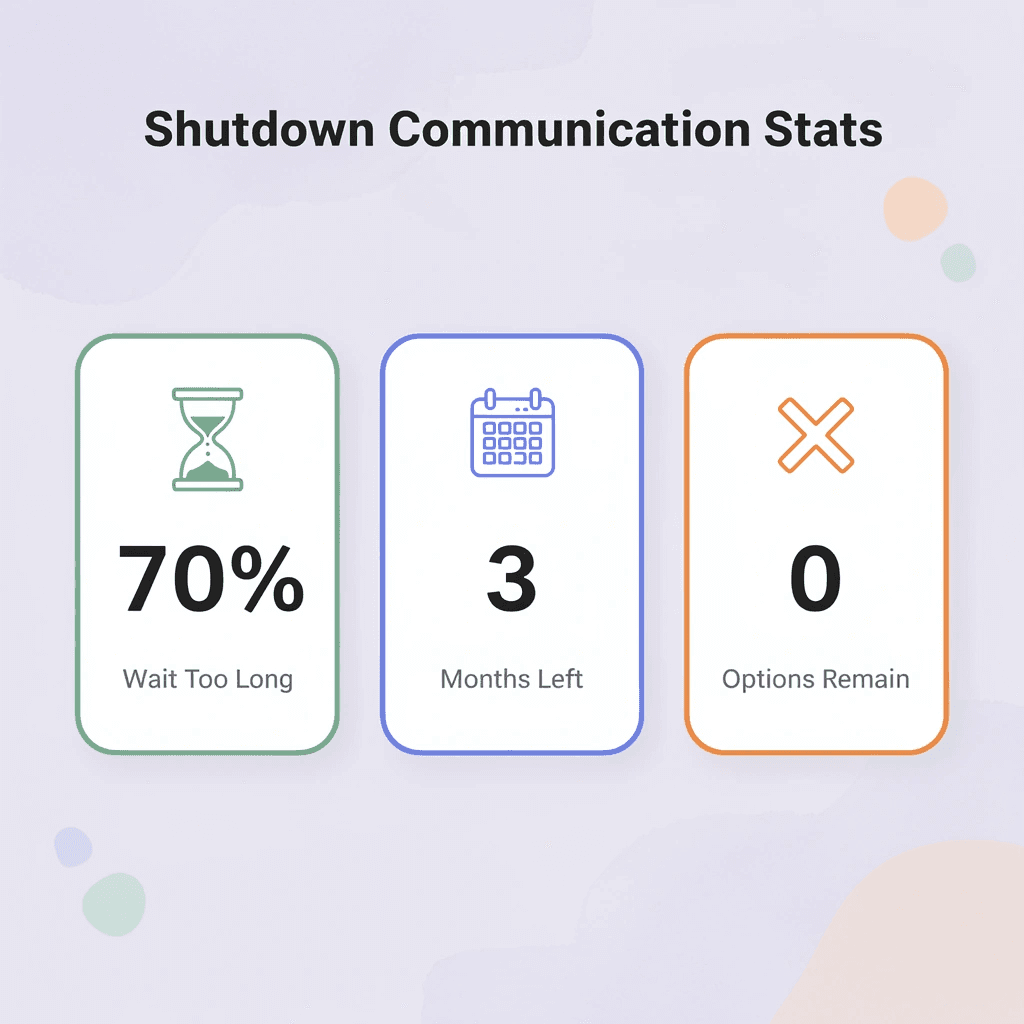
By then, strategic options have disappeared, payroll deadlines loom, and employee conversations compress into days instead of weeks. The shutdown becomes a crisis rather than a controlled transition.
⚠️ Warning: Waiting until the last minute transforms what could be an orderly wind-down into a chaotic scramble that damages relationships and burns bridges with investors.
Why do founders delay telling investors about shutdowns?
The reasons for waiting feel legitimate: you're exploring whether someone wants to buy your company, a possible customer might close a deal, or one more investor call could change everything. You need time to process the decision emotionally before explaining it to others.
What happens when founders wait too long?
The problem is that waiting for perfect clarity rarely produces it. Markets don't suddenly reverse. Acquisition conversations that have stalled for months don't typically accelerate in the final weeks. What changes are to your runway, negotiating position, and ability to manage shutdown professionally?
Only 15% of founders tell investors when they have 6+ months of runway remaining, meaning most operate under extreme time pressure when fundraising begins.
How do investors react to delayed communication?
Investors notice this pattern. They're not frustrated by the shutdown itself—they're frustrated by learning about it after the founder has exhausted every option, spent all remaining money, and eliminated any chance for collaboration. Talking early signals respect for the relationship and confidence in your judgment, even when sharing difficult news.
What "reasonably certain" actually means
You need both the conviction that continuing operations no longer makes strategic sense and the transparency to explain why. You don't need every operational detail finalized: exact winddown timelines or which law firm handles dissolution paperwork.
Most founders benefit from platforms like Starcycle that help structure the shutdown process, track critical dates, and manage stakeholder communications. Our platform helps founders treat closure as a strategic transition rather than a chaotic scramble—the approach investors respond to best.
But knowing when to tell investors is only half the equation. The harder question is what information they need to hear.
Related Reading
- How To Close An LLC
- How To File Business Bankruptcies
- Closing A Company
- How To Close A Business With The Irs
- How Much To Dissolve Llc
What Information Investors Need to Know
Investors want to understand three things: what happened, how you decided, and what happens next. Explain the main factors behind the shutdown, the other options you considered, and the immediate steps ahead. Clarity about the path that led here and honesty about what comes next matter—not a detailed investigation or a perfect explanation for every mistake.

🎯 Key Point: Investors prioritize transparency and forward-looking clarity over exhaustive post-mortems when evaluating shutdown decisions.
"Being clear about the path that led here and being honest about what comes next are what matter—not a detailed investigation or a perfect explanation for every mistake."

⚠️ Warning: Avoid overwhelming investors with excessive detail about past mistakes—focus on demonstrating sound decision-making and clear next steps instead.
Why the shutdown decision was made
Investors follow your progress but may not see the complete picture. Fundraising conversations may slow down, customer adoption may plateau despite product improvements, or competition may make unit economics unsustainable. According to Bigdata, 90% of investment decisions are now data-driven. Investors understand that multiple variables compound and want to know why continuing no longer makes strategic sense.
What alternatives were explored
Investors want to know what you tried before closing. Did you attempt to raise additional capital, pursue an acquisition, reduce expenses significantly, or pivot the product or restructure the business model? Show that the decision was deliberate, not reactive. If you spent three months exploring acquisition interest but couldn't find a buyer willing to assume liabilities, that context matters. If you cut operating costs by 60% but still couldn't extend runway beyond two quarters, that matters too.
Financial position and outstanding liabilities
Investors need an accurate view of your current financial state: cash remaining, expected expenses over the next weeks or months, and runway. If you're down to three weeks of operating capital, say that directly. Equally important is an overview of outstanding obligations: creditor agreements, vendor invoices, lease commitments, loan balances, and tax liabilities. These obligations shape what's possible during the winddown. Investors need to understand both what resources remain and what claims exist against those resources.
How should you handle employee and customer transitions?
Investors will want to know how you're managing employee transitions, including severance, final payroll obligations, and communication plans. They'll also ask about customer impact: how you'll notify customers, what will happen to active contracts, how you'll handle service commitments, and what will become of customer data. These reflect on reputation and future relationships, which matter to both you and your investors.
What operational steps should you outline next?
Outline the next operational steps. You don't need a fully detailed closure plan, but describe immediate priorities, the anticipated timeline, and major milestones. Our business closure platform helps founders organize winddown tasks through tailored action plans and date tracking, compressing months of reactive scrambling into a structured process.
How do you maintain credibility during difficult conversations?
Trust comes from demonstrating understanding of what's happening and explaining how you made your choice. Investors expect uncertainty during a shutdown. What damages trust is unclear communication, missing information, or explanations that contradict reality. If you can't answer a question now, say so clearly and explain when you'll have more information. That honesty builds more trust than a polished answer that collapses under follow-up questions.
Knowing what to say is only half the battle. The harder part is figuring out how to say it in a way that feels authentic without sounding defensive.
Start With the Decision
Start with a clear statement like "We've decided to wind down the company" rather than building up the context slowly. This directness removes the discomfort of investors trying to decipher your meaning. According to Psychology Today, 70% of employees avoid difficult conversations, and founders often soften bad news with lengthy introductions that create confusion. Investors appreciate knowing the outcome immediately so they can focus on understanding the situation rather than guessing where the conversation is heading.
Explain the Reasoning
Once the decision is clear, walk through the major factors that led to it. Focus on primary drivers like stalled fundraising, plateaued customer adoption, or unsustainable unit economics. The goal is to provide a credible explanation of how leadership arrived at this conclusion, not to defend every choice or prove closure was inevitable. Most investors recognise that startup outcomes depend on variables outside any founder's control and value transparency over perfection.
Share the Winddown Plan
After explaining the decision, shift toward what happens next. Investors want to know whether leadership has a structured approach for managing the shutdown process. Discuss employee and customer communication plans, operational shutdown priorities, major winddown activities, anticipated timelines, and immediate next steps. Demonstrating that the closure will be handled thoughtfully provides confidence during uncertainty. Founders often underestimate the operational complexity involved: vendor contracts, data retention obligations, and final tax filings. Platforms like business closure help organize these tasks through tailored action plans and contract management tools, compressing months of manual tracking into a structured timeline.
What should you expect when you invite questions from investors?
Investors will have questions about finances, company debts, employees, customers, remaining assets, and closure procedures. Make time for those conversations and answer truthfully. If you don't know something, say so and commit to finding out later.
Founders build trust by being honest about what they know, what they're still figuring out, and when they'll share more information, rather than acting like they have all the answers immediately.
How can clear communication preserve relationships during shutdown?
The structure is straightforward: state the decision, explain the reasoning, share the plan, and invite discussion. Clear communication cannot eliminate the disappointment of a shutdown, but it preserves trust and professionalism throughout the process.
Investors remember how founders handled difficult situations long after a company's outcome has faded. But even with the right structure in place, certain missteps can undermine the entire conversation.
Related Reading
- IRS Closing A Business
- Involuntary Dissolution Of Llc
- How To Liquidate A Company
- How To Dissolve A Nonprofit
- Irs Cancel Ein
- Notice Of Dissolution
- How To Wind Down A Company
Common Mistakes Founders Make When Communicating a Shutdown
Most founders handle shutdown communication poorly, not because they lack professionalism, but because the conversation is emotionally difficult. Disappointment, uncertainty, stakeholder expectations, and the practical realities of shutting down create pressure that can lead to communication patterns that confuse people or damage trust unintentionally.

🎯 Key Point: The biggest communication mistakes during shutdowns stem from emotional overwhelm, not lack of business knowledge. Founders who prepare for the psychological challenges communicate more effectively.
"75% of startup founders report that communicating a shutdown was more emotionally challenging than making the actual decision to close." — Startup Communication Research, 2023

⚠️ Warning: Avoiding difficult conversations with stakeholders only makes the situation worse. Delayed communication creates uncertainty and can lead to legal complications or damaged relationships that affect your future ventures.
Waiting Too Long
The most common mistake is waiting too long to have the conversation. Founders often delay telling investors, hoping for a last-minute fundraising breakthrough, an acquisition, a major customer win, or a strategic pivot. Others need time to process the decision themselves. Waiting to communicate creates surprises; investors understand difficult outcomes better than being kept in the dark.
Research from CB Insights found that cash-flow problems and the inability to raise capital are among the leading causes of startup failure. These challenges develop gradually, giving founders opportunities to communicate concerns before situations become irreversible. Early communication preserves trust; last-minute surprises undermine it.
Over-Explaining or Becoming Defensive
Another common reaction is trying to justify every decision that led to the shutdown. Founders may feel pressure to explain every fundraising conversation, product decision, hiring choice, market shift, or strategic pivot. While context matters, excessive justification distracts from the main message. Investors need a clear explanation of what happened, why leadership reached this decision, and what happens next, not a detailed defense of choices made over several years.
Being Vague About Next Steps
Uncertainty is hard to avoid during a shutdown, but investors want a basic understanding of what comes next. When founders announce a closure decision without discussing employee transitions, customer communications, remaining obligations, or operational timelines, stakeholders fill in the gaps with assumptions. Platforms like Starcycle help founders organize winddown details through tailored action plans, contract management, and document tracking, compressing months of scattered effort into a structured process. Sharing a preliminary plan, even if incomplete, reassures stakeholders that the company is approaching the winddown thoughtfully.
Ignoring Emotional Reactions
Shutdown discussions are business conversations, but they involve more than money changing hands. Investors may feel disappointed, frustrated, surprised, or sad about what happened—as may founders. Recognizing the significance of this situation enables better discussions, not by turning it into emotional processing, but by understanding that people respond to more than numbers, and many investors have supported the company for years.
What most founders miss is that the first conversation is the beginning, not the end.
What Happens After the Investor Conversation?
The focus shifts to execution. Board resolutions need immediate approval. Employees must understand timelines and final compensation structures. Customers need clarity on service transitions and how their sensitive data will be handled. Assets require comprehensive plans for dissolution. Tax filings, payroll obligations, and state compliance requirements continue regardless of whether operations have stopped. Each task connects to the others, creating complex dependencies that demand careful planning of the proper order.
🎯 Key Point: Post-investor conversations trigger immediate execution phases where every stakeholder—from employees to customers—requires clear communication about timelines and transitions.
"Each task connects to the others, creating dependencies that require careful planning of the order." — Business Dissolution Best Practices
⚠️ Warning: Neglecting the interconnected nature of dissolution tasks can create legal complications and stakeholder confusion that delays the entire process.

Board Approvals and Corporate Actions
Formal resolutions usually come first. Depending on the company's structure and governing documents, dissolution may require documented board approval, shareholder consent, or specific corporate actions. These create the legal foundation for asset transfers and final tax filings. Missing this step can create ongoing liability exposure after the company stops operating.
The paperwork establishes clear authorization for winding down operations, protects directors and officers during the process, and satisfies state filing requirements.
Employee Communication and Transition
Team members deserve direct conversations about closure, including expected timelines, final paychecks, accrued benefits, severance arrangements, references, and transition support. These discussions rank among leadership's hardest responsibilities during shutdown, but avoiding them amplifies uncertainty and damages relationships that may matter professionally for years to come.
One founder described the experience as "harder than any board meeting I've ever sat through, because these were people who believed in what we were building." Transparency about the situation, even when difficult, lets people plan their next steps rather than scramble in confusion.
Customer Obligations and Asset Disposition
Customers need clear information about service availability, support timelines, contract obligations, and data handling procedures. Unclear communication creates frustration and reputational damage that can follow founders into future ventures. Outstanding vendor balances, loans, leases, and service agreements require review and resolution in accordance with legal requirements. Equipment, inventory, intellectual property, and receivables require disposition plans that address both value recovery and creditor priorities.
According to the 2025 Investor Shift report, 42% of investors cite lack of timely data as a key frustration. Stakeholders want clear information about what happens next, not silence followed by surprises.
Tax Filings and Ongoing Compliance
Tax authorities don't consider a business closed simply because it stopped generating revenue. Final tax returns, payroll obligations, sales tax settlements, and state compliance filings remain required. Many founders discover that certain accounts and registrations require formal closure procedures before obligations end. Regulatory inquiries and tax notices can arrive months or years after operations cease, making thorough record-keeping essential.
No activity eliminates filing responsibility.
What happens during formal dissolution and record maintenance?
Eventually, the company reaches formal dissolution, in which business registrations, corporate entities, licenses, and legal structures are officially terminated in accordance with state requirements. Founders should retain important company records, tax documents, financial statements, corporate filings, and closure documentation for potential audits.
Platforms like Starcycle help founders manage these connected tasks through tailored action plans, contract tracking, and document organization, compressing timelines that might otherwise stretch across months.
Why do clean shutdowns require careful coordination?
By itself, none of these activities seems too hard. The real problem emerges when they all happen simultaneously while you're managing financial stress, stakeholder expectations, and the difficult emotions of closing something you created. A successful shutdown requires handling many different tasks correctly and in the right sequence.
How Starcycle Helps Founders Navigate Shutdowns After the Investor Conversation
Once the investor conversation ends, founders face a different type of pressure. The decision is made, and stakeholders are informed, but the actual work of closing a company remains. Tax accounts need attention, vendor relationships require formal termination, licenses must be canceled, and compliance obligations continue regardless of whether operations have stopped.

🎯 Key Point: The shutdown conversation with investors is just the beginning - the real work of properly closing your company involves dozens of administrative, legal, and financial tasks that can't be ignored.
"Founders often underestimate the complexity of company closure, with compliance obligations continuing even after operations cease." — Startup Legal Guide, 2024
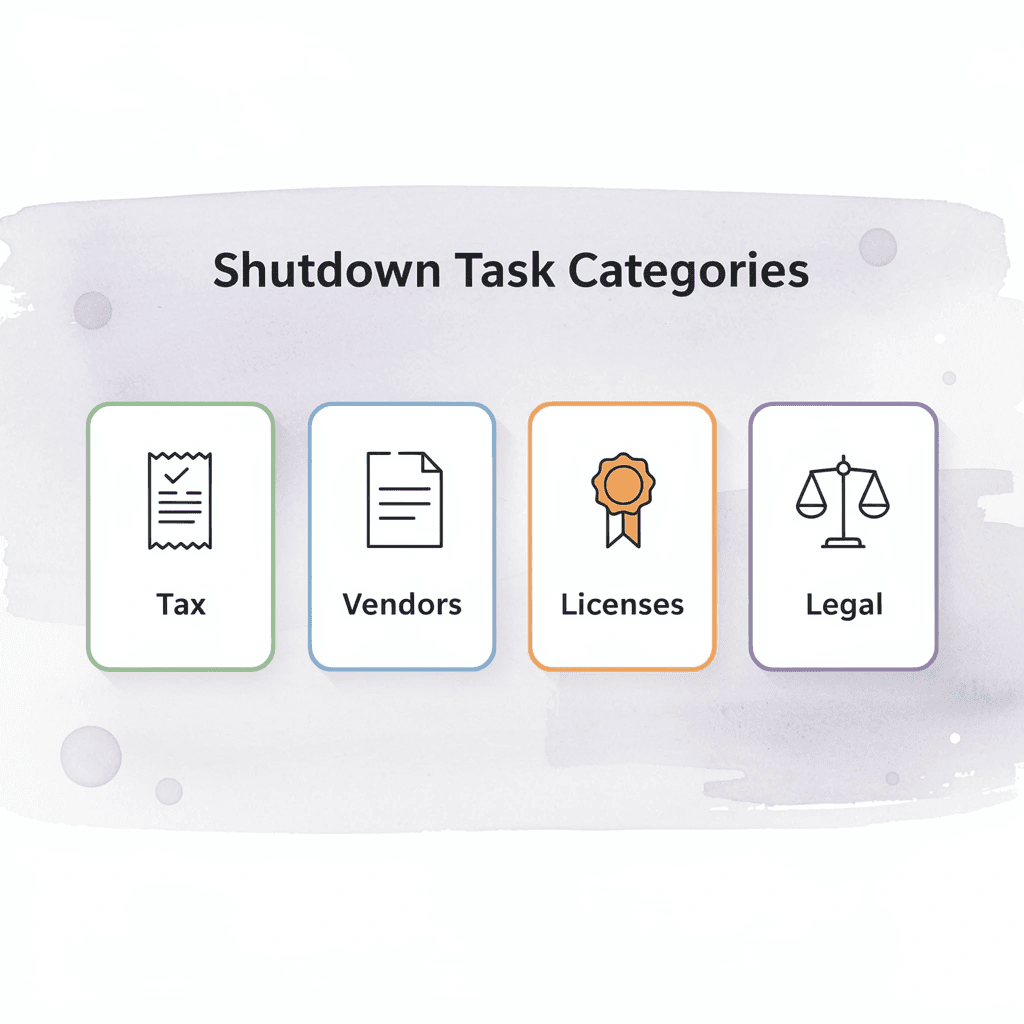
💡 Tip: Create a comprehensive shutdown checklist immediately after your investor conversation to ensure no critical closure tasks fall through the cracks during this emotionally challenging time.
What business obligations often remain unresolved?
Business obligations don't respect operational timelines. A founder might stop serving customers in March but discover in July that a state tax account remained active, generating penalties. A subscription service continues billing because no one formally canceled it. A vendor sends an invoice for an improperly terminated contract.
These small administrative gaps accumulate because no single system tracks what requires formal closure versus what ends with operations. Starcycle helps organize and track these obligations, ensuring nothing falls through the cracks during business closure.
How can founders organize outstanding responsibilities?
Starcycle helps founders organize outstanding responsibilities into a structured process. Our platform identifies obligations across tax accounts, payroll systems, vendor agreements, registrations, and compliance requirements, providing visibility so founders won't assume something is resolved when it isn't.
What makes documentation the primary bottleneck during shutdown?
Shutting down a company requires extensive paperwork: dissolution filings, final tax returns, employee termination records, vendor cancellations, asset transfers, and investor notifications, all coordinated across accountants, attorneys, government agencies, and service providers.
According to Yuval Passov, early-stage success depends on storytelling, traction, and trust. Investors and stakeholders trust founders who maintain clear communication and documentation even when outcomes are disappointing.
How can centralized platforms reduce documentation friction?
When documentation lives across email, Slack, and multiple file systems, founders lose track of submissions, pending items, and remaining tasks.
Business closure platforms bring materials and workflows together in one place, streamlining work across different systems and demonstrating to advisors, investors, and regulators that closure was handled methodically rather than reactively. Our platform shows that your closure process was well-documented and organized.
The emotional weight doesn't disappear
Founders facing financial pressure, disappointed employees, and personal setbacks find that routine administrative tasks become harder to complete. The emotional difficulty of closing something you built doesn't end when you inform your board—it continues through every vendor call, employee goodbye, and form asking why your company no longer exists. Structure doesn't eliminate that difficulty, but it creates a clearer path forward when everything else feels uncertain.
But there's one part of this process most founders don't anticipate until they're deep into it.
Sign up to Make your Business Closure Process Easier
If your company is shutting down, communicating clearly with investors is the first step. The work that follows often determines whether the shutdown proceeds smoothly or creates problems later on. Our Starcycle platform helps you identify remaining tasks, organize your closure, and manage your shutdown with greater clarity and confidence.

🎯 Key Point: The conversation with investors starts the next phase, where how you organize things matters just as much as being honest did in that first hard call.
💡 Tip: Don't let the complexity of business closure overwhelm you after that difficult investor conversation. Having the right tools and guidance can transform a potentially chaotic process into a structured, manageable transition.
"The way you handle your business closure process can significantly impact your professional reputation and future opportunities in the entrepreneurial ecosystem." — Business Closure Best Practices, 2024
Phase | Key Focus | Starcycle Benefit |
|---|---|---|
Investor Communication | Transparency & honesty | Clear messaging framework |
Closure Planning | Organization & structure | Comprehensive task management |
Execution | Confidence & clarity | Step-by-step guidance |