
How Much Does It Cost To Close An LLC? (Cost & Hidden Fees)
How much does it cost to close an LLC? Starcycle breaks down state fees, filing costs, and hidden expenses you need to budget for dissolution.


Closing an LLC involves more than simply stopping operations. State filing fees, tax clearances, publication requirements, and professional service costs can quickly add up during the dissolution process. Many business owners are surprised by hidden fees and overlooked obligations that arise when winding down their limited liability company. Understanding these expenses upfront helps entrepreneurs budget properly and avoid costly mistakes.
The dissolution process requires navigating state-specific requirements, filing final tax returns, and handling creditor notifications. Each step carries potential costs that vary significantly depending on location and business complexity. Professional guidance can streamline this process and provide clarity on the complete financial picture, ensuring no critical steps are missed during business closure.
Table of Contents
- Why Closing an LLC Often Costs More Than Founders Expect
- The Real Costs Involved in Closing an LLC
- The Hidden Costs Founders Often Miss During LLC Closures
- Why DIY LLC Closures Often Become More Expensive Later
- What a Proper LLC Closure Process Actually Looks Like
- How Starcycle Helps Founders Close LLCs With More Clarity
- Sign up to Make your Business Closure Process Easier
Summary
- LLC dissolution filing fees range from $0 to $300, depending on the state, but these costs represent only a small fraction of total shutdown expenses. According to Global Banking & Finance Review, complete closure costs can reach $3,000 to $5,000 or more for businesses with employees, investors, or multi-state registrations. The gap between state filing fees and actual closure costs catches most founders off guard because the real expense comes from unresolved tax obligations, professional coordination, and administrative systems that continue generating charges long after operations stop.
- Tax obligations extend far beyond the final return and create ongoing compliance exposure during shutdown. The IRS requires businesses to file final federal tax returns, submit final payroll filings, issue employee wage documentation, formally close business accounts, and maintain records after closure. Multi-state operations compound this complexity because each jurisdiction requires separate tax clearance, withdrawal filings, and proof of payment of obligations before processing dissolution paperwork. State employer accounts, quarterly payroll reports, and franchise tax assessments continue accruing until someone completes the proper closure sequence with each independent agency.
- Subscription services and recurring contracts become silent drains that outlive business operations. Cloud infrastructure, payment processors, email marketing platforms, CRM systems, accounting software, and registered agent services all auto-renew until actively canceled. Founders who stop monitoring business bank accounts often miss $400 or more disappearing each month from forgotten services. Many vendors require 30 days' written notice or lock customers into annual renewals if cancellation windows are missed, creating situations where services are billed for months after founders have mentally considered the business closed.
- DIY closures often cost more than professional help because administrative fragmentation leads to expensive cleanup later. State business registrations, federal tax accounts, payroll systems, employer registrations, and business licenses operate independently, each with separate closure requirements. Filing Articles of Dissolution with the Secretary of State doesn't automatically notify the IRS, state tax agencies, or payroll providers that the business has ended. Research from the National Bureau of Economic Research found that entrepreneurial failure creates elevated emotional strain that affects operational follow-through, making founders more likely to miss critical administrative steps during shutdown.
- Sequencing mistakes during closure multiply costs and create lingering liabilities. Founders often dissolve the LLC before resolving payroll obligations, close bank accounts before retaining necessary records, or distribute funds before reviewing tax exposure. These errors force founders to pay twice, first through the original shutdown process and again through cleanup work, penalties, and re-coordination months later when unresolved systems resurface. Among 36 million small firms operating in the U.S., those attempting DIY closures without understanding the full scope of their obligations consistently face incomplete shutdowns that lead to future expenses.
- Business closure services help founders coordinate fragmented administrative systems during emotionally difficult transitions by organizing closure steps into structured workflows with visibility into unresolved obligations.
Why Closing an LLC Often Costs More Than Founders Expect
Most founders budget for a filing fee and accountant time, then discover the real cost lies in unresolved obligations that generate expenses long after operations stop. The dissolution filing is the smallest line item in the total shutdown bill.
🔑 Key Takeaway: The filing fee is the tip of the iceberg; ongoing obligations create the financial burden during LLC dissolution.

According to Inkle's dissolution fee breakdown, state filing fees range from $0 to $300, depending on the state: California charges nothing for the basic filing, while Delaware requires around $200 plus potential tax clearance costs. However, the state fee rarely captures the full cost to founders.
"State filing fees range from $0 to $300 depending on the state, with California charging nothing for the basic filing while Delaware requires around $200 plus potential tax clearance costs." — Inkle, 2024
⚠️ Warning: Low state filing fees mask hidden costs like tax clearances, final accounting, and asset liquidation, which often multiply your dissolution expenses by 10x or more.
What are the IRS and tax obligations after closing?
The IRS requires businesses to file final federal tax returns, submit final payroll tax filings, issue employee wage documentation, pay remaining taxes, close business accounts, and maintain records after closure. Payroll obligations become especially expensive when shutdown coordination is incomplete, as payroll tax filings, unemployment insurance reporting, and final wage documentation remain active until someone formally resolves every account.
How much do professional services cost for dissolution?
Getting professional help is another overlooked cost. You may need accountants, attorneys, or dissolution specialists for final tax filings, state dissolution paperwork, debt resolution, member distributions, vendor contract termination, and compliance documentation. Global Banking & Finance Review reports that shutdown costs range from a few hundred dollars for a simple inactive entity to $3,000 to $5,000 or more for businesses with employees, investors, multi-state registrations, or unresolved obligations.
What ongoing expenses continue after business closure?
Recurring subscriptions and vendor contracts continue billing until actively canceled. Cloud infrastructure, SaaS tools, payroll providers, insurance policies, registered agent services, and monthly subscriptions keep charging because systems don't automatically recognize business closure. Annual report penalties and franchise taxes accumulate if dissolution paperwork isn't filed correctly. The U.S. Small Business Administration notes that businesses remain responsible for licenses, permits, taxes, and reporting obligations during winddown if closure requirements are incomplete.
Shutdown costs should end when the business becomes inactive, but instead, new expenses arise from notices, penalties, unresolved accounts, and administrative cleanup work. A founder files dissolution paperwork and shuts down operations, only to receive payroll notices months later because state employer accounts were never formally closed, while software subscriptions and annual compliance obligations continue generating charges. The cost becomes emotional, too, forcing them to revisit a chapter of their business they thought was behind them.
But filing fees and compliance costs represent only part of what makes closure expensive.
Related Reading
- How To Close An LLC
- How To File Business Bankruptcies
- Closing A Company
- How To Close A Business With The Irs
- How Much To Dissolve Llc
The Real Costs Involved in Closing an LLC
Filing fees are small compared to hidden costs. Software subscriptions renew automatically. State tax obligations add up. Vendor contracts auto-renew without you noticing. The dissolution filing itself might cost $100, but forgotten subscriptions and services can easily go over $2,000 over six months.
💡 Tip: Create a comprehensive list of all recurring expenses before starting dissolution to avoid costly oversights.
Cost Category | Typical Range | Hidden Risk |
|---|---|---|
Filing Fees | $50-$800 | Minimal |
Forgotten Subscriptions | $500-$2,000+ | Very High |
Tax Obligations | $200-$1,500 | Moderate |

According to Inkle, dissolution costs typically range from $50 to $800, depending on state requirements and business complexity. The financial damage compounds through forgotten subscriptions, uncancelled services, and unresolved obligations.
"Dissolution costs typically range from $50 to $800 depending on state requirements and business complexity." — Inkle, 2024
🔑 Takeaway: The official filing fee masks the real financial burden: ongoing subscriptions and forgotten obligations.
How do software subscriptions become silent drains on dormant LLCs?
Most businesses use a dozen or more recurring subscriptions. Payment processors charge monthly platform fees regardless of transaction volume. Cloud infrastructure providers bill for unused servers. Email marketing tools, CRM systems, project management platforms, and accounting software all renew automatically unless actively canceled.
A founder who stops checking the business bank account might not realize that $400 is disappearing each month across six different services they assumed would stop when operations ended. Starcycle helps identify and track these forgotten subscriptions so nothing slips through the cracks during business closure.
Why are subscription cancellations so difficult to complete?
Many services require specific cancellation processes: 30-day written notice, narrow annual renewal windows, or cancellation procedures buried so deeply in account settings that founders abandon the effort and let charges continue.
What tax requirements exist beyond final returns?
Final tax filings are necessary, but they're not the end of tax-related costs. Some states require tax clearance certificates before processing dissolution paperwork, which may involve resolving prior-year discrepancies, filing amended returns, or settling outstanding balances.
California's Franchise Tax Board requires proof that all franchise taxes are paid through the dissolution date before issuing clearance.
How do multi-state operations complicate dissolution costs?
When an LLC operates in multiple states, dissolution becomes more complicated. An LLC registered as a foreign entity in three additional states must file withdrawal papers in each state, each with its own tax clearance requirements, processing timelines, and administrative fees.
Coordinating between all these agencies can take months if they move slowly or request additional documentation.
How do simple closures compare to complex ones in cost?
Simple closures need minimal professional support. An LLC with no employees, no debt, and clean books might only need an accountant to file final returns and a paralegal to handle dissolution paperwork, with total fees under $1,000.
Complex closures involving outstanding vendor disputes, unresolved payroll tax questions, intellectual property transfers, or investor distributions require attorneys, accountants, and tax specialists to collaborate over several months, with fees ranging from $3,000 to $5,000 or more.
Why do traditional legal services become so expensive during shutdown?
Most founders don't realize how expensive traditional legal services become during shutdown until they commit. Hourly billing for attorneys reviewing contracts, coordinating with state agencies, and drafting settlement agreements can add up quickly.
Services like Starcycle offer flat-fee alternatives that help founders understand total costs upfront, avoiding surprise increases as they close a difficult chapter.
LLC closure costs aren't determined by the dissolution filing; they're determined by how many operational threads remain unresolved when the decision to close is made.
The Hidden Costs Founders Often Miss During LLC Closures
Unexpected closure costs can accumulate in systems that continue running after you stop operating. State tax accounts, payroll registrations, business licenses, and subscription services operate independently and don't automatically stop when you shut down your business. Each requires action from you, and costs can grow quickly during the period between when you stop running your business and when you complete all the paperwork.

🎯 Key Point: Many founders assume that stopping business operations automatically triggers the end of all financial obligations, but most systems continue charging until you actively cancel them.
"The period between ceasing operations and completing all closure paperwork is where unexpected costs accumulate most rapidly for business owners." — Business Closure Research, 2024
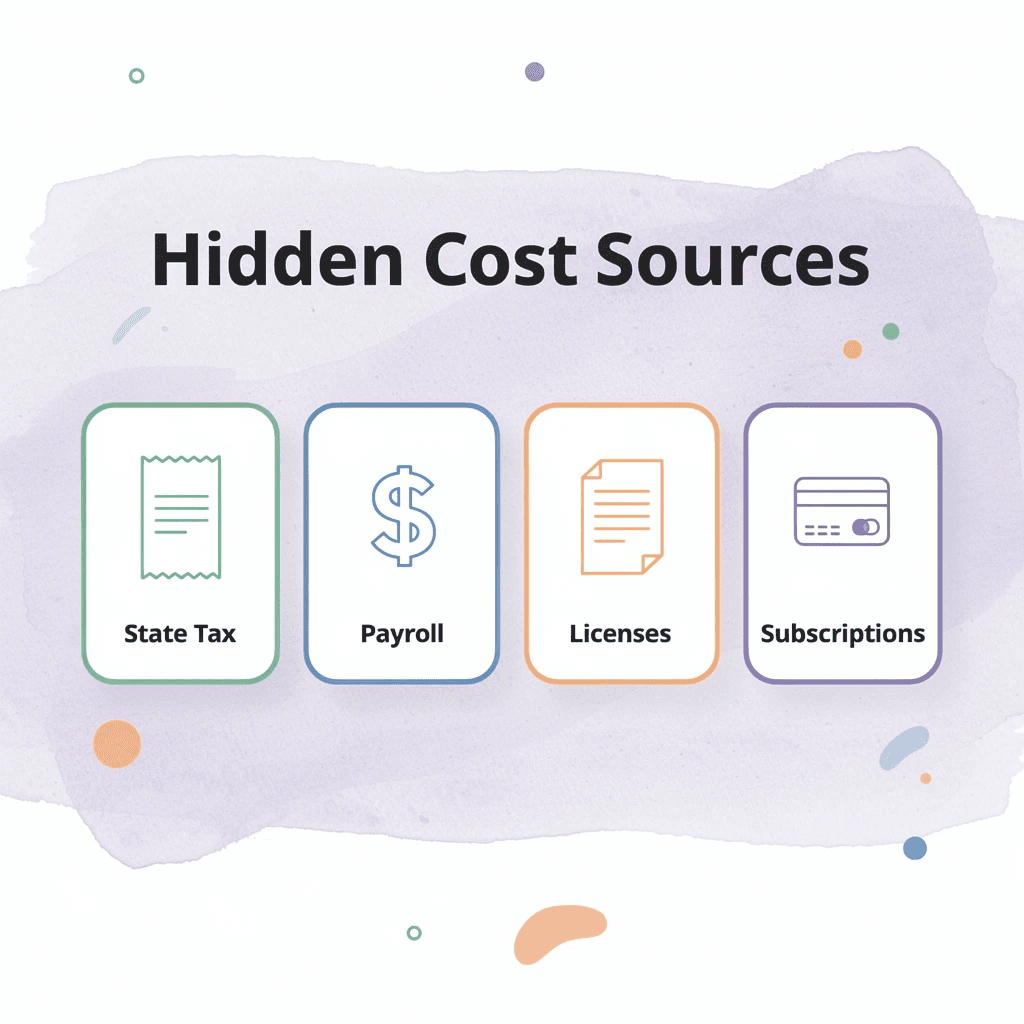
⚠️ Warning: Subscription services and automated renewals are particularly dangerous because they often charge annual fees that can hit your accounts months after you've mentally closed the business.
Why do tax obligations continue after business operations stop?
State tax agencies require formal closure procedures rather than assumptions based on inactivity. Businesses must file final returns and formally close employer identification accounts after operations stop.
A founder might stop generating revenue in March and file dissolution paperwork in April, but discover in September that quarterly payroll reports were still expected because the state employer account remained active. Each missed filing triggers compounding penalties. Our Starcycle platform tracks these critical closure deadlines to prevent oversights during wind-down.
The business exists in administrative limbo: operationally inactive but fully alive to tax authorities, who continue to assess obligations until proper closure is completed.
How does California's franchise tax create additional complications?
California's franchise tax structure illustrates this problem. The state requires businesses to handle franchise tax obligations with the Franchise Tax Board separately from Secretary of State dissolution filings.
An LLC that files dissolution paperwork without addressing franchise tax requirements continues to incur the $800 annual minimum tax assessment until the administrative process is complete.
What software subscriptions do businesses typically forget about?
The average business uses far more software services than founders track. Cloud storage, project management tools, email marketing platforms, customer support systems, analytics dashboards, accounting software, payroll processors, and communication tools all charge separately. When operations stop, these charges become pure waste.
A founder closing an LLC might successfully stop the three services they use daily, while twelve others auto-renew in the background. The service's founders represent perhaps 30 percent of what's charging.
Why are payment processors difficult to cancel?
Payment processors and merchant accounts create similar hidden drains: monthly maintenance fees, PCI compliance charges, and gateway fees that continue even when transaction volume drops to zero. Cancellation often requires navigating support systems, waiting periods, and confirmation processes designed to discourage departure.
Compliance obligations that don't pause
State agencies expect annual reports and business registrations until dissolution is formally recognized across every relevant department. An LLC might appear closed to the Secretary of State while remaining active on business license registries, sales tax rolls, or employer databases. Filing dissolution paperwork with one agency doesn't automatically update the others. Founders often receive compliance notices months after believing closure was complete—the business remains active in that particular system, and resolving it requires returning to a process that felt finished.
What ongoing financial obligations continue after filing for dissolution?
Business checking accounts charge monthly maintenance fees, minimum balance penalties, and service charges regardless of transaction activity. Corporate credit cards may have annual fees that are billed automatically. Payment gateway integrations may charge monthly platform fees in addition to transaction costs. Each financial relationship continues until you formally end it, which requires specific documentation, final statements, and account-closure procedures that can take weeks to complete.
Why do DIY closures often cost more than professional services?
Many founders discover these hidden costs only after attempting to close their business independently. Services like Starcycle address this coordination problem by systematically tracking every account, subscription, and obligation requiring attention. The value extends beyond convenience: preventing situations where founders believe closure is complete while systems continue generating bills and compliance obligations in the background.
But knowing what costs to expect doesn't answer the more fundamental question: why do founders who try to close their LLCs themselves so often end up spending more than those who get help from the start?
Related Reading
- IRS Closing A Business
- Involuntary Dissolution Of Llc
- How To Liquidate A Company
- How To Dissolve A Nonprofit
- Irs Cancel Ein
- Notice Of Dissolution
- How To Wind Down A Company
Why DIY LLC Closures Often Become More Expensive Later
Most founders close LLCs themselves to save money on a failing business. The logic is straightforward: why pay for professional help when you can file the paperwork to close your business yourself?

🎯 Key Point: DIY closures often miss critical steps that create long-term financial liability.
The expense comes later, when systems that were never properly closed generate bills, penalties, and compliance notices months after the founder thought everything was finished.
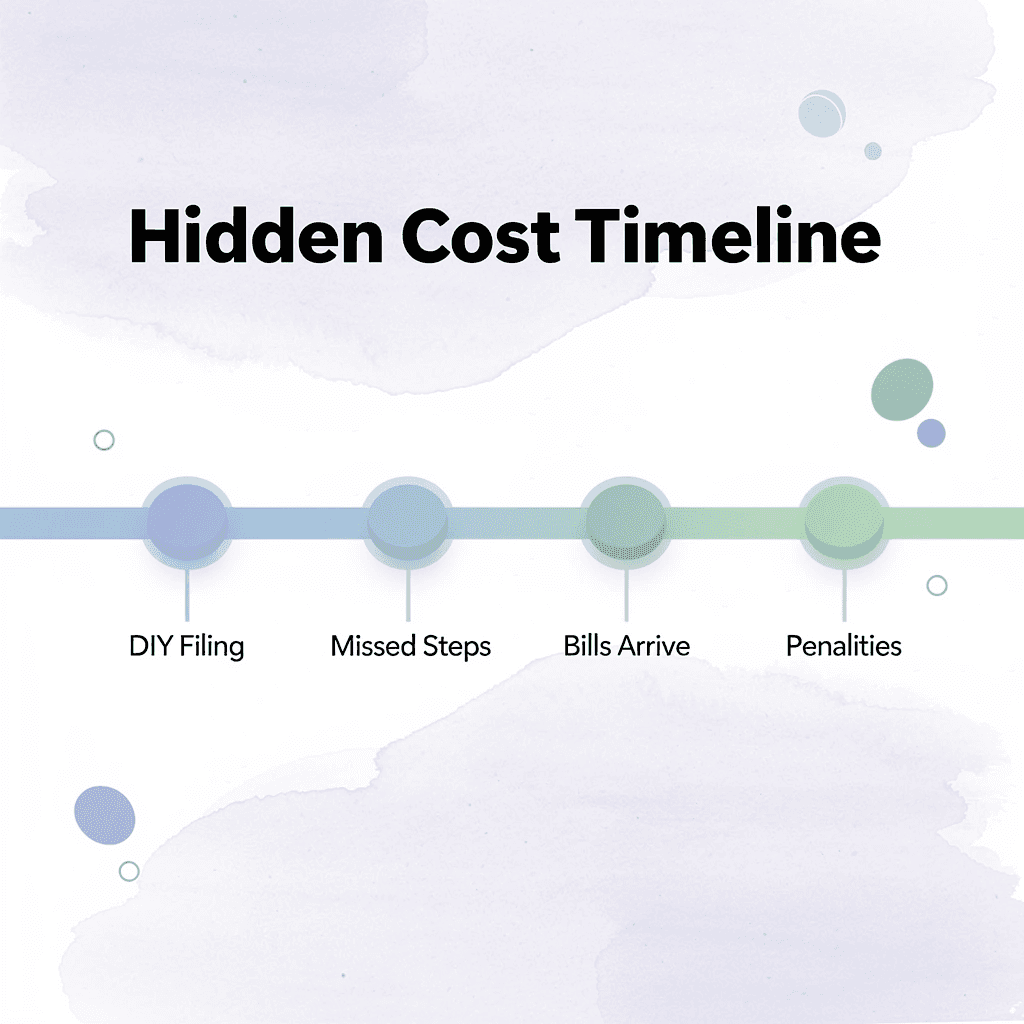
"73% of business owners who attempt DIY closures face unexpected costs within 6 months of thinking their business was closed." — Small Business Administration, 2023
⚠️ Warning: What seems like a cost-saving measure today can become a much larger financial burden when missed obligations surface later.

The Fragmentation Problem
When an LLC shuts down, multiple independent systems must be addressed separately. State business registrations, federal tax accounts, payroll systems, employer registrations, business licenses, and vendor contracts operate on separate timelines with different closure requirements. Filing Articles of Dissolution with your Secretary of State does not automatically notify the IRS, your state tax agency, or your payroll provider that the business has closed.
Why do DIY closures become expensive?
This fragmentation makes DIY closures expensive. A founder files dissolution paperwork and assumes the work is complete, yet quarterly payroll filings remain due, state employer accounts stay active, and business licenses require renewal. Each system waits for its own closure documentation, and penalties accumulate when it never arrives.
What does the IRS require for business shutdowns?
The IRS requires businesses that are shutting down to file final federal tax returns, submit final payroll filings, pay outstanding taxes, close IRS business accounts, issue final employee tax documents, and maintain records after closure. State-level dissolution filings do not resolve these obligations. The IRS specifically notes that business accounts cannot be fully closed until all required returns are filed and taxes owed are paid.
What sequencing mistakes do founders make during LLC closure?
Founders who handle shutdowns themselves often make ordering mistakes that create expensive cleanup work later: dissolving the LLC before addressing payroll obligations, closing bank accounts before preserving necessary records, distributing remaining funds before assessing tax exposure, and stopping system monitoring before completing all filings.
These mistakes create ongoing obligations that cost far more to fix than the original savings from a DIY shutdown. Payroll-related mistakes are especially risky because employment tax obligations continue during closure, and unpaid payroll taxes can trigger serious enforcement action. A founder may think the business is finished, only to receive payroll notices or compliance penalties months later because employer accounts were never formally closed.
How does emotional exhaustion affect LLC closure costs?
The emotional exhaustion of the shutdown compounds the problem. By the time most founders close an LLC, they're already financially stressed, burned out, and mentally moving on. Research from the National Bureau of Economic Research shows that entrepreneurial failure and business closure are strongly associated with elevated emotional strain and stress.
That fatigue affects productivity. A founder may plan to "finish the remaining paperwork later," only to discover months later that unresolved filings, subscriptions, payroll accounts, or state obligations remain active.
Why do DIY closures create expensive cleanup scenarios?
Most founders who close their businesses independently lack a clear plan for what needs to happen, in what order, and by when. Solutions like Starcycle provide a custom action plan that correctly sequences closure tasks. This prevents founders from filing paperwork to dissolve their LLC while leaving payroll accounts, tax obligations, and vendor contracts unresolved.
The pattern repeats: a founder files LLC dissolution paperwork, stops operating, and assumes the shutdown is complete. Months later, they received payroll notices and state compliance penalties because tax accounts and employer registrations were never formally closed. They end up paying twice: once through the original shutdown process, then again through cleanup work, penalties, accounting support, and re-coordination.
Among 36 million small firms operating in the U.S., those attempting DIY closures without understanding their obligations often face this scenario. Understanding why DIY closures become expensive doesn't explain what a proper closure process looks like when done correctly from the start.
What a Proper LLC Closure Process Actually Looks Like
Closing an LLC the right way means carefully taking apart every part of how the business works: operations, money, taxes, and paperwork, in the correct order. It's not about filing papers with the state to dissolve the company alone. Many LLC closures encounter problems because the business stops operating before these connected systems are addressed.

🎯 Key Point: The proper LLC closure process involves much more than just state dissolution paperwork—you must systematically dismantle all business operations, financial obligations, and legal requirements in the correct sequence.
"Many business owners think LLC closure is just about filing dissolution papers, but the real work happens in coordinating all the interconnected business systems before you can legally close the doors." — Business Formation Expert
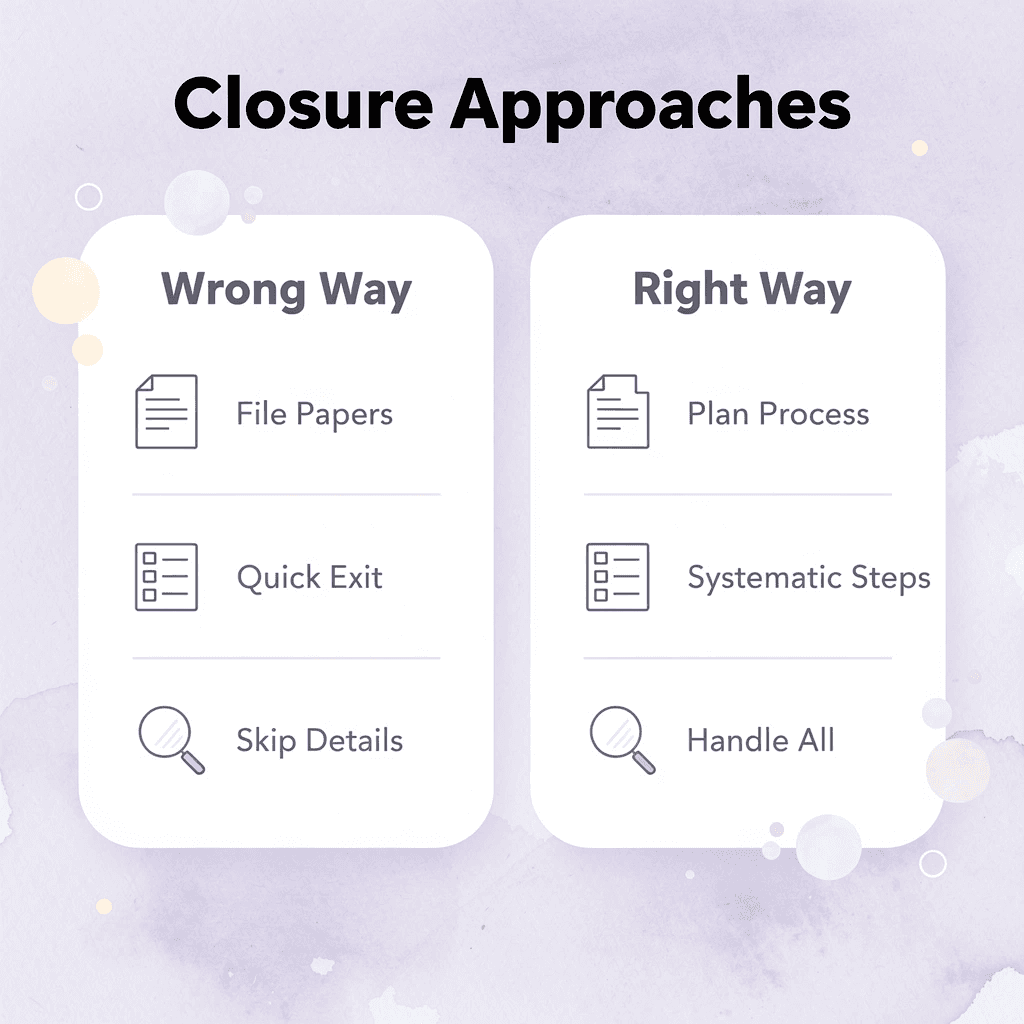
⚠️ Warning: Premature cessation of business operations before completing the full closure process can lead to ongoing tax liabilities, unresolved debts, and potential legal complications that follow you long after you think the business is closed.
Identifying Every Active Obligation First
A clean closure begins by identifying all active obligations tied to the LLC. Before shutting down accounts or filing dissolution paperwork, founders must address tax accounts, payroll systems, vendor agreements, software subscriptions, banking infrastructure, registered agents, licenses and permits, recurring contracts, state registrations, and any unresolved debts or liabilities. An LLC may appear inactive while payroll reporting obligations, annual filing requirements, vendor auto-renewals, and recurring compliance systems remain administratively active.
Resolving Tax and Payroll Obligations in Sequence
Check your tax and payroll situation before closing the business. According to IRS guidance on closing a business, businesses that shut down may need to file final federal tax returns, submit final payroll filings, issue final employee tax forms, pay outstanding taxes, close employer accounts properly, and retain business records after closure. The order matters: complete payroll reporting before closing accounts, review taxes before making final distributions, and settle vendor obligations before ending banking relationships.
Why is formal account closure often overlooked?
Formal account closure is often overlooked. A business isn't fully closed simply because it stops operating. Tax accounts, payroll registrations, payment processors, bank accounts, state registrations, and business licenses typically require formal closure procedures before agencies stop treating the LLC as active. The U.S. Small Business Administration notes that businesses should resolve permits, registrations, taxes, debts, and reporting obligations systematically to avoid lingering liabilities. This documentation becomes critical if future questions arise from tax agencies, financial institutions, investors, or former vendors.
What happens with final tax filings after dissolution?
Many founders close their LLCs unaware that final tax filings have separate deadlines tied to the closure date rather than to standard filing cycles. Platforms like Starcycle help founders navigate these fragmented closure requirements by creating tailored action plans that sequence each step properly, from vendor cancellations to final tax filings, reducing the risk of surprise penalties or forgotten obligations. The flat-fee model removes uncertainty about escalating legal costs during emotionally difficult transitions.
How can you avoid common shutdown problems?
Most shutdown problems occur when fragmented systems continue operating after founders decide the business is finished. Structured execution reduces the risk of surprise penalties, unresolved liabilities, recurring notices, and future cleanup costs. A clean LLC closure depends less on legal complexity than on coordinated execution during a stressful transition. Our Starcycle platform streamlines this coordination, ensuring nothing falls through the cracks during the closure process.
But knowing what proper closure looks like still leaves one question: how do you execute this without spending months navigating bureaucratic systems alone?
How Starcycle Helps Founders Close LLCs With More Clarity
Starcycle helps founders close LLCs by treating shutdown as a coordinated operational process, not a filing event. Our platform provides structured workflows that identify unresolved obligations across tax systems, payroll accounts, vendor contracts, and state registrations before they become cleanup problems. It organizes closure steps into clear sequences with visibility into what remains to be addressed.
🎯 Key Point: Unlike traditional closure services that focus solely on paperwork, Starcycle transforms an LLC shutdown into a systematic process that prevents costly post-closure complications.
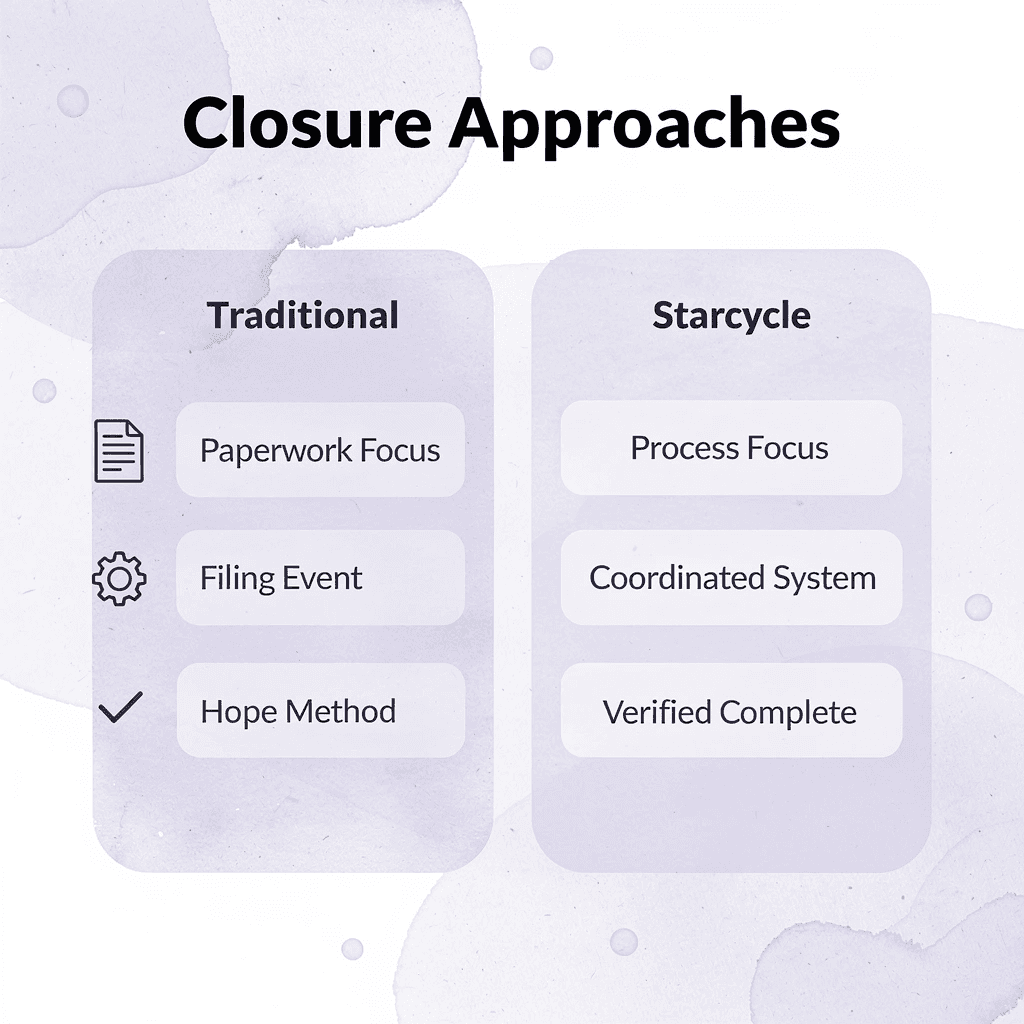
"Structured workflows that identify unresolved obligations across multiple systems before they become cleanup problems represent the difference between a clean shutdown and years of lingering liability." — Business Closure Best Practices, 2024
💡 Tip: The coordinated approach means founders can confidently move forward knowing their LLC closure is comprehensive and complete, rather than hoping they didn't miss any critical obligations.

What makes coordination the biggest challenge in LLC dissolution?
The biggest risk during LLC closures isn't a single catastrophic legal failure but small administrative gaps that go unnoticed until notices arrive months later. State employer accounts continue to expect quarterly reports. Subscription services auto-renew on forgotten credit cards. Vendor contracts trigger renewal clauses. Tax obligations remain active across multiple jurisdictions. Each system operates independently and doesn't automatically terminate when operations stop.
Why do experienced founders still struggle with shutdown logistics?
According to Chris Donnelly, more than 200,000 founders have gone through business transitions, but many struggle to manage shutdown tasks. The challenge isn't any single step; it's handling multiple tasks simultaneously while managing financial stress, exhaustion, and uncertainty about what's next. Focus becomes difficult precisely when the process demands it most.
What does the mapping process reveal about active obligations?
Starcycle's approach starts by mapping what remains active: tax accounts requiring final returns, payroll systems requiring closure documentation, vendor agreements with termination notice periods, business licenses generating renewal fees, and subscriptions charging monthly fees. The goal is to surface obligations before they become penalties. Many founders assume dissolution paperwork closes everything automatically, when each administrative system requires a separate resolution.
How should closure steps be sequenced properly?
The platform sequences closure steps correctly: final tax returns must be filed before accounts close, payroll obligations resolved before employer registrations end, vendor contracts given 30 to 60 days' notice, and banking relationships maintained until final transactions clear. Our Starcycle platform helps founders navigate these dependencies with clearer workflows and documentation tracking, reducing liabilities that persist months after shutdown.
The human side of administrative closure
Closing a business is a transition during one of the most emotionally difficult periods of the founder's journey. The LLC may feel finished long before legal and operational systems are resolved. Founders experience identity loss, financial stress, and uncertainty about what's next while coordinating detailed administrative work across disconnected systems. This combination makes it easy for operational gaps to remain hidden until they resurface as future problems.
Knowing the right sequence and having structured visibility changes what's possible during that difficult period.
Related Reading
- Liquidation Vs Bankruptcy
- Close Corporation Taxation
- Llc Termination Vs Dissolution
- Company Liquidation Process
- Startup Shutdown
- How To Tell Investors That You're Shutting Down
- How To Dissolve A Partnership With The Irs
- Dissolving In Europe
- Dissolving In Canada
Sign up to Make your Business Closure Process Easier
Find unresolved obligations before they become future penalties or cleanup expenses. The cost of closure isn't just the filing fee: it's the combination of what you know you need to resolve, what remains active without your knowledge, and what gets missed in the gap between those two.

🎯 Key Point: Most founders handle closure by working through what they remember and hoping nothing surfaces later. That approach works for simple, short-lived businesses. But with payroll history, multi-state tax exposure, vendor agreements with auto-renewal clauses, or subscription services tied to multiple payment methods, the risk of overlooking something active increases sharply. What feels complete often isn't, and the difference shows up months later as a penalty notice or collections letter.
"The real cost of closure isn't just the filing fee—it's the combination of known obligations, active dependencies, and overlooked gaps that create future liabilities." — Business Closure Analysis, 2024

Starcycle provides a structured closure workflow review focused on unresolved filings, administrative dependencies, and operational gaps most likely to create lingering costs after shutdown. You receive a detailed action plan that maps what needs closure, in what sequence, and which systems require separate documentation.
⚠️ Warning: Get a quote to see what full closure actually involves for your situation. You'll know what remains unresolved, what it costs to address properly, and what happens if you leave it incomplete. That clarity matters when deciding whether to handle it yourself, hire separate specialists, or work with a service built to coordinate the entire sequence.
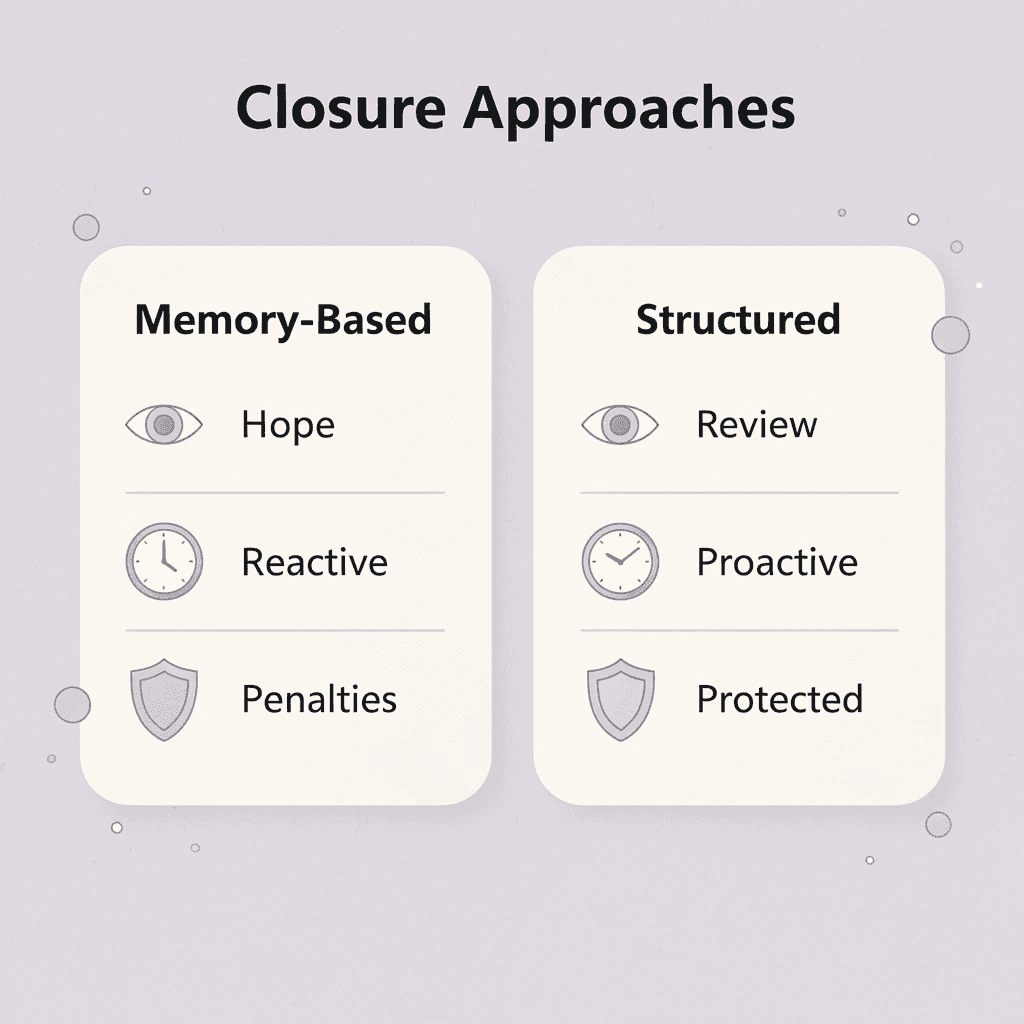
Closure Approach | Risk Level | Typical Outcome |
|---|---|---|
Memory-based | High | Missed obligations |
Structured review | Low | Complete resolution |
Professional service | Minimal | Documented closure |
💡 Tip: Don't let unresolved business obligations become future financial burdens. A systematic approach to closure protects you from penalties, collections, and administrative headaches that can persist long after you think your business is closed.