
How To Liquidate A Company: Step-by-Step Guide to Avoid Mistakes
Learn how to liquidate a company properly with Starcycle's step-by-step guide. Avoid costly mistakes and legal issues during the dissolution process.


Closing down a business requires more than simply ceasing operations. The liquidation process involves settling debts, distributing assets, filing dissolution paperwork, and ensuring compliance with state regulations. Business owners who skip crucial steps often face personal liability, tax penalties, and legal complications that persist for years.
The administrative burden can feel overwhelming when navigating legal requirements across different entity types and jurisdictions. Professional guidance ensures the liquidation process proceeds smoothly while protecting owners from future claims and obligations, making expert support invaluable for business closure.
Table of Contents
- Why Company Liquidation Feels Overwhelming for Founders
- What It Actually Means To Liquidate A Company
- Step-by-Step Process on How To Liquidate A Company
- Why Business Winddowns Become So Time-Consuming
- How Starcycle Helps Founders Liquidate Companies More Clearly
- Sign up to Make your Business Closure Process Easier
Summary
- Company liquidation involves settling debts, distributing assets, filing dissolution paperwork, and ensuring compliance with state regulations in a specific sequence. Most founders underestimate the timeline, with proper closures often stretching three to six months rather than the few weeks initially expected. The delay stems from coordinating dozens of interdependent obligations across disconnected systems while managing legal deadlines, financial reconciliations, and stakeholder communication simultaneously.
- Stopping revenue doesn't legally close a company. An LLC or corporation continues to exist in the eyes of the state until formal dissolution occurs, which means annual reports, tax obligations, and contractual agreements remain active even after operations cease. Founders who walk away without liquidating properly often discover years later that they owe back taxes, penalties, or fees because the entity never formally dissolved.
- Roughly half of new businesses don't survive past five years, according to the U.S. Bureau of Labor Statistics, making liquidation a normal part of the business lifecycle despite founders rarely discussing it openly. A record number of companies went bankrupt in 2025, according to LinkedIn research by Firuz Alimov, yet most founders still navigate liquidation with minimal guidance, often missing state dissolution requirements entirely and continuing to receive compliance notices years after they thought the business was closed.
- Creditor payment follows legal priority rules that vary by state, with secured debts taking precedence over unsecured ones and creditors being paid before shareholders. Violating that sequence can create personal liability for directors or officers, and most states require that corporate documents, tax returns, and financial records be maintained for three to seven years even after dissolution.
- The emotional strain during closure compounds every operational challenge. A CEREVITY survey of 127 California tech founders found that 73% of tech founders hide burnout despite performing well, and liquidation forces complex administrative work during a period when mental energy is already depleted from processing the end of something you built.
- Starcycle's business-closure service helps founders navigate liquidation with structured action plans that sequence tasks correctly, manage contract terminations, and organize documentation so nothing is missed during the emotional transition.
Why Company Liquidation Feels Overwhelming for Founders
Shutting down a company requires organizing legal filings, settling debts, closing tax accounts, ending contracts, and distributing assets in the correct order. Each step connects to another, deadlines overlap, and missing even one filing can trigger penalties or personal liability long after operations cease.

🎯 Key Point: Company liquidation involves multiple interconnected processes that must be completed in precise sequence to avoid legal complications.
The emotional weight compounds this burden. For many founders, the business represents years of identity, relationships, and sacrifices that don't disappear when revenue stops. You're dismantling something you built while managing conversations with employees who trusted you, investors who believed in the vision, and creditors who need answers. That psychological load depletes the energy needed to handle administrative tasks correctly.
"The dual burden of managing both the technical requirements and emotional impact of business closure creates a perfect storm for critical oversights." — Business Closure Research Institute, 2023
⚠️ Warning: The combination of administrative complexity and emotional stress often leads founders to make costly mistakes during the liquidation process.

The Administrative Reality Hits Fast
The operational complexity becomes clear once you start the process. Resolving outstanding debts requires knowing which creditors have priority, how to negotiate settlements without creating new liabilities, and when partial payments might expose you to future claims.
What payroll obligations remain after closing?
Payroll obligations don't end with the last paycheck: you need final tax filings, benefits termination paperwork, and severance documentation. Closing tax accounts requires filing final returns with federal, state, and sometimes local agencies, each with different deadlines depending on your entity type.
How do state requirements affect dissolution paperwork?
Filing dissolution paperwork varies by state, entity structure, and outstanding obligations. Some states require tax clearance certificates before accepting dissolution filings; others impose waiting periods or publication requirements. Contracts and leases don't automatically terminate when you stop operating. Review early termination clauses, notice periods, and penalty provisions. Software subscriptions, insurance policies, vendor agreements, and service contracts continue charging until formally canceled, often with specific notice requirements buried in years-old terms.
What legal priorities govern asset distribution?
When a company closes, it must distribute its remaining money and assets in accordance with legal priority rules: creditors are paid before shareholders, and secured debts take precedence over unsecured ones. If directors or officers fail to comply with this order, they may be held personally responsible. Most states require companies to retain corporate documents, tax returns, and financial records for three to seven years after closure. This adds complexity to determining what to keep, where to store it, and how long to retain each document type.
Why do most founders navigate liquidation without proper guidance?
Research from Firuz Alimov's LinkedIn analysis found that a record number of companies went bankrupt in 2025, yet most founders navigate liquidation without guidance. Some founders miss state dissolution requirements and continue receiving annual fees, compliance notices, or tax obligations years after closure.
Others delay communicating with creditors because they're unsure how to structure conversations without making promises they can't keep or admitting liability prematurely.
What makes liquidation such a complex coordination challenge?
Liquidation is a coordination problem disguised as a legal one. Each task connects to others in non-obvious ways that emerge midway through the process. Closing a bank account before settling final payroll creates problems, as does filing for dissolution before canceling licenses.
The sequence matters, but most founders discover the correct order only after making mistakes. Starcycle helps by providing tailored action plans that sequence tasks correctly, manage contract terminations, and organize documentation.
How does emotional strain affect the liquidation process?
The emotional strain compounds every operational challenge. According to a CEREVITY survey of 127 California tech founders, 73% of tech founders hide burnout despite performing well.
Liquidation forces you to do complex administrative work during a time when your mental energy is depleted: you're processing the end of something you cared about deeply while managing complicated legal requirements.
Related Reading
- How To Close An LLC
- How To File Business Bankruptcies
- Closing A Company
- How To Close A Business With The Irs
- How Much To Dissolve Llc
What It Actually Means To Liquidate A Company
Liquidating a company means converting everything the business owns or owes into a final state before it ceases to exist legally. You sell or distribute assets, settle debts, close accounts, end contracts, and file the paperwork that notifies the government and creditors that the entity is winding down. Liquidation is the formal process that moves from "we're done operating" to "this company no longer exists."

🎯 Key Point: Liquidation is not the same as bankruptcy - it's simply the orderly process of converting business assets into cash and settling obligations before legal dissolution.
"Company liquidation involves the systematic conversion of all business assets into cash to pay creditors and distribute remaining funds to shareholders before formal dissolution." — Corporate Finance Institute, 2024

⚠️ Warning: Many business owners confuse liquidation with bankruptcy, but liquidation can happen for many reasons, including retirement, merger, or simply ending operations profitably.
How do liquidation terms differ from each other?
Several terms get used interchangeably when they shouldn't be. Liquidation is the process of identifying what you owe, who you owe it to, what you still own, and how to resolve all of it cleanly. Dissolution is the legal filing that officially ends your business entity with the state, typically after liquidation is complete.
Bankruptcy is a court-supervised process for businesses unable to pay their debts, though many liquidations occur voluntarily. Administrative closure occurs when a state removes your business from good standing for stopped filings or unpaid fees, but this doesn't resolve your obligations.
What happens if you don't properly dissolve your business?
Stopping revenue doesn't close the company. You can shut down your website, stop answering emails, and cancel your lease, but your LLC or corporation still exists legally. It still owes annual reports and tax obligations. Contracts are signed as the business doesn't vanish. Founders who walk away without liquidating properly often discover years later that they owe back taxes, penalties, or fees because the entity never formally dissolved.
How does proper liquidation protect you from liability?
According to Wikipedia's entry on liquidation, liquidation ensures that creditors, tax authorities, and other stakeholders are paid before the business closes. Done properly, it limits your personal liability. Done improperly or skipped entirely, it creates problems that can follow you.
What liquidation actually involves
The process includes financial obligations such as outstanding invoices, loans, and vendor bills; tax responsibilities at the federal, state, and sometimes local levels; legal filings and creditor communications; and operational shutdown tasks such as closing bank accounts, canceling subscriptions, and terminating leases.
Why does liquidation take longer than expected?
Many founders underestimate this process, thinking it takes a few hours. In reality, it's a multi-step process that can span weeks or months, depending on your business's complexity. If you have employees, you're handling final payroll and benefits termination. If you have investors, you're working through distribution waterfalls and cap table reconciliation. If you owe money, you're prioritizing creditors according to state-specific legal requirements.
The difficulty isn't any single task; it's the number of connected steps that must happen in sequence, with each depending on the one before it.
What are the common reasons businesses liquidate?
Liquidation happens for many reasons: startups that don't gain traction, profitable businesses closing due to changing priorities, operational fatigue, market changes, or burnout. The U.S. Bureau of Labor Statistics reports that roughly half of new businesses don't survive past five years.
Liquidation is a normal part of the business lifecycle, though founders rarely discuss it openly.
How can founders manage the liquidation process effectively?
Most founders navigate liquidation without a plan, while already mentally exhausted. You're managing complex paperwork while processing the end of something you created.
Platforms like Starcycle provide step-by-step action plans and contract management tools that streamline months of legal work into an organized process, reducing emotional burden and the risk of missing critical steps.
Step-by-Step Process on How To Liquidate A Company
Execution requires sequence. The order of actions matters more than the decision itself. Skipping steps or handling tasks out of sequence creates gaps that surface months later as missed filings, unresolved liabilities, or compliance notices for companies' founders thought no longer existed.
🎯 Key Point: Company liquidation follows a strict legal sequence - deviating from the proper order can result in personal liability for directors and ongoing compliance obligations even after you think the business is closed.

"75% of business closure issues stem from incomplete liquidation processes, leaving founders exposed to unexpected liabilities years later." — Corporate Restructuring Institute, 2023
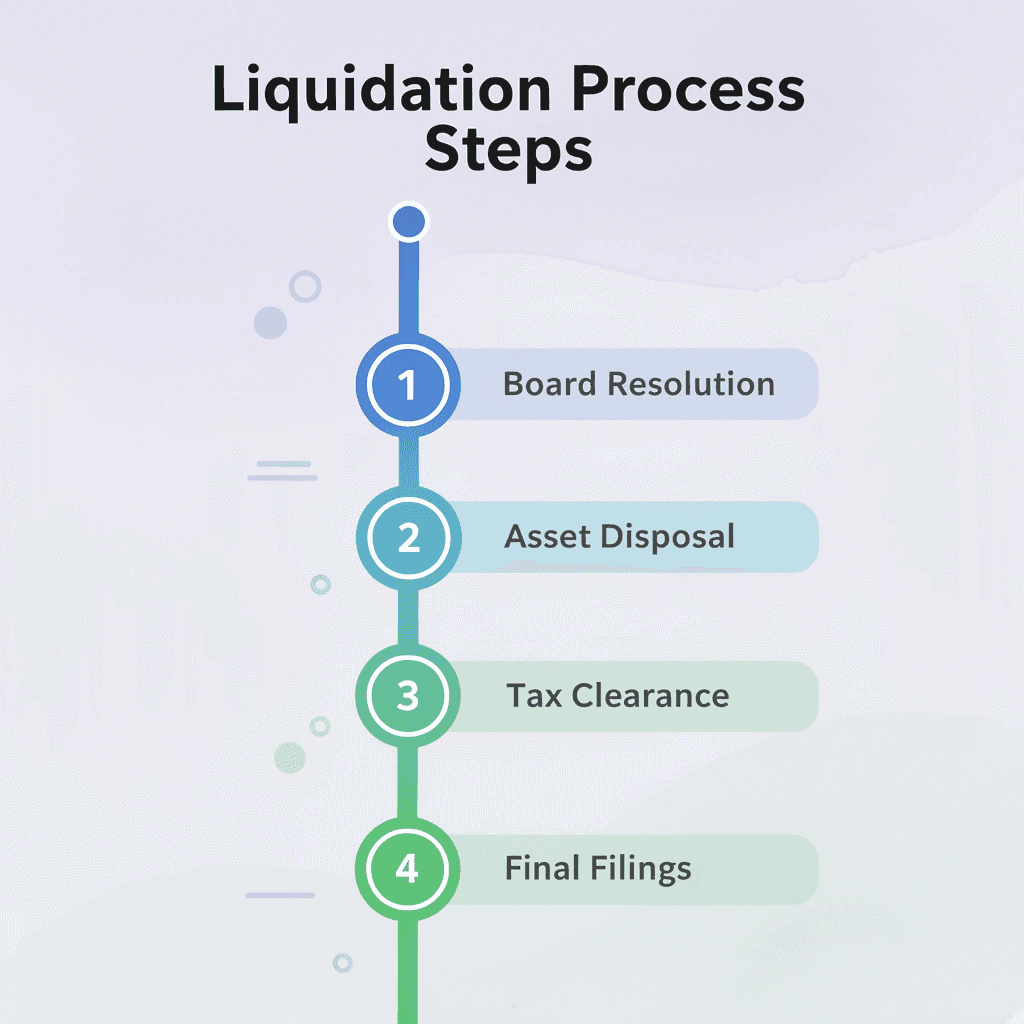
Liquidation Stage | Key Actions | Timeline |
|---|---|---|
Pre-liquidation | Board resolution, creditor notification | 2-4 weeks |
Asset disposal | Sell assets, collect debts, pay creditors | 3-6 months |
Final compliance | Tax clearance, final filings, deregistration | 4-8 weeks |
⚠️ Warning: Attempting to rush the process or handle steps simultaneously rather than sequentially often results in regulatory penalties, extended timelines, and additional costs that can exceed $10,000 in professional fees to rectify.
Step 1: Review Company Financials and Obligations
Write down every active obligation: outstanding debts, vendor agreements, payroll, tax liabilities, customer contracts, software subscriptions, commercial leases, insurance policies, and investor obligations. Most founders underestimate how many obligations continue generating costs after operations slow down. A complete financial review prevents the mistake of thinking the business is closed when it remains legally and financially active.
Step 2: Notify Stakeholders
When you communicate, it matters significantly for how smoothly the shutdown proceeds. Employees need clear information about their paychecks and benefits. Vendors need to know when they will be paid. Customers need to hear about changes to support, contracts, or unfinished work. Investors need to understand the shutdown timeline and asset division. Poor communication can create confusion, legal problems, or damaged relationships that follow founders into their future businesses.
Step 3: Stop or Wind Down Business Operations
Shutting down a business should be done in a controlled manner rather than all at once. This involves finishing work for current clients, ending recurring subscriptions, closing service accounts, ending vendor agreements, offboarding employees, securing company records, and managing remaining inventory or equipment. Many obligations continue to accrue if you don't formally close them: a business may still accrue lease obligations, software fees, tax notices, or compliance penalties if accounts remain active. Our Starcycle platform helps by providing step-by-step action plans and contract management tools that compress months of coordination into a structured workflow, reducing both the emotional load and the risk of missing critical steps.
Step 4: Liquidate Business Assets
After operations wind down, remaining assets must be sold, distributed, or resolved. This includes equipment, inventory, intellectual property, cash, furniture, and technology infrastructure. The liquidation process varies based on the company's financial condition and the priority of creditor or investor claims. Companies with significant liabilities or investor obligations may require legal guidance to ensure proper creditor hierarchy.
Step 5: Resolve Debts and Tax Obligations
Before final distributions occur, outstanding liabilities must be addressed, including vendor payments, invoices, payroll taxes, federal and state taxes, loan obligations, and creditor settlements. Tax obligations are especially critical because unresolved filings or unpaid taxes can create compliance issues even after business activity stops. According to IRS guidance on closing a business (2024), businesses may still need to file final returns, make final federal tax deposits, and report employee wage information during closure.
Step 6: File Dissolution Paperwork
After meeting operational and financial obligations, the company must be formally dissolved with the appropriate jurisdiction. This includes state dissolution filings, final tax filings, business license cancellations, EIN or tax account closures, and regulatory account closures, depending on the industry. Formal dissolution is critical because a company may continue accumulating filing requirements or annual fees until it is legally dissolved. A common problem occurs when founders shut down operations but delay filing dissolution paperwork, then discover months later that the business continued to receive compliance notices, annual report requirements, or state fees because the entity technically remained active.
Step 7: Maintain Records After Closure
Even after liquidation is complete, founders should retain key company records, including tax documentation, payroll records, contracts, financial statements, employee records, legal filings, and dissolution paperwork. Retention periods vary by location and business type, but keeping records protects founders against future questions, audits, or disputes. Many liquidation problems stem not from the decision to close, but from incomplete closure processes, missed filings, unresolved obligations, or poor sequencing during winddown that create complications founders believed they had resolved.
The real challenge is managing how long each step takes.
Why Business Winddowns Become So Time-Consuming
Most founders expect liquidation to take a few weeks. In reality, properly closing a company often stretches across three to six months, sometimes longer. The process requires managing dozens of connected obligations across different systems while legal deadlines, financial reconciliations, and stakeholder communication compete for attention simultaneously.

🎯 Key Point: The complexity isn't just in the number of tasks—it's in how these obligations interconnect and create dependency chains that can't be rushed.
"Properly closing a company often stretches across three to six months, sometimes longer, due to managing dozens of connected obligations across different systems."

⚠️ Warning: Underestimating the winddown timeline can lead to rushed decisions, missed deadlines, and unnecessary legal complications that could have been avoided with proper planning.
What makes coordinating multiple agencies so challenging?
One founder may need to file final tax returns with the IRS, submit state dissolution paperwork, cancel business licenses with local municipalities, close payroll tax accounts, and terminate registered agent services. Each agency operates on different timelines with different requirements.
The state may require tax clearance before accepting dissolution paperwork. The IRS may need payroll records to finalize employee severance. Missing one filing can delay everything downstream, sometimes triggering penalties or keeping the entity legally active months after operations cease.
How do different jurisdictions complicate the dissolution process?
Different areas have different rules for closing a business. Some states require you to publish notices in local newspapers, while others require you to wait a certain amount of time between filing for dissolution and receiving final approval.
A founder operating in multiple states must coordinate separate dissolution processes for foreign qualifications, each with its own documentation requirements and processing times.
Why is stakeholder communication challenging during liquidation?
Founders rarely close companies during calm, well-planned moments. Liquidation usually happens during periods of financial pressure and emotional exhaustion. According to Yaware, unproductive work environments cost organizations $37 billion annually. This inefficiency worsens during winddowns when founders operate with depleted energy and fragmented focus.
What information do different stakeholders need during company closure?
Employees need to know about their final paychecks, continuing benefits, and reference letters. Investors want to understand remaining assets and how debts will be paid. Vendors may await payments or need to complete their contracts. Customers need to know how to access their data, how long support will last, and how products will change. Each conversation requires careful word choice, accurate information, and emotional energy that founders struggle to maintain while handling legal paperwork and finances.
Why do financial obligations take so long to resolve?
Outstanding liabilities rarely resolve quickly. Collecting final receivables can take weeks if customers delay payment, and negotiating debt settlements requires back-and-forth communication with creditors who may not respond promptly.
Closing software subscriptions, insurance policies, and service agreements often requires navigating cancellation procedures buried in contract fine print. Small businesses accumulate dozens of recurring obligations that demand individual attention, manual tracking, and formal termination steps.
How can founders manage the emotional and logistical burden?
Founders experience decision fatigue, stress, and grief during the closure process. A founder may spend hours manually tracking dissolution requirements across spreadsheets, vendor obligations across email threads, and tax documents across disconnected folders while managing investor updates and employee offboarding simultaneously.
Platforms like Starcycle consolidate workflows into structured action plans with automated reminders and document organization, compressing what typically takes months of scattered effort into a guided process.
The challenge lies in managing the entire sequence correctly while balancing legal deadlines, financial obligations, and operational shutdown responsibilities. The complexity of liquidation stems not from any single filing or document, but from coordinating the full closure process accurately from beginning to end.
Related Reading
- IRS Closing A Business
- Involuntary Dissolution Of Llc
- How To Wind Down A Company
- How To Liquidate A Company
- How To Wind Down A Company
- How To Dissolve A Nonprofit
- Irs Cancel Ein
- Notice Of Dissolution
How Starcycle Helps Founders Liquidate Companies More Clearly
Starcycle helps founders navigate liquidation with less friction by organizing the entire wind-down process into sequenced, actionable steps. Rather than piecing together requirements from scattered legal guides, accounting checklists, and state filing portals, founders work through a tailored plan that clarifies what needs to happen, when, and in what order.

🎯 Key Point: Instead of navigating multiple disconnected resources, Starcycle provides a single, unified workflow that eliminates the guesswork from company liquidation.
"The biggest challenge in company liquidation isn't the complexity of individual tasks—it's coordinating them in the right sequence while ensuring nothing falls through the cracks." — Business Liquidation Research, 2024

💡 Tip: A structured approach to liquidation typically reduces the time founders spend on administrative tasks by 40-60%, allowing them to focus on strategic decisions rather than process management.
How does centralized workflow management reduce the complexity of liquidation?
Liquidation feels overwhelming because it requires managing dozens of disconnected obligations simultaneously: filing dissolution paperwork, negotiating vendor contracts, closing business accounts, preparing final tax documents, and communicating with stakeholders on different timelines. Each task operates in isolation, and missing one creates downstream problems you won't discover until months later when a compliance notice arrives.
What benefits does coordinated task tracking provide during company closure?
Starcycle brings scattered work together into a single, organized workflow. Instead of manually tracking which state forms you've submitted, which subscriptions you've canceled, or which creditors you've settled with, the platform organizes closure tasks by priority and dependencies. Founders can see what's complete, what's pending, and what comes next without maintaining separate spreadsheets or email threads. Starcycle reduces the mental effort that makes liquidation feel impossible to finish.
Pricing clarity when financial pressure is already high
Founders closing a business rarely have unlimited money for administrative support. Many manage tight budgets, outstanding debts, or personal financial strain. Unpredictable legal fees and surprise costs compound an already stressful situation. According to research highlighted by Starcycle, 90% of startups fail, meaning most founders undergoing liquidation lack the cushion of a successful exit.
Starcycle starts at $399 with pricing tailored to shutdown complexity. Founders know upfront what support costs will be, eliminating worry about open-ended hourly billing or hidden fees. This transparency matters when closing responsibly without draining remaining runway.
Guidance designed for founders who've been there
Liquidation is personal. You're shutting down something you built, often while managing the emotional weight of letting people down or abandoning a vision that didn't work. Founders using Starcycle get support from people who understand what it feels like to wind down a company because they've done it themselves. That empathy shapes how the platform works, from the tone of guidance to how tasks are framed. The goal is to make the process feel manageable when everything else feels like it's falling apart.
What happens when you're ready to move forward?
Related Reading
- Liquidation Vs Bankruptcy
- Close Corporation Taxation
- Llc Termination Vs Dissolution
- Company Liquidation Process
- Startup Shutdown
- How Much Does It Cost To Close an LLC
- How To Tell Investors That You're Shutting Down
- How To Dissolve A Partnership With The Irs
- Dissolving In Europe
- Dissolving In Canada
Sign up to Make your Business Closure Process Easier
A personalized winddown quote from Starcycle provides clarity that most founders lack during liquidation. Answer questions about your business structure, obligations, and state filings. Our platform builds a roadmap tailored to your specific situation, not a generic template. This clarity matters when cash is limited and emotional bandwidth is scarce.

🎯 Key Point: Starcycle was built by founders who've been through liquidation. The pricing is clear, guidance is organized, and support comes from people who've filed the same paperwork and negotiated the same vendor exits.
💡 Tip: Sign up at Starcycle for a quote that reflects your actual situation, not an upsell estimate.

"Clarity matters when cash is limited and emotional bandwidth is scarce." — The reality of business liquidation