
Startup Shutdown Mistakes That Create Problems Later
Startup shutdown mistakes can cost you thousands later. Starcycle reveals the critical errors founders make and how to avoid them completely.


Closing a business involves more than turning off the lights and walking away. Entrepreneurs who wind down their ventures face legal obligations, tax filings, and administrative tasks that can create problems for years if handled incorrectly. Understanding how to dissolve an LLC properly requires knowing which steps to take, which forms to file, and which deadlines matter most. Common startup shutdown mistakes often create lingering liabilities that follow founders long after they think their business has ended.
Professional guidance helps entrepreneurs navigate dissolution requirements without costly oversights. Rather than piecing together information from multiple sources or risking missed deadlines, founders need a clear path through filing dissolution paperwork, settling outstanding debts, and canceling business licenses. Starcycle specializes in helping entrepreneurs meet all requirements for a proper business closure.
Summary
- Most founders expect startup shutdowns to take weeks when the reality spans multiple months of coordinated work across legal, financial, and administrative systems. Over 60% of shutdowns involve unexpected legal or tax complications that founders didn't anticipate when they made the closure decision. The gap between "we're done" and "we're actually done" creates chaos because founders mentally move forward while administrative systems keep generating obligations behind them. State tax notices arrive months later, unresolved contracts trigger collection letters, and missed annual report filings result in penalties.
- Tax obligations don't pause when operations stop. The IRS and state tax agencies continue expecting quarterly payroll reports, sales tax filings, and franchise tax payments even when the business is completely dormant. Payroll accounts often remain active until founders submit formal closure documentation to each relevant agency. Businesses may still be responsible for taxes, licenses, permits, and reporting obligations during the winddown process if closure steps remain incomplete. What feels operationally finished still appears administratively alive to government systems.
- DIY shutdowns create sequencing errors that compound into expensive cleanup problems. Seventy percent of founders who attempt DIY shutdowns end up needing professional help to resolve issues they believed were already finished. Average cleanup costs for DIY shutdowns are three times higher than doing it right the first time, largely because resolving sequencing errors requires reopening closed processes and reconstructing missing documentation. Closing a bank account before finalizing payroll obligations or distributing assets before confirming tax liabilities can leave founders personally exposed when agencies determine the company owes additional amounts.
- Entrepreneurial failure is strongly associated with elevated stress, emotional strain, anxiety, and mental health challenges, according to research from the National Bureau of Economic Research. Only 10% of founders openly share their emotional challenges with their team, yet 57% of employees say they regularly notice signs of founder stress. That emotional exhaustion directly reduces the ability to manage detailed administrative processes consistently over time. Founders might handle state filings but forget county business licenses, or close the bank account but miss merchant services agreements still charging monthly fees.
- Some founders face as much as $250,000 in debt during shutdown while simultaneously managing layoffs, investor conversations, and the emotional weight of closing a company they spent years building. That financial and emotional context makes coordination significantly harder, turning even relatively small administrative tasks into overwhelming burdens. The administrative aftermath of a shutdown often creates more lingering problems than the shutdown itself because founders are trying to coordinate fragmented systems across legal, financial, and compliance domains during one of the most stressful transitions of their professional lives.
- Business closure addresses this by organizing shutdown steps into a structured workflow that identifies outstanding obligations, properly sequences closure tasks, and maintains visibility across fragmented systems, such as tax accounts, payroll obligations, and state filings.
Why Startup Shutdowns Often Become More Chaotic Than Founders Expect
Most founders think shutting down a company means stopping revenue and laying off employees. But the real chaos starts when they realize the company doesn't legally disappear. Tax obligations, state filings, vendor contracts, and compliance requirements continue long after operations cease.

⚠️ Warning: The legal entity of your company remains active until you formally dissolve it through proper state procedures. This means ongoing liability, annual fees, and regulatory obligations that can add up to high costs and legal complications.
"85% of startup founders underestimate the time and cost required for proper business dissolution, leading to unexpected liabilities that can persist for years after shutdown." — Small Business Administration, 2023

🔑 Takeaway: Proper shutdown planning requires at least 3-6 months of preparation to handle asset liquidation, final tax returns, employee benefits termination, and formal dissolution paperwork. The administrative burden often exceeds what founders budget for both time and money.
What creates the operational gap that nobody plans for?
Deciding to shut down might feel like the end, but the work that follows isn't finished. Payroll systems still need final reports. Business licenses stay active until you formally cancel them. Software subscriptions keep renewing automatically. Bank accounts remain open. Vendor invoices arrive weeks after you thought everything was done.
According to SimpleClosure's State of Startup Shutdowns 2025, more than 60% of shutdowns involve unexpected legal or tax problems that founders didn't anticipate.
Why does the gap between deciding and finishing create chaos?
The gap between "we're done" and "we're actually done" creates chaos. Founders move forward mentally while administrative systems continue generating obligations.
A state tax notice arrives three months later. An unresolved contract triggers a collections letter. A missed annual report filing triggers penalties.
When emotional exhaustion meets operational complexity
Shutting down a business follows months of stress, difficult conversations, and financial strain. Research from the National Bureau of Economic Research found that business-closure events are strongly associated with higher stress and mental-health strain among founders.
By the time founders decide to close, they're emotionally worn out, making it nearly impossible to handle the detailed, step-by-step work required for a proper shutdown. You're managing employee departures, investor updates, remaining debts, and your own financial uncertainty while filing shutdown paperwork, closing tax accounts, and settling vendor agreements.
Each task needs focus when your energy is lowest. Incomplete shutdowns resurface as new problems, extending chaos for months.
Why shutdowns aren't single events
A startup doesn't end when you stop answering emails or turn off the website. It ends when every operational, legal, and financial system is properly resolved: final tax returns filed correctly, employer accounts closed with the state, business licenses canceled, and registered agent services terminated. Each piece depends on the others happening in the right order, and missing one step can invalidate the entire process.
Services like Starcycle provide a structured path through the shutdown process. Rather than assembling scattered state requirements, tax deadlines, and filing procedures, founders receive platform support for contract management, document organization, and step-by-step guidance, compressing what typically takes months into a clear timeline.
How long does a proper shutdown actually take?
SimpleClosure reports that 90% of founders underestimate how much time a proper wind-down requires. They expect weeks; the reality is multiple months of coordinated work across legal, financial, and administrative systems.
The administrative aftermath of the shutdown often creates more lingering problems than the shutdown itself.
The Hidden Operational Problems That Appear After a Startup Shutdown
Shutting down doesn't make your business disappear: it shifts work from operational to administrative. The company stops generating revenue and product development ends, but the legal entity continues to accrue obligations until it is formally dismantled. Those obligations don't pause while you process what happened.

🎯 Key Point: Your startup's legal obligations continue accumulating even after you stop operations, creating a ticking clock of administrative responsibilities.
"The legal entity keeps generating obligations until formally dismantled—those obligations don't pause while you process what happened." — Startup Reality Check

⚠️ Warning: Many founders underestimate the administrative burden that follows a shutdown, assuming that stopping operations means stopping responsibilities.
The tax filing trap
Tax obligations don't end when you shut down your business. The IRS requires final income tax returns, employment tax returns, W-2s or 1099s, and formal EIN closure; stopping business activity doesn't automatically close these accounts. Missing deadlines triggers compounding penalties.
State tax agencies operate identically. Your dormant business still owes quarterly payroll reports, sales tax filings, and franchise tax payments. Payroll accounts remain active until you submit formal closure documentation to each agency. What feels operationally finished remains administratively alive to government systems.
The vendor subscription problem
Software subscriptions create their own category of problems after a company shuts down. Cloud infrastructure charges keep running. SaaS contracts automatically renew in the background. Payment processors, accounting platforms, communication tools, and data storage services continue billing monthly unless someone actively cancels each one. Founders often discover hundreds of dollars in charges months after shutdown because no one built a complete vendor shutdown checklist.
What ongoing obligations continue after you stop operating?
According to the U.S. Small Business Administration, businesses remain legally active until you file official paperwork to close them. Your state does not automatically know you've stopped operating.
Annual report filings, registered agent fees, and business licenses create ongoing obligations. Some states send notices, charge penalties, and eventually send unpaid fees to collections for money you didn't know you still owed.
How do you handle intellectual property and customer data obligations?
Intellectual property and customer data create another hidden operational layer. Who owns the code you built? How long must you store customer records? What happens to user data after closure?
For startups handling sensitive information, these obligations persist after operations cease. They require deliberate decisions and documentation, often with legal implications extending beyond the shutdown itself.
What tools can help coordinate the entire shutdown process?
Most founders gather advice from lawyers, accountants, and other founders who have experienced a shutdown. Platforms like Starcycle consolidate the entire shutdown process into a single coordinated workflow, transforming scattered tasks across legal, financial, and administrative systems into a structured action plan that tracks completion.
Instead of discovering problems months later through penalty notices, you handle everything systematically, keeping details up to date. But even when you manage all the operational pieces correctly, something more challenging lurks beneath the surface that most founders don't anticipate.
Related Reading
- How To Close An LLC
- How To File Business Bankruptcies
- Closing A Company
- How To Close A Business With The Irs
- How Much To Dissolve Llc
Why Founders Often Underestimate the Emotional Side of Startup Shutdowns
Founders often treat shutdowns as purely operational problems because investors discuss runway and liabilities, lawyers focus on dissolution filings, and accountants handle final tax returns. The language around closure is transactional, making it feel unprofessional to acknowledge the emotional weight. Yet that emotional reality directly shapes how well founders execute the operational work everyone assumes will get done.

🎯 Key Point: The business world's transactional language around shutdowns creates a false separation between emotional and operational challenges.
"The emotional reality of startup failure directly impacts how well founders can execute the practical tasks of winding down operations." — Startup Psychology Research, 2023

⚠️ Warning: Ignoring the emotional side of shutdowns doesn't make it disappear—it just makes the operational tasks harder to complete effectively.
Why does startup failure create such intense emotional strain?
A startup is rarely just a business structure to the person who built it. It represents years of sacrifice, identity, relationships with employees and investors, and a vision worth risking everything for. By the time shutdown conversations start, most founders have spent months operating under crushing pressure while trying to save something slipping away. According to research published by the National Bureau of Economic Research, entrepreneurial failure is strongly associated with elevated stress, emotional strain, anxiety, and mental health challenges. That stress doesn't pause while founders coordinate final payroll, negotiate vendor exits, or draft investor updates.
How does emotional exhaustion impact daily operations?
Administrative work becomes harder on your mind when unresolved tasks force you to keep dealing with something painful. Founders often want emotional closure before operational closure is complete: the company feels "over" internally, but legal, tax, and administrative systems remain active and demanding. This gap is where most shutdown problems begin.
Avoidance becomes common, not from negligence but from overload. Some delay difficult decisions after months of exhausting uncertainty; others rush the shutdown to escape emotional pressure. Communication avoidance is especially evident when founders feel embarrassed about discussing the shutdown with investors, employees, vendors, or partners.
Why do founders struggle with team communication during shutdowns?
According to Startup Snapshot research on founder wellbeing, only 10% of founders openly share emotional challenges with their team, while 57% of employees regularly notice signs of founder stress. This disconnect creates isolation when founders need clear thinking most.
Burnout makes everything harder. When emotionally worn out, organizing fragmented administrative systems across legal, financial, and compliance areas becomes significantly harder. Exhaustion reduces the ability to manage detailed processes consistently: you might handle state filings but forget county business licenses, close the bank account but miss merchant services agreements still charging monthly fees. Each gap creates future problems.
What causes most shutdown mistakes to happen?
Most shutdown mistakes stem from emotionally exhausted people coordinating complex processes during a stressful professional transition, not careless negligence. DIY shutdowns often prove riskier than founders expect because fragmented coordination, combined with mental fatigue, creates lingering problems months after the company appears to be closed.
Starcycle helps by consolidating scattered tasks into a single structured workflow, reducing the coordination burden when founders lack the emotional bandwidth to track details across disconnected systems.
But understanding the emotional weight explains only part of why shutdowns go wrong.
Why DIY Startup Shutdowns Often Create More Cleanup Later
DIY shutdowns fail mainly because of sequencing errors that create larger problems requiring professional help later. SimpleClosure reports that 70% of founders who attempt DIY shutdowns end up needing professional help to fix issues they thought were resolved.
"70% of founders who attempt DIY shutdowns end up needing professional help to fix issues they thought were already done." — SimpleClosure, 2025
🎯 Key Point: Sequencing errors during self-managed shutdowns create cascading problems that require costly professional intervention later.
⚠️ Warning: What appears to be a cost-saving measure can become a significantly more expensive cleanup operation when critical steps are missed or done in the wrong order.
Why do founders struggle with shutdown sequencing?
Founders usually handle shutdowns like any other business problem: tackling obvious tasks first, then dealing with what remains. This approach fails during a shutdown. Closing a bank account before finishing payroll obligations leaves no way to pay when state agencies require final payments. Giving assets to investors before checking tax liabilities puts founders at personal risk when the IRS determines more money is owed. Filing shutdown paperwork before canceling state registrations creates administrative problems that agencies discover months later.
What makes shutdown failures so common?
These represent the most common patterns in shutdown failures. The mistake isn't carelessness but a fundamental misunderstanding of how closure systems interact. Each agency operates independently with different timelines, documentation requirements, and definitions of what "closed" means.
How does professional fragmentation create coordination problems?
Most founders assume hiring professionals eliminates coordination risk. In practice, each professional handles their domain without seeing the bigger picture of the shutdown sequence.
Your accountant files final tax returns but doesn't verify that state payroll accounts are closed. Your attorney submits dissolution documents but doesn't ensure vendor contracts are terminated. Your payroll provider stops processing payments without confirming that final reporting is complete.
Why do sequencing errors increase shutdown costs?
Everyone finishes their part, assuming someone else will handle the rest. The founder ends up being the only person who sees everything, but usually doesn't understand how the tasks depend on each other.
Average cleanup costs for DIY shutdowns are 3x higher than doing it right the first time because mistakes in the order of steps require reopening closed processes, rebuilding missing paperwork, and renegotiating with agencies that consider the matter already finished.
What records problems surface years after LLC dissolution?
Founders often delete operational records too quickly—closing email accounts, canceling cloud storage, shutting down financial systems—because the company feels done. Months later, a state agency requests audit documentation, a vendor disputes a final invoice, or the IRS questions a deduction. Without access to original records, founders cannot defend positions they know were correct and end up paying disputed amounts because rebuilding proof costs more than settling.
This is not theoretical. Tax agencies audit final returns years after closure. Vendor disputes arise when auto-renewals are charged to cards that have been canceled. Employment claims are filed to dispute terminations of severance or benefits. In every case, proof falls on the founder and lives in systems they no longer control.
How can founders protect themselves from documentation disputes?
Platforms like business closure maintain organized documentation throughout shutdown, ensuring founders can access records after operational systems are turned off. Our Starcycle solution provides legal protection when questions arise months or years later.
But even with perfect documentation, there is one part of the shutdown process most founders never see coming until it's too late.
Related Reading
- IRS Closing A Business
- Involuntary Dissolution Of Llc
- How To Liquidate A Company
- How To Dissolve A Nonprofit
- Irs Cancel Ein
- Notice Of Dissolution
- How To Wind Down A Company
What a Proper Startup Shutdown Process Actually Looks Like
A proper startup shutdown is a coordinated unwinding process that resolves every operational, legal, financial, and administrative dependency in the correct sequence. Most shutdown problems occur when founders treat closure as a single event rather than a structured process with dependencies.

🎯 Key Point: Startup shutdown isn't just about closing doors—it's about systematically dismantling every business relationship, obligation, and asset in a way that protects founders from future liability and preserves professional relationships.
"90% of startup closure problems stem from founders treating shutdown as an event rather than a process, leading to unresolved obligations that can haunt them for years." — Startup Legal Analysis, 2023

⚠️ Warning: Skipping proper shutdown procedures can result in personal liability, damaged credit, and legal complications that follow founders into their next ventures. The time invested in proper closure always pays dividends in peace of mind and clean records.
Visibility comes first
Before filing paperwork to close the company or cancel accounts, founders must identify every active obligation tied to the company: tax accounts, payroll systems, vendor agreements, state registrations, software subscriptions, financial accounts, investor documentation, and unresolved reporting requirements. Many founders discover lingering subscriptions still billing monthly, active payroll accounts, unresolved vendor contracts, or missing tax filings from prior periods.
Sequencing determines whether shutdowns stay clean
Once you identify what you owe, the order in which you close things down matters. Many obligations depend on other steps being completed first: payroll reporting must be finished before accounts can be closed, tax liabilities reviewed before distributions happen, and vendor obligations resolved before financial accounts are terminated. Completing these steps out of order leaves operational loose ends that surface later as notices or penalties.
Documentation protects founders after operations stop
A proper shutdown creates a clear operational record showing when the company ceased operations, which obligations were resolved, how the remaining assets were handled, when the accounts were formally closed, which filings were completed, and which records were retained. This documentation becomes critical if tax agencies, state regulators, investors, or former vendors raise questions later. According to the IRS guidance on closing a business, businesses may still need to maintain records, submit final returns, close employer accounts, and resolve payroll obligations after operations cease. Platforms like Starcycle maintain organized documentation throughout shutdown, ensuring founders retain access to records after operational systems are decommissioned.
Why is formal account closure essential for a complete shutdown?
A company is not fully shut down because employees leave or revenue stops. Payroll accounts, tax registrations, licenses, permits, bank accounts, and operational systems must be formally resolved so agencies and vendors no longer treat the business as active.
How does structured execution reduce future liabilities?
Planning your shutdown carefully reduces the risk of lingering problems, surprise notices, unresolved compliance issues, and operational loose ends resurfacing months later. A clean shutdown depends more on coordinated execution during a difficult transition than on extreme legal complexity.
Most founders struggle not because the process is impossible to understand, but because managing fragmented operational systems while emotionally and financially moving forward creates overwhelming friction.
How Starcycle Helps Founders Navigate Startup Shutdowns With More Clarity
Starcycle treats shutdowns as organized operational workflows rather than isolated legal tasks. Our platform helps founders identify unresolved obligations, organize closure steps in the right order, and track progress across fragmented systems like tax accounts, payroll obligations, vendor contracts, and state filings. This structure prevents obligations from slipping through unnoticed during an emotionally demanding period.
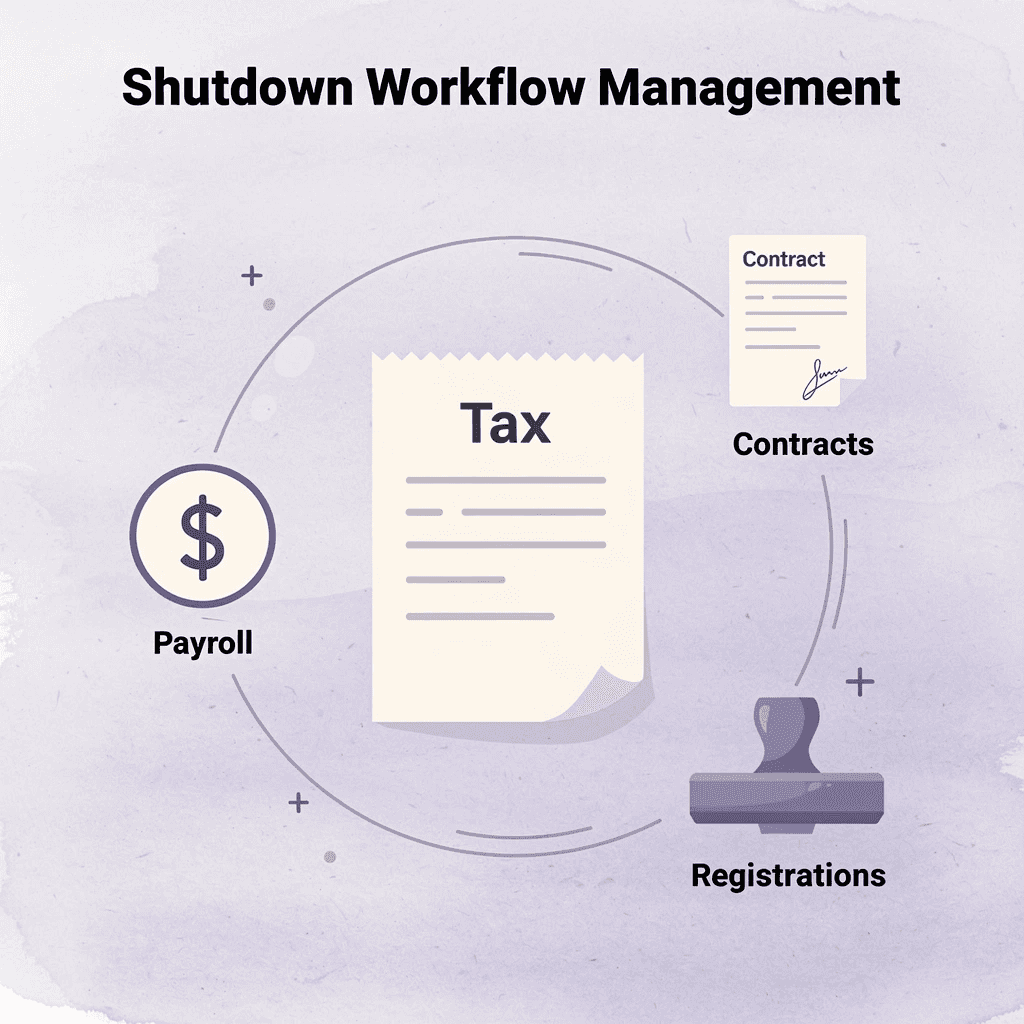
🎯 Key Point: Startup shutdowns involve dozens of interconnected obligations across multiple systems - from federal tax filings to state registrations to vendor contracts. Without a centralized workflow, founders typically miss critical steps that can create long-term liability.
💡 Best Practice: Rather than treating shutdown as a single legal event, Starcycle's approach breaks it into manageable operational steps with clear sequencing and progress tracking. This prevents the overwhelming chaos that leads to incomplete closures.

Why visibility matters during shutdown
The biggest operational risk during a startup shutdown is fragmented coordination across multiple moving pieces, with founders exhausted. A startup may stop operating while payroll accounts remain active, tax filings remain incomplete, software subscriptions continue to renew, or dissolution requirements are only partially resolved. These loose ends often surface later, when founders are already trying to move on professionally and emotionally. Starcycle reduces that uncertainty by bringing dependencies into a clearer operational workflow, helping founders identify what still needs attention before unresolved obligations become lingering problems months later.
What founders actually need during closure
Founders facing shutdowns manage layoffs, investor conversations, personal financial crises, and the emotional toll of closing companies they built over the years. According to the Round Two Podcast episode with Jason Patel, some founders accumulate as much as $250K in debt during the shutdown. This financial and emotional strain complicates coordination: even routine administrative tasks overwhelm founders managing grief, stress, and burnout. Starcycle simplifies and structures the process so founders can focus on what comes next rather than revisiting lingering shutdown problems.
How fragmented systems create ongoing problems
Most shutdown problems occur after founders assume the company has ceased operating. Tax accounts may remain open after filing final returns without being deliberately closed. Vendor contracts continue charging fees. State filings stay incomplete. Documentation requirements go unmet. Platforms like Starcycle help founders organize these dependencies through tailored action plans, contract management, document organization, and step-by-step guidance, enabling them to close one chapter with clarity and move forward faster rather than managing fragmented administrative systems months after shutdown.
The broader value of a structured shutdown
A clean startup shutdown is less about extreme legal complexity and more about coordinated execution during a difficult transition. Starcycle reduces friction by increasing visibility into remaining tasks, organizing them in the proper sequence, and preventing missed administrative steps. Many shutdown problems aren't catastrophic failures but small unresolved obligations that resurface later. Founders who close with clarity and coordination can focus on what comes next rather than revisiting lingering shutdown issues.
But even with structure and visibility, one more step makes the entire process easier.
Related Reading
- Liquidation Vs Bankruptcy
- Close Corporation Taxation
- Llc Termination Vs Dissolution
- Company Liquidation Process
- How Much Does It Cost To Close an LLC
- How To Tell Investors That You're Shutting Down
- How To Dissolve A Partnership With The Irs
- Dissolving In Europe
- Dissolving In Canada
Sign up to Make your Business Closure Process Easier
Get help before problems emerge. Most founders discover gaps only when a collection letter arrives, or a state filing penalty appears months after they believed everything was finished. If you're uncertain whether your startup shutdown is fully resolved across legal, operational, and financial areas, identify unresolved obligations before they become cleanup problems.

💡 Tip: Don't wait for penalties and collection notices to discover what you missed during your business closure process.
Get a quote from Starcycle to receive a structured shutdown workflow review focused on unresolved filings, operational dependencies, and administrative gaps most likely to create lingering issues after closure. Our workflow review identifies what needs resolution, sequences the steps properly, and provides visibility into obligations that often get missed when founders close everything themselves.
"Most founders find gaps only when a collections letter arrives or state filing penalty shows up months after they thought everything was finished." — Business Closure Research, 2024
Closing a startup is not failure—it's a transition. The faster you complete it with structure and precision, the sooner you move forward without unfinished obligations holding you back.

🔑 Takeaway: Professional guidance transforms chaotic closure into systematic completion, preventing future surprises that could impact your next venture.