
How To Dissolve an LLC in Minnesota the Right Way: Full Guide
Dissolve an LLC in Minnesota the right way with Starcycle's step-by-step guide. Avoid penalties and close your business correctly.


Closing an LLC in Minnesota involves more than stopping operations. Owners must file dissolution paperwork with the Minnesota Secretary of State, settle outstanding debts, notify creditors, and handle final tax obligations. Knowing how to dissolve an LLC in Minnesota correctly protects members from lingering legal and financial liability.
Having the right support makes every step more manageable. Starcycle works with LLC owners to handle the details that matter most, from canceling business licenses to distributing remaining assets. For a clear, guided approach to business closure, Starcycle removes the guesswork from start to finish.
Table of Contents
- Most Minnesota LLCs Stay Active Longer Than Owners Expect
- Prepare Your Minnesota LLC Before Filing for Dissolution
- Step-by-Step Process on How To Dissolve An LLC In Minnesota
- The Small Details That Delay Minnesota LLC Closures
- How Starcycle Helps Founders Dissolve an LLC in Minnesota With Confidence
- Sign up to Make Your Business Closure Process Easier
- Frequently Asked Questions About Dissolving an LLC in Minnesota
Summary
- Approximately 52,000 out of 525,000 active Minnesota businesses are expected to change hands or dissolve in the next five to ten years, according to the Center for Rural Policy and Development. Despite how common this transition is, most owners approach it without a structured process. The gap between stopping operations and completing formal dissolution is where penalties, missed filings, and lingering liability tend to accumulate.
- Minnesota recognizes three paths to LLC dissolution: voluntary, administrative termination, and judicial. Voluntary dissolution is the only one where the owner controls the timeline and terms. The other two result from inaction, and neither offers a clean exit. Administrative termination, triggered by missed annual renewals, is fixable but not immediate and not free.
- Minnesota's formal dissolution process involves two separate filings with the Secretary of State, a Statement of Dissolution and a Statement of Termination, not one. Articles of Dissolution must be filed within 90 days of the member vote to dissolve. The filing fee runs $35 by mail, or $55 for expedited in-person processing, and online filings typically process within two to five business days.
- Automatic renewals are one of the most overlooked liabilities in any wind-down. Software subscriptions, domain registrations, and payroll platforms tied to business accounts keep charging after operations stop, often on statements that fewer people actively review. Pulling 12 months of bank and card statements to identify and cancel every recurring charge, with written confirmation stored for each, is a step most founders skip or handle incompletely.
- About 50% of small businesses fail within five years, according to The Kaplan Group, which means dissolution is far more common than most founders anticipate at the time of formation. The ones who close cleanly almost always treated the member authorization step with the same care they gave original formation documents. Verbal agreement among members, even when everyone is aligned, leaves no paper trail to demonstrate that the dissolution followed the Operating Agreement or Minnesota's default rules under Chapter 322C.
- One in three Minnesota businesses cited regulatory burden as a barrier to growth, according to the Minnesota Chamber of Commerce's 2025 State of Business Retention and Expansion report. That burden does not end when an owner decides to close. Tax registrations, assumed name filings, professional licenses, and employer accounts each require independent cancellation on their own timelines, none of which are triggered by the Secretary of State filing alone.
- Starcycle addresses this by providing tailored action plans, contract and subscription tracking, key date alerts, and document organization so founders can move through each closure milestone in the correct sequence without managing all of it from memory.
Most Minnesota LLCs Stay Active Longer Than Owners Expect
Many Minnesota business owners think their LLC automatically closes when they stop operating. But the LLC keeps existing according to the state until the members formally dissolve it through the Minnesota Secretary of State. That gap between "stopped operating" and "legally closed" is where real problems quietly build up.
"The gap between 'stopped operating' and 'legally closed' is where real problems quietly build up: most owners don't realize it until it's too late." — Key Insight
🚨 Warning: Simply stopping operations does not close your LLC in the eyes of Minnesota law. Your business remains legally active and fully liable until you file formal dissolution paperwork with the Minnesota Secretary of State.
🔑 Takeaway: The longer the gap between stopping operations and legally dissolving, the greater your exposure to ongoing fees, compliance requirements, and unexpected legal liability.

What happens if you stop operating without formally dissolving?
Until your LLC is formally dissolved, Minnesota may still expect you to file your annual renewal and remain in good standing. Miss that window, and the Secretary of State can administratively terminate your LLC: a status that is fixable but costly and time-consuming. The difference between stopping operations and completing dissolution is the difference between a clean exit and lingering liability.
Why do so many Minnesota business owners dissolve without a clear process?
According to the Center for Rural Policy and Development, via Post Bulletin, 52,000 of 525,000 active Minnesota businesses are expected to change hands or dissolve within five to ten years. Most owners approach dissolution without a clear process. Closing a company requires the same attention to detail and structure as starting one.
Most owners handle dissolution by gathering information from multiple sources and tracking deadlines informally. A missed business license cancellation, unfiled final tax return, or overlooked creditor claim can surface months after you thought the business was closed. Platforms like Starcycle address this directly by offering tailored action plans, key-date tracking, and document organization, so founders can move through each step of the dissolution process without having to rebuild the checklist from scratch.
Why do so many LLCs stay open by accident?
The failure point is the assumption that doing nothing equals closure. Owners stop paying attention to the LLC once revenue stops, but the state does not operate on that logic. Minnesota law recognizes three paths to dissolution: voluntary, administrative termination, and judicial. Voluntary dissolution is the one you control—members approve the decision, wind up affairs, satisfy creditors, complete final tax filings, and file dissolution documents. The other two paths happen to you, not with you, and neither is as clean.
Why does voluntary dissolution give you the most control?
Voluntary dissolution puts the timeline and terms in your hands. It lets you cancel licenses, close accounts, distribute remaining assets to members, and file the Certificate of Dissolution knowing every prior step was handled correctly. Skipping steps does not make them disappear; they resurface later, often at the worst possible moment.
What catches most owners off guard before filing?
What catches most owners off guard is everything that must happen before a single form gets filed.
Related Reading
- How To Dissolve An Llc In Maine
- How To Dissolve An Llc In Illinois
- How To Dissolve An Llc In Montana
- How To Dissolve An Llc In Virginia
- How To Dissolve An Llc In Arizona
- How To Dissolve An Llc In Indiana
- How To Dissolve An Llc In Wisconsin
- How To Dissolve An Llc In North Carolina
- How To Dissolve An Llc In Georgia
- How To Dissolve An Llc In Pennsylvania
- How To Dissolve An Llc In New York
- How To Dissolve An Llc In New Jersey
- How To Dissolve An Llc In Kentucky
- How To Dissolve An Llc In Arkansas
- How To Dissolve An Llc In Texas
- How To Dissolve An Llc In Colorado
- How To Dissolve An Llc In Missouri
- How To Dissolve An Llc In Tennessee
- How To Dissolve An Llc In California
- How To Dissolve An Llc In Massachusetts
- How To Dissolve An Llc In Michigan
- How To Dissolve An Llc In Florida
- How To Dissolve An Llc In Delaware
Prepare Your Minnesota LLC Before Filing for Dissolution
Your Operating Agreement is the critical starting point for any dissolution. It specifies exactly how members must vote, what notice requirements apply, and how remaining assets get distributed after creditors are paid. Skipping this review risks a dissolution that members can later challenge as improperly authorized — a costly and time-consuming outcome.
"The Operating Agreement is the governing document that controls every major decision in an LLC's lifecycle — including how it ends." — Minnesota Business Law Practitioners
💡 Tip: Pull your Operating Agreement before you take any other dissolution step. The document controls voting thresholds, notice periods, and asset distribution order — all of which must be followed precisely.
⚠️ Warning: Skipping the Operating Agreement review is one of the most common — and most expensive — mistakes Minnesota LLC owners make. A dissolution that wasn't properly authorized by members can be legally challenged and unwound.
Operating Agreement Element | Why It Matters for Dissolution |
|---|---|
Member Vote Requirements | Sets the approval threshold needed to authorize dissolution |
Notice Requirements | Defines how and when members must be formally notified |
Asset Distribution Rules | Governs how remaining assets are divided after creditors are paid |
Creditor Priority | Establishes the order in which debts and obligations are settled |

What "winding up" actually requires
Stop accepting new clients or entering into new contracts once members approve the dissolution. Finish existing work, collect outstanding invoices, and notify all affected parties: employees, vendors, landlords, lenders, and service providers. Each relationship carries its own timeline, and advance notice is both a legal courtesy and practical necessity. Contracts do not dissolve themselves upon closure.
Why is a complete obligation inventory the step most owners miss?
The failure point most owners miss is the inventory step. Before filing anything, build a complete checklist: unpaid debts, active leases, business licenses, recurring software subscriptions, tax accounts at both the federal and Minnesota state level, and physical assets still on the books. Missing one item does not make the obligation disappear; it comes back later, usually with penalties.
Most founders handle this with a spreadsheet, which works until the list grows to thirty line items across six categories. Tracking cancellation deadlines, final payment dates, and document requirements in separate tabs creates gaps easy to miss under pressure. Our business closure platform centralizes contract and subscription management with key date tracking, so nothing falls through while you finish the work itself.
What happens if you file before wind-up is actually finished?
According to Tailor Brands, once you submit dissolution documents to the Minnesota Secretary of State, the process takes 5 to 7 days. This timeline begins only after you complete all prior obligations. Filing before the wind-up is finished does not accelerate closure; it creates a gap between the legal end date and actual completion, during which liability accumulates.
Why does documenting every decision during wind-up matter?
Write down every decision made during this phase. Written meeting minutes or a signed member consent form confirming the dissolution vote serve as proof that the process was properly authorized under your Operating Agreement and the Minnesota Revised Uniform Limited Liability Company Act. If a creditor or former member questions the process, this documentation protects you. Once wind-up is complete and every obligation is accounted for, the filing feels like confirmation rather than a finish line. Knowing what to file, in what order, and what each step triggers is where the process becomes specific enough to catch even prepared owners off guard.
Step-by-Step Process on How To Dissolve An LLC In Minnesota
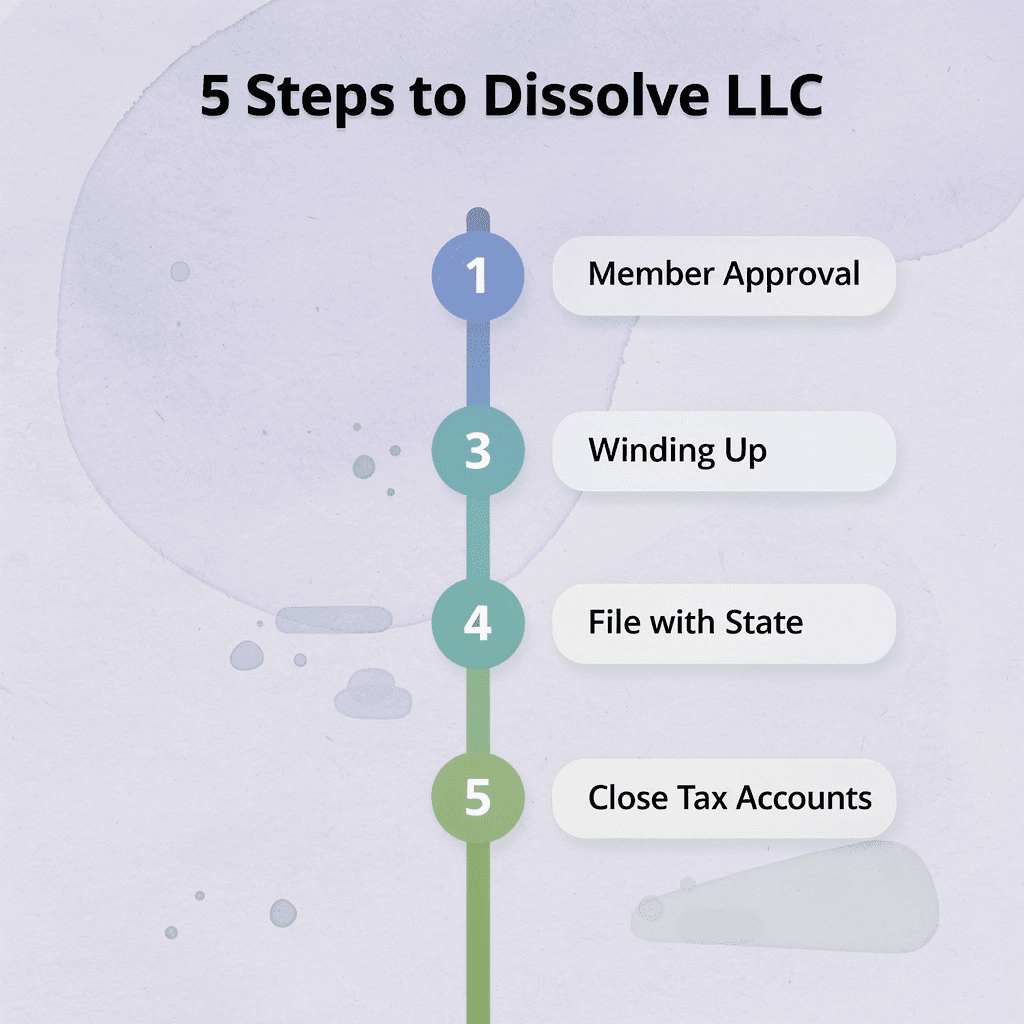
Formal dissolution in Minnesota follows five steps in order: member approval, winding up, filing with the Secretary of State, closing tax accounts, and canceling licenses. Skipping steps or changing the sequence creates serious problems that surface months later.
"Dissolution done out of order isn't just inconvenient — it can leave personal liability exposure and unresolved tax obligations that follow members long after the LLC is gone."
Step | Action Required | Why It Matters |
|---|---|---|
1. Member Approval | Vote to dissolve per operating agreement | Establishes legal authority to proceed |
2. Winding Up | Settle debts, liquidate assets | Protects members from creditor claims |
3. File with Secretary of State | Submit Articles of Dissolution | Official legal termination of the LLC |
4. Close Tax Accounts | File final returns, cancel EIN usage | Prevents future tax liability |
5. Cancel Licenses | Revoke permits and business licenses | Avoids ongoing fees and penalties |
🎯 Key Point: The sequence matters as much as the steps themselves — completing step 3 before step 2, for example, can expose members to personal liability for unsettled debts.
⚠️ Warning: Skipping the tax account closure step is one of the most common and costly mistakes Minnesota LLC owners make — the IRS and Minnesota Department of Revenue can continue to assess fees and penalties against a dissolved entity if accounts aren't properly closed.
Step 1: Approve the Dissolution
Start with your Operating Agreement: it controls voting requirements, whether written consent replaces a formal meeting, and documentation. If silent on dissolution, Minnesota's Revised Uniform Limited Liability Company Act (Chapter 322C) requires affirmative consent from all members unless your agreement specifies otherwise. Produce written minutes or a signed consent form and date it. That document is the legal starting point for everything that follows.
Step 2: Wind Up the LLC's Affairs
Approval starts the wind-up period, during which you collect money owed to you, pay creditors, resolve any open disputes, and distribute the remaining assets to members per your Operating Agreement. Minnesota law requires creditors be paid before members receive anything. After settling financial obligations, close bank accounts, cancel business credit cards, and terminate all recurring subscriptions—accounting software, cloud storage, and others. Most founders underestimate how many active services continue billing a dormant business.
Why do wind-up tasks so often slip through the cracks?
The failure point is usually tracking. Most founders manage wind-up through email threads, spreadsheets, and memory, which fails when cancellation deadlines slip or vendors keep charging after closure. Our business closure platform centralizes contract management, subscription tracking, and key date reminders in one place, preventing oversights during final weeks.
Step 3 File With the Minnesota Secretary of State
Minnesota requires two separate filings: a Statement of Dissolution (signaling wind-up) and a Statement of Termination (legally ending the LLC). According to Dougherty, Molenda, Solfest, Hills & Bauer P.A., Articles of Dissolution must be filed within 90 days of the dissolution decision. The filing fee is $35 by mail or $55 for expedited in-person processing at the Secretary of State's Saint Paul office; online filings typically process within two to five business days. The LLC remains active until the Statement of Termination clears.
What do you need to do to close tax accounts and cancel licenses?
Filing dissolution paperwork does not close your tax accounts. You still need to file a final federal return marked as your last, submit any outstanding Minnesota business tax returns, close your Minnesota Department of Revenue accounts, and file final payroll and sales tax returns if either applied to your business. Skipping this step causes dissolved LLCs to accumulate penalties long after the owner has moved on.
After taxes are settled, work through every license and registration tied to the business: local permits, assumed names (DBAs), professional licenses, sales tax permits, and employer registrations. The Secretary of State filing does not handle these. Each requires its own cancellation with its own timeline. The formal filings often proceed smoothly, while smaller administrative details create friction that outlasts the closure itself.
Related Reading
- How To Dissolve An Llc In South Dakota
- How To Dissolve An Llc In Ohio
- How To Dissolve An Llc In Maryland
- How To Dissolve An Llc In Utah
- How To Dissolve An Llc In West Virginia
- How To Dissolve An Llc In Connecticut
- How To Dissolve An Llc In Oklahoma
- How To Dissolve An Llc In Louisiana
- How To Dissolve An Llc In Nevada
- How To Dissolve An Llc In Hawaii
- How To Dissolve An Llc In Mississippi
- How To Dissolve An Llc In North Dakota
- How To Dissolve An Llc In Iowa
- How To Dissolve An Llc In Washington State
- How To Dissolve An Llc In Idaho
- How To Dissolve An Llc In Vermont
- How To Dissolve An Llc In South Carolina
- How To Dissolve An Llc In Rhode Island
- How To Dissolve An Llc In New Hampshire
- How To Dissolve An Llc In North Carolina
- How To Dissolve An Llc In Oregon
The Small Details That Delay Minnesota LLC Closures
Small administrative details create liability that follows you long after you've mentally moved on from the business.
"Small administrative details create liability that follows you long after you've mentally moved on from the business."
⚠️ Warning: Assuming your obligations disappear when you stop operating is one of the most costly mistakes Minnesota LLC owners make during closure.

The failure point is usually specificity. Most founders know they need to "close accounts" and "cancel things," but that vague awareness doesn't survive contact with a 12-item checklist spread across six different agencies. According to The Kaplan Group, approximately 36 million small businesses operate across the United States, and the administrative infrastructure built to support them — tax permits, employer registrations, professional licenses, assumed names — doesn't dissolve itself when a business stops operating. Each registration was opened independently. Each one closes independently.
Registration Type | Closes Automatically? | Action Required |
|---|---|---|
Tax Permits | ❌ No | Must cancel with state agency |
Employer Registrations | ❌ No | Must file separately |
Professional Licenses | ❌ No | Must notify licensing board |
Assumed Names (DBAs) | ❌ No | Must withdraw independently |
🔑 Takeaway: With 36 million small businesses in the U.S., the agencies managing their registrations are built for volume — not for automatically detecting when your business has stopped. Every account you opened requires its own deliberate closure.
💡 Tip: Before you begin the LLC dissolution process, build a complete inventory of every registration, permit, and license your business holds. A vague plan to "cancel things" will leave loose ends that create real legal exposure.
The accounts that keep charging after you stop looking
Automatic renewals are a quiet problem in any dissolution. A software subscription tied to a business debit card, a domain renewal set to auto-pay, a payroll platform still billing a monthly base fee—these charges don't announce themselves. They accumulate on statements fewer people check until someone reconciles the account months later. Pull every bank and card statement from the past 12 months, flag every recurring charge, and cancel each one with written confirmation you can store. That documentation matters if a vendor disputes the cancellation or continues billing.
Why does working from memory fail for vendor cancellations?
Most founders handle this by working from memory, trusting themselves to remember every vendor relationship. That works for five vendors but breaks down fast for fifteen. Starcycle tracks active contracts and subscriptions in an organized way, flagging renewal dates and cancellation windows so nothing slips through while you focus on larger filing requirements.
Why does written authorization protect members during dissolution?
A verbal agreement among members isn't enough, even when everyone agrees. Without written consent or documented meeting minutes authorizing dissolution, you lack a paper trail showing the decision followed your Operating Agreement or Minnesota's default rules under Chapter 322C. This gap becomes problematic if a creditor later challenges the dissolution or a member's position changes. The Kaplan Group reports that about 50% of small businesses fail within five years, making dissolution far more common than most founders anticipate. The ones who close cleanly almost always treated the authorization step with the same care they gave their original formation documents.
Why does asset distribution order matter for member liability?
One detail that slows down closures: distributing assets before paying all creditor debts. Minnesota law is clear about the order: creditors get paid before members. Skipping that order exposes members to personal liability that the LLC structure was designed to prevent. Getting this right means finishing with the same care and thought you put into starting.
How Starcycle Helps Founders Dissolve an LLC in Minnesota With Confidence
Starcycle exists because the dissolution process has a real design flaw: the legal framework tells you what to file, but not how to manage everything else at the same time. Minnesota's formal requirements are only one layer of a much more complex wind-down. The founders who close cleanly aren't the ones who worked harder — they're the ones who had a clearer picture of the whole board.
"The legal framework tells you what to file, but not how to manage everything else at the same time — and that gap is where most dissolutions go wrong." — Starcycle
🎯 Key Point: Filing your Articles of Dissolution is just the beginning. A truly clean close means managing taxes, contracts, creditors, and compliance in parallel — not as an afterthought.
💡 Tip: Founders who approach dissolution with a full-picture strategy — not just a legal checklist — are the ones who avoid costly surprises and close with confidence.
What Minnesota's Framework Tells You | What It Doesn't Tell You |
|---|---|
Which forms to file | How to sequence every step |
State fees and deadlines | How to manage creditors simultaneously |
Registered agent requirements | How to handle outstanding contracts |
Tax clearance obligations | How to protect founders from liability |

Why does sequencing cause so many founders to miss critical steps?
The failure point is usually sequencing. Most founders approach dissolution as a to-do list, checking off tasks as they arise rather than following a structured order. Creditor notifications get delayed because member vote documentation isn't ready. Tax clearance gets overlooked because focus shifts to filing Articles of Dissolution with the Secretary of State. According to LLC Dojo's 2025 guide on dissolving an LLC in Minnesota, the state filing fee is $35, which makes it tempting to treat the paperwork as the finish line when it's one checkpoint on a longer path.
When does a simple checklist stop being enough to close cleanly?
Managing the wind-down through memory, email threads, and a rough checklist works for simple businesses. When vendor contracts, recurring software subscriptions, state tax registrations, assumed name filings, and employee-related accounts run simultaneously, the checklist approach misses things—not from the founder's incapacity, but because the system cannot handle that level of parallel complexity. Platforms like Starcycle address this directly by providing tailored action plans, contract and subscription tracking, key-date alerts, and document organization, so founders can move through each closure milestone in the right order.
How does having visible obligations change the experience of dissolving an LLC?
What that kind of structure changes is how closing feels emotionally. According to the Minnesota Chamber of Commerce's 2025 State of Business Retention and Expansion report, 1 in 3 Minnesota businesses said regulatory burden hindered growth. That burden doesn't disappear during closing; it persists through compliance requirements, cancellation deadlines, and tax obligations, each with their own timeline. When you track these obligations, the process shifts from reactive to intentional, where confidence emerges.
What makes the difference between closing an LLC and actually being finished?
Finishing a business well is a skill, and like most skills, it's easier with the right tools and sequence. Starcycle was built by founders who have personally experienced shutdown, so the guidance reflects what actually trips people up, not just what the laws require. The legal and operational requirements of dissolution are not the same. Closing an LLC in Minnesota isn't difficult, but missed steps often surface weeks or months later, long after you thought you were done. For most founders, that realization is what separates closing from actually being finished.
Sign up to Make Your Business Closure Process Easier
The difference between closing and being finished is knowing what you missed before it shows up later. A first-session wind-down review with Starcycle gives you a clear picture of every open item: outstanding tax accounts, license cancellations, and creditor obligations before you file your Articles of Dissolution with the Minnesota Secretary of State.
"The gap between thinking you're done and actually being done is where costly surprises hide: outstanding obligations, unfiled cancellations, and missed deadlines that follow you into your next chapter." — Starcycle
💡 Tip: Don't wait until after filing to discover what you missed. A wind-down review catches open items early, when they're still fixable.
⚠️ Warning: Skipping a structured closure review before filing your Articles of Dissolution can leave you personally liable for unresolved tax accounts, active licenses, and outstanding creditor obligations.
Sign up for a personalized quote and get a structured roadmap that identifies filing gaps, flags pending obligations, and sequences your closure tasks in the right order. Close with confidence, knowing the next chapter starts clean.
What Starcycle Covers | Why It Matters |
|---|---|
Outstanding tax accounts | Prevents unexpected liability after closure |
License cancellations | Avoids ongoing fees and compliance penalties |
Creditor obligations | Ensures a legally clean dissolution |
Filing gap identification | Catches missed steps before they become problems |
Task sequencing | Closes in the right order, not just any order |
🎯 Key Point: A personalized closure roadmap doesn't just list what needs to be done—it sequences your tasks in the correct order, so nothing falls through the cracks.
✅ Best Practice: Sign up for a structured wind-down review before filing your dissolution paperwork. Starting your next chapter clean means finishing your last one completely.
Frequently Asked Questions About Dissolving an LLC in Minnesota
How long does it take to dissolve an LLC in Minnesota?
The overall timeline depends on how long it takes you to wind up your LLC's affairs, including paying creditors, resolving tax obligations, and distributing remaining assets. Once you're ready to file, online and in-person filings with the Minnesota Secretary of State are typically processed faster than mailed filings. Keep in mind that for LLCs governed by Chapter 322C, filing a Statement of Dissolution begins the dissolution process, but the LLC is not fully terminated until you file a Statement of Termination after winding up is complete.
How much does it cost to dissolve an LLC in Minnesota?
For domestic LLCs governed by Chapter 322C, the filing fees are:
$35 if you file by mail.
$55 if you file online or in person.
These fees apply to both the Statement of Dissolution and the Statement of Termination, so businesses that must file both documents should plan accordingly.
Can I dissolve a Minnesota LLC online?
Yes. Minnesota allows LLCs to file dissolution documents online through the Minnesota Secretary of State's online business filing system. You may also submit the required forms by mail or file them in person at the Secretary of State's Business Services office.
Do I Have to Pay Taxes Before Dissolving My Minnesota LLC?
Yes. Before closing your LLC, you should file your final federal and Minnesota tax returns, pay any outstanding taxes, submit your final employer withholding and payroll tax filings if you had employees, file your final sales and use tax return if applicable, and close your tax accounts with the Minnesota Department of Revenue.
What Happens if I Stop Operating but Never Dissolve My Minnesota LLC?
Simply stopping business operations does not legally close your LLC. Until you formally dissolve and terminate the company, it remains on record with the Minnesota Secretary of State and may still be required to file annual renewals and meet other compliance obligations. Failing to do so can result in the LLC's administrative termination.
Can Creditors Still Pursue a Dissolved Minnesota LLC?
Yes. Dissolving your LLC does not eliminate legitimate debts or legal obligations. Creditors may still pursue claims that arose before the LLC was dissolved. That's why Minnesota law requires the LLC to wind up its affairs and satisfy creditor claims before distributing remaining assets to members.
Can I Reinstate a Dissolved Minnesota LLC?
If your LLC was administratively terminated for failing to file its annual renewal or comply with state requirements, you may generally reinstate it by filing the required reinstatement documents, submitting any overdue annual renewals, and paying the applicable reinstatement fee. However, if your LLC was voluntarily dissolved, reinstatement is generally unavailable. In that situation, you'll typically need to form a new LLC if you want to operate again.