
How to Dissolve an LLC in Connecticut Without Costly Mistakes
Dissolve an LLC in Connecticut the right way with Starcycle. Step-by-step guide covering costs, filings, and deadlines.


Closing an LLC in Connecticut requires more than a decision to stop operating. Owners must file specific forms, settle outstanding debts, notify the state, and cancel licenses and tax accounts before the process is legally complete. Skipping any of these steps can leave the business exposed to penalties or ongoing liability.
Knowing how to dissolve an LLC in Connecticut correctly saves time and protects owners from costly oversights. Starcycle guides LLC owners through every stage of business closure, from filing the Certificate of Dissolution with the Connecticut Secretary of State to closing out remaining obligations cleanly.
Table of Contents
- Most Connecticut LLCs Stay Active Longer Than Owners Expect
- Prepare Your Connecticut LLC Before Filing for Dissolution
- Step-by-Step Process on How To Dissolve An LLC In Connecticut
- The Small Details That Delay Connecticut LLC Closures
- How Starcycle Helps Founders Dissolve an LLC in Connecticut With Confidence
- Sign up to Make Your Business Closure Process Easier
- Frequently Asked Questions About Dissolving an LLC in Connecticut
Summary
- Connecticut LLCs remain legally active until a Certificate of Dissolution is formally filed with the Secretary of the State, regardless of how long the business has been inactive. Annual report deadlines continue to arrive, late fees accumulate, and the state may eventually declare the LLC's authority forfeited, creating a separate administrative problem to resolve. The state has no mechanism to detect inactivity and offers no grace period based on it.
- Connecticut saw annual net business formations triple from 13,847 in 2010 to 44,146 in 2024, according to CTData. That growth means inactive LLCs that were never formally dissolved quietly accumulate alongside new registrations, each one still technically subject to annual report filings and state compliance obligations.
- There are three dissolution paths available in Connecticut: voluntary, administrative forfeiture, and judicial. Voluntary dissolution is the only path that gives owners control over the timeline and sequence of steps. The other two happen to the business owner rather than being initiated by them, often with fewer options for managing outstanding obligations.
- Connecticut law requires a minimum 90-day wind-up period for creditor claims, according to UpCounsel's guide to dissolving an LLC in Connecticut. Creditors must be paid before any assets are distributed to members, and rushing this stage creates legal risk rather than just administrative inconvenience. The wind-up phase is where most closures run into problems, not the final filing.
- Filing the Certificate of Dissolution does not close federal or state tax accounts, cancel trade name registrations, or withdraw local business licenses and permits. Each of those accounts and registrations has its own agency, cancellation process, and timeline. The Connecticut Business Portal notes there are two distinct types of dissolution notices that business owners must respond to separately, making the paperwork burden more layered than most founders anticipate.
- The Certificate of Dissolution carries no filing fee for domestic Connecticut LLCs, but reinstating a business that was forfeited rather than properly dissolved, resolving tax accounts that were never formally closed, or unwinding vendor contracts that kept billing after operations stopped all carry real financial costs that organized closure avoids. Starcycle addresses this by providing a guided shutdown platform with tailored action plans, contract and subscription tracking, and document organization built around the actual sequence of closure.
Most Connecticut LLCs Stay Active Longer Than Owners Expect
Connecticut LLCs don't close themselves. The state has no way to tell when you've stopped operating. Until a Certificate of Dissolution is filed with the Connecticut Secretary of State, your LLC exists as a legal entity with active obligations, regardless of whether it has earned a dollar in years.
"Until a Certificate of Dissolution is filed with the Connecticut Secretary of the State, your LLC exists as a legal entity with active obligations, regardless of whether it has earned a dollar in years."
🚨 Warning: Many owners assume that stopping operations closes their LLC—it does not. Your legal obligations remain active until dissolution is formally filed.
💡 Tip: If you've stopped doing business, filing a Certificate of Dissolution is the only way to eliminate your LLC's ongoing state obligations.

The numbers matter. According to CTData and the Connecticut Secretary of State, annual net business formations in Connecticut tripled — from 13,847 in 2010 to 44,146 in 2024. Inactive LLCs that were never formally dissolved pile up in the state's registry, each still technically required to file annual reports and follow state rules.
Year | Annual Net Business Formations |
|---|---|
2010 | 13,847 |
2024 | 44,146 |
Growth | 3x increase |
🔑 Takeaway: A 3x surge in business formations over 14 years means the number of potentially dormant, undissolved LLCs in Connecticut's registry is larger than ever — and every single one carries active filing obligations.
What actually happens when owners let an LLC linger?
Most owners let their LLC sit dormant because closing a business feels final and the paperwork seems unimportant. They assume the state will eventually handle it. Instead, annual report deadlines keep arriving, late fees accumulate, and the Secretary of State may declare the LLC's authority forfeited, creating a separate administrative problem if you ever need to formally close the record.
Which dissolution path puts you in control of the outcome?
The three dissolution paths available in Connecticut—voluntary, administrative forfeiture, and judicial—are not equally positioned. Voluntary dissolution is the only option that puts you in control of the timeline, the sequence of steps, and the resolution of outstanding obligations. The other two happen to you. Founders who treat closure as a structured process reach a cleaner finish with fewer surprises and no lingering compliance exposure. Our business closure platform addresses this gap by replacing the scattered, self-managed approach with a guided sequence that tracks key dates, organizes required documents, and ensures nothing critical is missed before the Certificate of Dissolution is filed.
Why does the gap between stopping operations and dissolving legally matter?
The difference between stopping operations and legally dissolving your LLC is significant. It is the difference between being done and being legally done, and these two situations have different consequences. Connecticut has no grace period for inactivity, and the state has no obligation to inform you that your compliance clock is still running. The dissolution process has a specific order of operations; skipping steps or completing them out of sequence can delay closure or expose members to personal liability.
Related Reading
- How To Dissolve An Llc In Wisconsin
- How To Dissolve An Llc In Delaware
- How To Dissolve An Llc In Massachusetts
- How To Dissolve An Llc In Arkansas
- How To Dissolve An Llc In Kentucky
- How To Dissolve An Llc In Illinois
- How To Dissolve An Llc In Georgia
- How To Dissolve An Llc In New York
- How To Dissolve An Llc In Virginia
- How To Dissolve An Llc In Maine
- How To Dissolve An Llc In Florida
- How To Dissolve An Llc In California
- How To Dissolve An Llc In Missouri
- How To Dissolve An Llc In North Carolina
- How To Dissolve An Llc In Michigan
- How To Dissolve An Llc In New Jersey
- How To Dissolve An Llc In Texas
- How To Dissolve An Llc In Tennessee
- How To Dissolve An Llc In Indiana
- How To Dissolve An Llc In Pennsylvania
- How To Dissolve An Llc In Arizona
- How To Dissolve An Llc In Colorado
- How To Dissolve An Llc In Montana
Prepare Your Connecticut LLC Before Filing for Dissolution
The order of operations matters. Filing is one step, but preparing to file cleanly takes longer and requires more planning than most owners expect.

What does your Operating Agreement require before dissolving?
Your Operating Agreement is the governing document for how your LLC closes. Connecticut's Uniform Limited Liability Company Act provides a legal floor, but your Operating Agreement can raise that floor with specific voting thresholds, notice requirements, and asset distribution rules. If it requires a supermajority vote to dissolve or written notice to members 30 days in advance, those requirements are legally binding regardless of how informal your LLC has been in practice.
How should you properly document the dissolution vote?
Once you know what the agreement requires, hold the vote and document it properly. Written meeting minutes or a signed consent form that records the date and outcome of the dissolution vote protect every member if a dispute arises over whether the closure was legitimate.
Clear your obligations before you file anything
The failure point in most Connecticut LLC closures is not the paperwork: it's the gap between approving dissolution and resolving what the business still owes. Outstanding invoices, active leases, vendor contracts, software subscriptions, and open tax accounts remain attached to the LLC until addressed. Creating a written inventory of all open obligations before filing provides a working checklist and prevents issues from surfacing after closure.
Why do missed obligations create problems after closure?
Most founders handle this through spreadsheets, email threads, and memory. A missed subscription or unresolved vendor agreement can reopen liability questions months later. Our business closure platform tracks open contracts, subscriptions, and key dates in one place, eliminating gaps between the decision to close and the actual closure.
What does the actual Connecticut filing process look like?
When you are ready to file, the state process is straightforward. According to the CT Business Portal, only one filing is required to dissolve an LLC in Connecticut, with a $50 filing fee. The simplicity of this final step can mislead founders: a single form and modest fee suggest the entire process is equally simple, when the filing represents only the last five minutes of a much longer process. Once preparation is complete and all obligations are resolved, the filing is almost anticlimactic. Getting to that point cleanly, with documentation in order and no loose ends, separates a closure that holds up from one that keeps pulling you back in.
Step-by-Step Process on How To Dissolve An LLC In Connecticut
The filing sequence is straightforward, but order matters: skipping steps or completing them out of order can leave your LLC legally exposed even after you believe it's closed.
[IMAGE: https://im.runware.ai/image/os/a06dlim3/ws/3/ii/42b28c2d-c74a-4b74-9795-de6139f0679b.webp] Alt: Shield protecting an LLC from legal exposure during dissolution
"Skipping steps or completing them out of order can leave your LLC legally exposed even after you think it's closed." — Critical Dissolution Warning
💡 Tip: Always follow the exact filing sequence when dissolving your Connecticut LLC. Each step builds on the last, and missing even one can create serious legal and financial liability down the road.
⚠️ Warning: Do not assume your LLC is closed just because you've stopped operating. Official dissolution paperwork must be filed in the correct order to be legally recognized by the state of Connecticut.
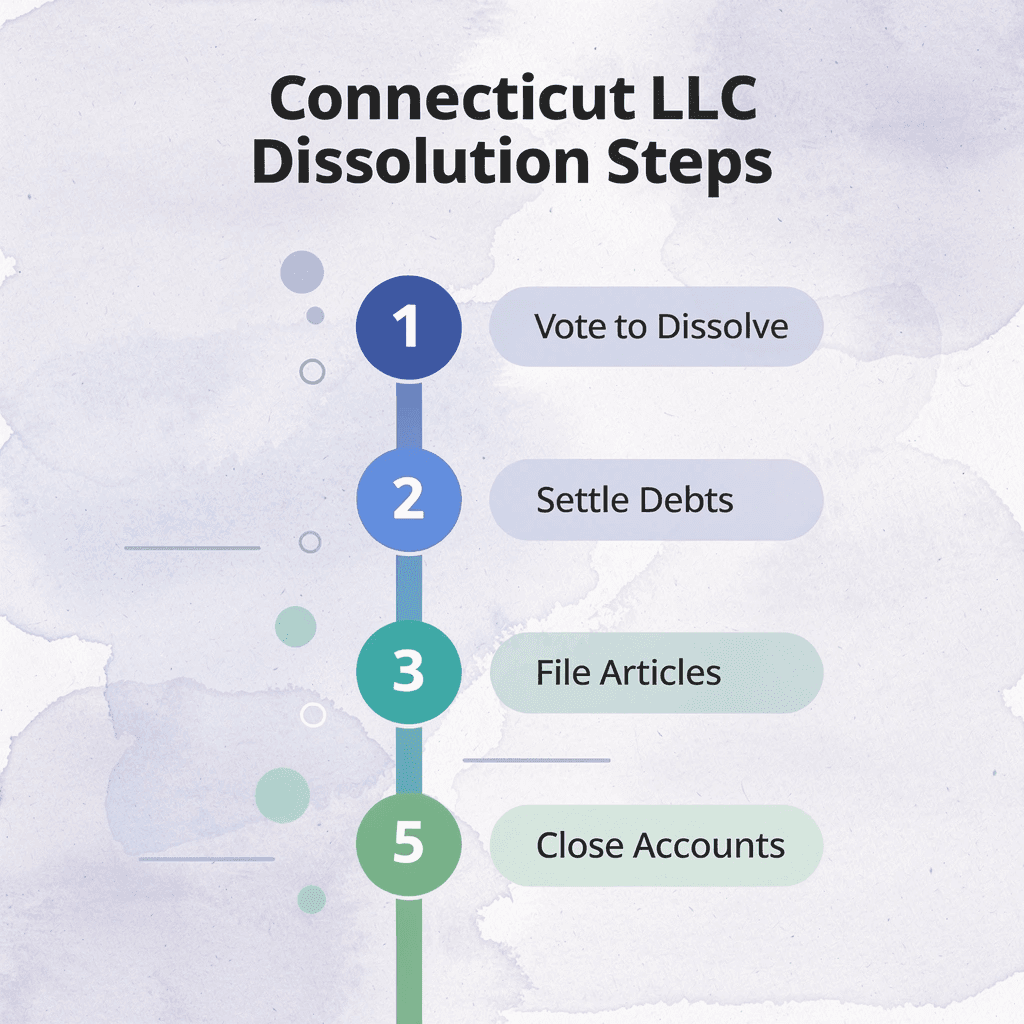
Step | Action Required | Why It Matters |
|---|---|---|
1 | Vote to dissolve & document decision | Establishes legal authority to proceed |
2 | Settle all debts & obligations | Protects members from personal liability |
3 | File Articles of Dissolution with the state | Officially closes the LLC in Connecticut |
4 | Cancel licenses, permits & registrations | Prevents ongoing fees and legal exposure |
5 | Notify the IRS & close tax accounts | Ensures full tax compliance after closure |
Step 1: Approve the Dissolution
Start with your Operating Agreement, which governs the dissolution vote threshold, whether written consent can substitute for a formal meeting, and how the decision is documented. If silent, Connecticut's default rule under Conn. Gen. Stat. § 34-267 requires majority consent from members by interest. Document the outcome in writing, record the date, and file it with your company records to protect all members if questions arise later.
Step 2: Wind Up the Business
Approval allows closure but doesn't finish it. The wind-up period involves collecting money owed to you, paying creditors in the order required by law, resolving any outstanding disputes, selling or distributing any remaining assets, and terminating all ongoing contracts and subscriptions. According to UpCounsel's guide to dissolving an LLC in Connecticut, Connecticut law requires a minimum 90-day wind-up period for creditor claims. Pay creditors before distributing anything to members; Connecticut law makes this priority clear.
Why do spreadsheet checklists fall short during wind-up?
Most founders use spreadsheet checklists, which fail once lists exceed twenty items and deadlines overlap. Subscriptions get missed, vendor termination windows close, and key dates slip. Our platform built for business closure tracks contract deadlines, manages cancellation workflows, and organizes documentation in one place, preventing costly oversights during this critical phase.
Step 3: File the Certificate of Dissolution
File your Certificate of Dissolution with the Connecticut Secretary of State through the Concord Business Services portal, by mail, or in person at 165 Capitol Avenue in Hartford. Include your LLC's legal name, a dissolution statement, and the signature of an authorized person. There is no filing fee for domestic Connecticut LLCs, and dissolution takes effect immediately upon online submission unless you specify a future effective date.
Step 4: Close Tax Accounts and Cancel Registrations
Filing the Certificate of Dissolution does not close your federal or state tax accounts. You must file final federal and Connecticut income tax returns marked as final, submit outstanding payroll and sales tax returns, and formally close accounts with the Connecticut Department of Revenue Services. If your LLC had employees, notify the Connecticut Paid Leave Authority and Department of Labor of the closure. Cancel all remaining licenses, permits, trade name registrations, and employer registrations outside of the Secretary of State's records, as the dissolution certificate does not affect them. Even founders who follow every step correctly sometimes encounter unexpected delays.
The Small Details That Delay Connecticut LLC Closures
The problems people don't expect rarely come from the big filings. They come from overlooked administrative threads: annual report obligations left unresolved, tax accounts left open, and recurring vendor charges nobody canceled. Each is small on its own. Together, they can stretch a clean closure into months of back-and-forth with agencies unaware you intended to shut down.
"The problems people don't expect rarely come from the big filings — they come from overlooked administrative threads that can stretch a clean closure into months of back-and-forth."
⚠️ Warning: Annual report obligations, open tax accounts, and uncanceled vendor charges are the silent delay triggers most LLC owners never see coming — until the closure is already stalled.
Common Delay Trigger | Why It Causes Problems |
|---|---|
Annual report obligations | Agencies flag the LLC as non-compliant, blocking dissolution |
Open tax accounts | State tax authorities require formal closure before releasing the entity |
Recurring vendor charges | Active billing signals the business is still operating to third parties |
💡 Tip: Before filing anything, audit every open administrative thread — even the ones that seem minor. A single unresolved account can add weeks or months to an otherwise clean Connecticut LLC closure.

The annual report problem nobody flags in time
Connecticut requires every LLC to file an annual report to maintain good standing with the Secretary of State. Overdue reports persist even after you file your Certificate of Dissolution; the Secretary of State can flag your business for compliance issues, slowing the dissolution process. Resolve all outstanding annual report filings before submitting your dissolution documents, as the state's records must show an active, compliant business until you formally close it.
Why tax accounts outlive the business
Filing your Certificate of Dissolution does not close your federal Employer Identification Number account, your Connecticut sales and use tax permit, or your employer registration with the Department of Labor. These accounts remain open until you file final returns, pay any remaining balances, and submit closure requests to each agency. According to the Connecticut Business Portal's "Closing Your Business" guide, business owners must respond to 2 distinct types of dissolution notices separately when closing a Connecticut LLC. Leaving any of these accounts open creates a paper trail of obligations that can surface months after you believed the business was closed.
How do you track multiple agency deadlines without missing a closure?
Most founders manage this with a spreadsheet, but tracking multiple agencies with different deadlines and forms quickly becomes unreliable. Platforms built for business closure address this directly, using structured action plans and key date tracking to ensure every tax account, permit, and vendor contract gets flagged for closure at the right time.
The subscriptions that keep charging after the doors close
The failure point is usually the recurring charge nobody thought to check. Software subscriptions, website hosting, payroll platforms, and marketing tools all renew automatically, and most vendors won't refund charges once a billing cycle starts. Check every recurring payment tied to your business accounts before closing them, and cancel each service in writing to keep records. Leaving business bank accounts open to "catch any final charges" often backfires by creating a window for unauthorized activity and unexpected fees that complicate final account reconciliation.
What the Certificate of Dissolution actually covers
The Certificate of Dissolution ends your LLC's legal existence with the Secretary of State but does not affect your trade name registration, local business license, professional permits, or industry-specific certifications filed with other state or municipal agencies. According to CTData's analysis of Connecticut business activity trends, the state's dashboard tracks business formations, closures, and net growth from 2010 to 2025 at the state, regional, and town levels. Each license and permit has its own cancellation process, agency, and timeline, and none communicate with the Secretary of State on your behalf.
Knowing which details can derail a clean closure is only half the challenge.
How Starcycle Helps Founders Dissolve an LLC in Connecticut With Confidence
Most founders approach Connecticut LLC dissolution by gathering documents when the deadline arrives, figuring out the sequence as they go, and hoping nothing slips through. According to UpCounsel, LLCs must file the Certificate of Dissolution within 90 days of the dissolution vote. During that time, multiple tasks happen simultaneously and demand attention: creditor notices, tax account closures, contract cancellations, license withdrawals, and final distributions to members.
"LLCs must file the Certificate of Dissolution within 90 days of the dissolution vote — while managing creditor notices, tax closures, and member distributions at the same time." — UpCounsel
Dissolution Task | Why It Matters |
|---|---|
Certificate of Dissolution | Must be filed within 90 days of vote |
Creditor Notices | Required to legally close outstanding obligations |
Tax Account Closures | Prevents future penalties and liability |
Contract Cancellations | Ends ongoing legal commitments |
License Withdrawals | Avoids fees for lapsed or active permits |
Final Member Distributions | Completes financial obligations to all members |
🔑 Takeaway: With 90 days on the clock and at least 6 concurrent task categories to manage, the margin for error is far smaller than most founders expect.

The critical difference between a clean closure and a drawn-out one is structure, not knowledge. Founders who close well keep every open task, deadline, and completed step in one place. Founders who struggle manage the same process across email threads, sticky notes, and memory: a system that fails quietly at thirty tasks.
💡 Tip: Treat your dissolution checklist as a living document. Update it in real time as tasks are completed, not after the fact.
⚠️ Warning: Managing 30+ concurrent closure tasks across scattered tools isn't inefficient. It's a direct path to missed deadlines and lingering legal liability.
What does Starcycle provide to guide the dissolution process?
Starcycle removes that friction by providing a guided shutdown platform with tailored action plans, contract and subscription management, key date tracking, and document organization specific to how a business was built. Our platform was created by founders who have personally closed companies, so the workflow reflects the real sequence of closure, not the legal minimum. Founders can identify outstanding obligations, track progress from preparation through filing, and move through each required step in the correct order.
Why does organized closure reduce financial risk for Connecticut founders?
The Connecticut Secretary of State charges a $120 filing fee to dissolve an LLC. Founders often overlook the cost of incomplete closure: restarting a business that was taken away, fixing tax accounts never formally closed, or ending vendor contracts that continued charging after shutdown. Organized records and a clear timeline reduce stress and financial risk. Closing a business deserves careful consideration. Founders who finish cleanly carry less into whatever comes next—whether a new venture, a career change, or simply the relief of having nothing unresolved. That outcome is available to anyone who approaches the wind-down with the same intentionality they brought to building the company.
Related Reading
- How To Dissolve An Llc In Iowa
- How To Dissolve An Llc In Nevada
- How To Dissolve An Llc In South Carolina
- How To Dissolve An Llc In Hawaii
- How To Dissolve An Llc In Rhode Island
- How To Dissolve An Llc In Minnesota
- How To Dissolve An Llc In Vermont
- How To Dissolve An Llc In Ohio
- How To Dissolve An Llc In New Hampshire
- How To Dissolve An Llc In South Dakota
- How To Dissolve An Llc In Louisiana
- How To Dissolve An Llc In Maryland
- How To Dissolve An Llc In West Virginia
- How To Dissolve An Llc In Mississippi
- How To Dissolve An Llc In Utah
- How To Dissolve An Llc In Oklahoma
- How To Dissolve An Llc In North Carolina
- How To Dissolve An Llc In Washington State
- How To Dissolve An Llc In Idaho
- How To Dissolve An Llc In North Dakota
- How To Dissolve An Llc In Oregon
Sign up to Make Your Business Closure Process Easier
Treating closure as a project means finishing with the same care you started with. Our personalized review from Starcycle identifies outstanding tasks before they become filing delays, flagging critical gaps in your tax accounts, annual report history, or creditor notices before you submit your Certificate of Dissolution.
💡 Tip: Unresolved gaps in your filing history are the most common reason LLC closures get delayed or rejected by the state.
"Treating closure as a project means every outstanding task, filing gap, and creditor notice is caught before it becomes a costly delay." — Starcycle
⚠️ Warning: Submitting your Certificate of Dissolution with unresolved tax accounts or missing annual reports can result in significant penalties and processing setbacks.

Sign up for a first-session wind-down review and get a clear roadmap built around your specific situation. A structured path to closing your Connecticut LLC cleanly, completely, and on your own terms.
✅ Best Practice: A personalized wind-down review ensures your closure is handled with zero loose ends — covering every filing requirement so you can move forward with full confidence.
What You Get | Why It Matters |
|---|---|
Personalized closure roadmap | Tailored to your LLC's specific situation |
Tax account gap review | Catches missed filings before submission |
Annual report history check | Prevents dissolution delays |
Creditor notice flagging | Ensures all obligations are resolved |
Certificate of Dissolution guidance | Closes your Connecticut LLC cleanly |
Frequently Asked Questions About Dissolving an LLC in Connecticut
How long does it take to dissolve an LLC in Connecticut?
The timeline depends on how long it takes you to wind up your LLC's affairs. Once you're ready to file, the fastest option is to submit your Certificate of Dissolution online through the Connecticut Secretary of State's Business Services portal. If you leave the effective date blank, the dissolution takes effect immediately upon filing because Connecticut does not conduct any additional review before processing the filing.
How much does it cost to dissolve an LLC in Connecticut?
There is no state filing fee to file a Certificate of Dissolution for a domestic Connecticut LLC. However, you'll still be responsible for paying any outstanding taxes, debts, or other obligations before closing your business.
Can I dissolve a Connecticut LLC online?
Yes. Connecticut allows LLCs to file a Certificate of Dissolution online through the Secretary of State's Business.CT.gov/Concord filing system. You may also submit a paper filing by mail or in person if you prefer.
Do I Have to Pay Taxes Before Dissolving My Connecticut LLC?
Yes. Before dissolving your LLC, you should file your final federal and Connecticut tax returns, pay any outstanding taxes, submit your final employer and sales tax filings if applicable, and close your Connecticut tax accounts. If your LLC had employees in Connecticut, you should also notify the CT Paid Leave Authority that your business has closed.
What Happens if I Stop Operating but Never Dissolve My Connecticut LLC?
Simply stopping business operations does not legally close your LLC. Until you file a Certificate of Dissolution, your business generally remains active in the state's records and may continue to receive annual report reminders and remain subject to ongoing compliance obligations. If you fail to meet those requirements, the Secretary of State may ultimately dissolve the LLC by forfeiture.
Can Creditors Still Pursue a Dissolved Connecticut LLC?
Yes. Dissolving your LLC does not eliminate legitimate debts or other legal obligations. Creditors may still pursue claims that arose before the LLC was dissolved. That's why it's important to pay creditors or make appropriate provision for their claims during the wind-up process before distributing assets to members.
Can I Reinstate a Dissolved Connecticut LLC?
Yes. Connecticut allows LLCs to be reinstated after both dissolution by forfeiture and voluntary dissolution, provided the statutory requirements are met. Generally, reinstatement requires member approval, filing a Certificate of Reinstatement with the Secretary of State, paying any applicable penalties, forfeitures, and reinstatement fees, filing the current annual report, and appointing a registered agent if necessary. Once reinstated, the LLC resumes its existence as though the dissolution had not occurred.
Related Reading
- How To Dissolve An Llc In Wyoming
- How To Dissolve Llc In Alabama
- How To Dissolve An Llc In New Mexico
- How To Dissolve A Corporation In Oregon
- How To Dissolve A Corporation In Texas
- How To Dissolve An Llc In Nebraska
- How To Dissolve A Business
- How To Dissolve A Corporation In Delaware
- How To Dissolve A Corporation In California
- How To Dissolve A Corporation In North Carolina