
7 Numbers Every Founder Needs to See Before Making Their Next Move
Examining seven numbers from recent small business and economic reports that reveal what is happening right now across the SMB landscape.


Running a business in 2025 feels different. Even steady companies that survived the chaos of the pandemic years are feeling pressure from all sides. Many founders are asking the same quiet questions. Why does everything feel harder. Is it something I’m doing wrong. Is this the moment to double down or step back.
When the market shifts, clarity becomes a gift. The right data can help you understand whether the challenges you are facing are part of a bigger pattern or something specific to your company. Below are seven numbers from recent small business and economic reports that reveal what is happening right now across the SMB landscape. These numbers can help you sense check your own experience and support more grounded decisions about what comes next.
Key Takeaway
- Only 41% of small business loan applicants receive the full amount they request, which is making financing harder even for healthy companies.Banks are tightening credit standards, reducing access to capital at a moment when many businesses need support.
- Rising costs and persistent inflation continue to squeeze margins, with most SMBs reporting significant financial strain.
- Tariffs and supply chain pressures are driving steep cost increases for import dependent businesses and pushing some toward early shutdown.
- If these signals point you toward closing, Starcycle can help you shut down with clarity and care so you can move forward confidently.
This is the data many founders are searching for
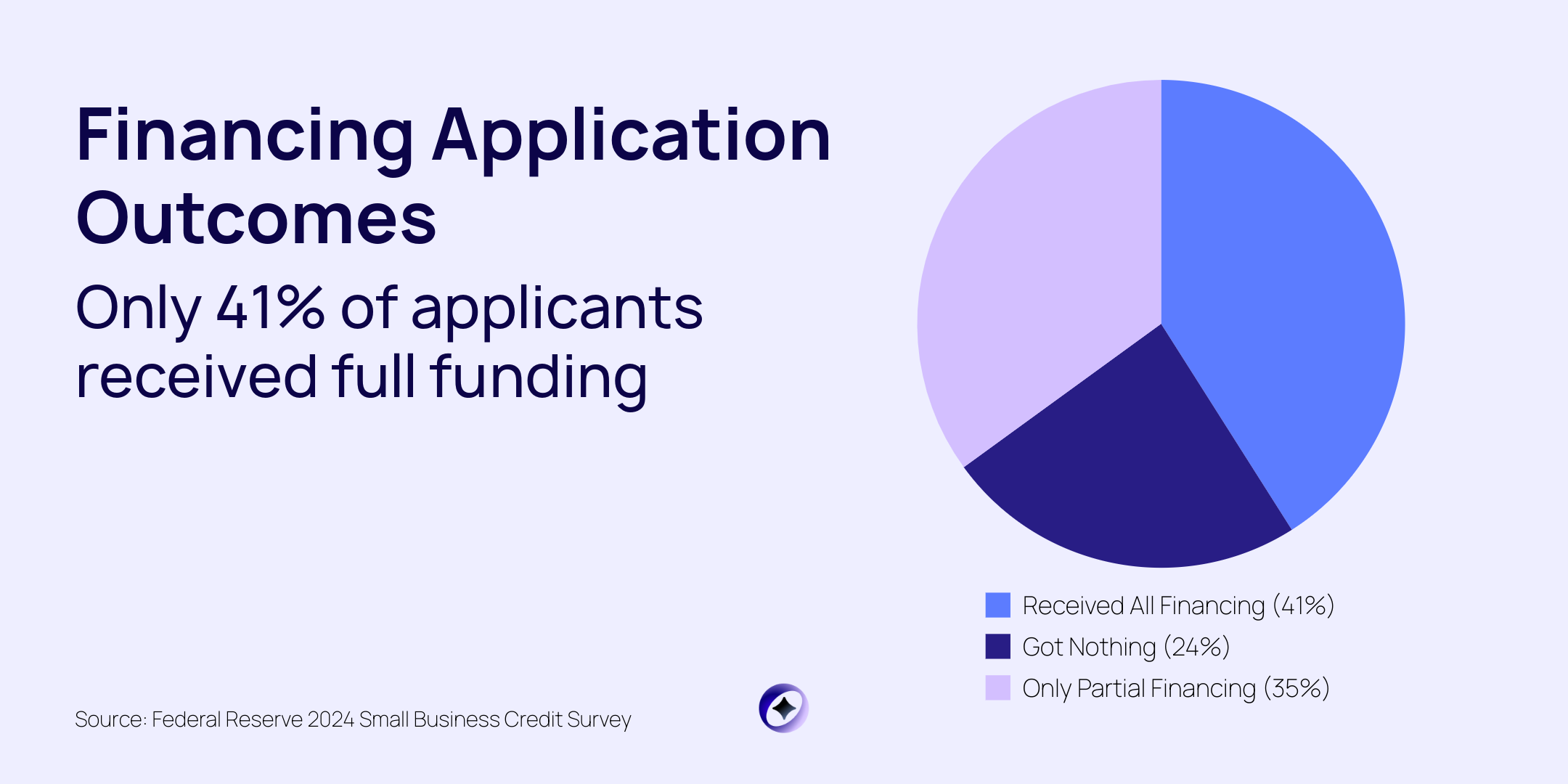
1. Only 41 percent of small business loan applicants received the full amount they requested
Bank lending is not as accessible as it used to be. According to the Federal Reserve’s 2025 Report on Employer Firms, only 41% of loan applicants received the full amount they requested. Analyses from BriteCap and LoanBox confirm the same number. They also note that roughly 24 percent of applicants received no funding at all.
This limits working capital. It slows hiring. It makes it harder to invest in the equipment or talent that can lift a business out of a cash crunch. For many companies, it also forces hard decisions much earlier than expected.
If you are having trouble finding financing, you are not alone. The data says this is a widespread challenge, not a failure of planning.
2. About one in five banks tightened credit standards for small businesses this year
Credit conditions matter. The Federal Reserve’s latest SLOOS survey reports that a modest but meaningful share of banks tightened lending standards on commercial and industrial loans, including those to smaller firms. The FDIC’s 2025 Risk Review highlights the same trend. In many categories, the shift aligns with roughly 10 to 20 percent of banks tightening standards, which directly affects access to capital for small businesses.
If you have been rejected for financing that would have been easy two or three years ago, this is why. Tight credit reduces your options, increases stress, and compresses your timeline for making decisions.
3. Debt is blocking access to new capital for 41 percent of businesses denied funding
This is one of the clearest indicators of where the market is headed. LoanBox’s analysis of the Small Business Credit Survey shows that 41 percent of businesses denied financing were rejected due to existing debt. In 2021, that number was only 22 percent. Forbes Advisor’s reporting on business loan denials confirms that too much existing debt is a leading reason lenders say no.
It also creates a painful cycle. If a business needs capital to stabilize during a tough season, lenders may reject them because of the very debts that are fueling the cash crunch. The path forward narrows. For some founders, this becomes a signal to evaluate other options.
4. Inflation remains a major concern for 58 percent of small businesses
Inflation is no longer spiking, but its effects are still deeply felt. The U.S. Chamber of Commerce Small Business Index reports that 58 percent of small businesses cite inflation as a top challenge in 2025. This matches a clear trend that has held for several quarters.
Prices remain elevated across categories. Raw materials. Packaging. Labor. Shipping. Insurance. Software subscriptions.
When more than half of small businesses say inflation is their top concern, it signals that cost pressure is still shaping the entire operating environment. Even small increases can squeeze thin margins.
If you feel like you cannot raise prices again without losing customers, you are in good company.
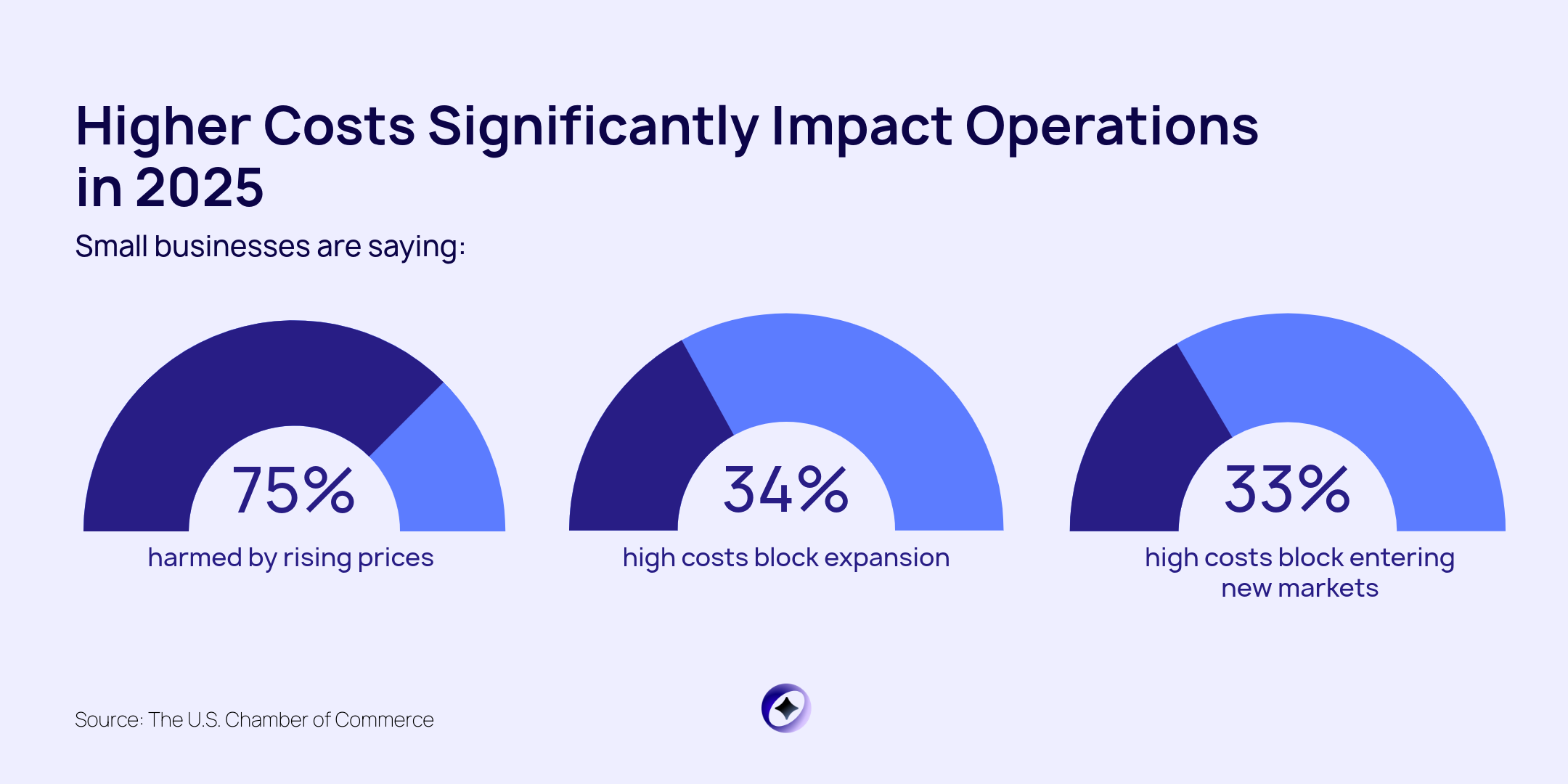
5. Rising costs hurt 75 percent of businesses in the past year
Three out of four small businesses say higher costs have significantly impacted operations in the past year. The Chamber’s Q3 2025 data shows that 75 percent of small businesses report being harmed by rising prices. It also reports that 34 percent say high costs are blocking expansion, and 33 percent say costs are preventing them from entering new markets.
These increases do not hit evenly. Some companies absorb the impact through lower margins. Others cut hours. Others reduce staff. Some shift their business model. For many, the result is a slow decline in stability.
When costs rise without a matching increase in revenue, runway shortens. For founders who already operate close to the line, this creates constant strain. Even strong leaders with clear plans can feel pushed to their limits.
6. Tariffs caused cost spikes that many small businesses cannot absorb
For businesses that rely on imported goods, tariff changes have been dramatic. While the exact scale varies across industries, high-authority sources paint the same picture.
The U.S. Chamber of Commerce notes that broad-based tariffs raise prices, disrupt supply chains, and hit small businesses the hardest because they have the least cushion. The Senate Small Business Committee describes the impact as a small business “crisis,” with owners reporting rising costs and uncertainty that threatens their survival. News profiles in outlets like the Guardian, LA Times, and CNN highlight small companies whose import costs doubled or tripled due to new tariffs.
These numbers are difficult to absorb without making big strategic changes. Many affected businesses respond by cutting expenses, raising prices, or altering suppliers. Some cannot adapt fast enough.
That is why tariff-driven stress is showing up in bankruptcy data and early closures.
7. Commercial bankruptcies have increased more than 10 percent year over year
Bankruptcies are not just a legal statistic. They reflect a trend. According to Epiq AACER data, commercial Chapter 11 filings in January 2025 were up 16 percent year over year. Total commercial bankruptcies were up 11 percent. A report from PYMNTS notes that business bankruptcy levels have reached their highest rate since 2010. The Administrative Office of the U.S. Courts confirms rising filings across categories during the year ending December 2024.
A double digit increase suggests that the economic environment is testing companies more aggressively than in previous years. These numbers do not tell you that shutdown is inevitable. They tell you the market is less forgiving. Decisions that used to be optional now need to be made earlier and with more intention.
What do these economic numbers mean for founders?
Numbers alone do not capture the lived experience of running a business in this environment. They do not reflect the late nights. The weeks where payroll feels impossible. The stress of trying to stay optimistic for your team. The part of you that still believes in the original spark.
But the numbers help confirm something important. The challenges you are facing are real. They are widespread. They are driven by conditions far outside your control.
If your business feels harder to operate today than it did two years ago, this data explains why. You are not imagining the pressure. The environment you are operating in has changed, and you are reacting to real signals.
Many founders blame themselves before they look at the bigger picture. They wonder why they cannot seem to regain momentum. They assume other leaders are handling the stress better. They think one more month of pushing might fix everything.
Understanding the market helps you step out of that loop. It clarifies that you are navigating conditions that challenge even the most experienced operators. It helps you ask better questions about your next step.
This is not about giving up. It is about getting clear on what is happening so you can make strong, grounded decisions.
What can you do next as a business owner?
Every founder reaches a moment where the business needs to evolve or come to a close. For some, that moment becomes a chance to pivot. For others, it becomes a chance to finish the current chapter and create space for the next one.
There is no shame in choosing closure. A clean shutdown can protect your financial health, your credibility, and your time. It can give you the chance to move forward without the weight of unresolved obligations. It can also be one of the most strategic decisions you will ever make.
If the numbers above reflect what you are living through, take time to reassess your timeline. Look at your runway with unfiltered eyes. Consider whether the current environment supports the version of the business you want to run. You deserve clarity.
And if you decide that closing is the right step, you should not have to do it alone. The process is complex, but it does not have to be chaotic. With the right support, you can shut down quickly and confidently, then focus on what comes next.
If closure is on your mind, we can help you finish strong
Starcycle helps founders close their companies with clarity and care. We handle the operational details so you can move forward with confidence.
Create your account to get your personalized shutdown quote. Pricing starts at $299, with no hidden fees.
You deserve a clear path forward. We are here when you are ready.